
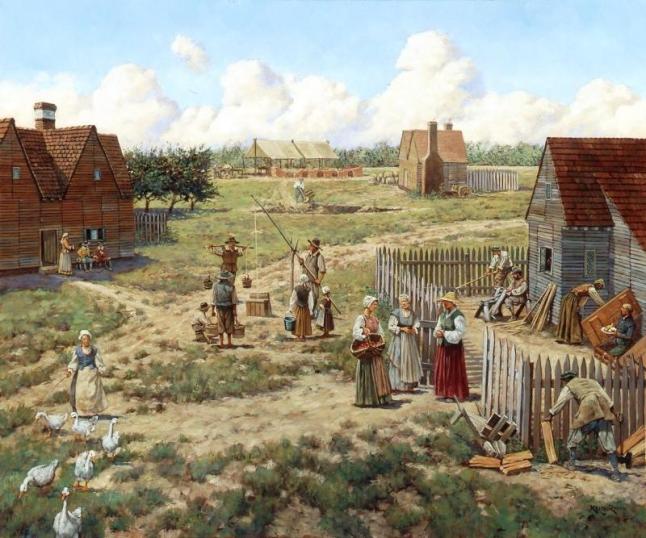
 The site of Jamestown Colony was nothing like the home they’d left. They’d felt pride in their natal farm though they’d belonged to it, not the other way around. Born to its manicured meadows, neat hedgerows, and trim outbuildings, its upkeep had been a part of every day. Born to thatched stone cottages in the shadow of the imposing barns and carriage house, they’d attended the chapel attached to the mossy, old manor house. They felt pride of place by virtue of family tradition; it was their work and the work of their fathers before them that stretched behnd them. They were often in need and sometimes Ill-treated, but they had a tie to the land. Had not fate intervened, their children would have worked and lived as they had.
Jamestown of 1643 was not a welcoming site. The vessel had tied to a crude wooden wharf. At the site of the rough timber fence surrounding the town, they didn’t have to be warned not to rush to disembark. A rutted, muddy trail led into the fort of nondescript houses. Blazing sun beat down as men in tattered rags, both black and white, gathered to await their turn unloading cargo from below. Mosquitoes buzzed around their heads and bore down, appreciative of the new blood. The humid air was thick with the smell of newly-turned earth, smoke, and manure from the enclosed animals.
Instead of fields of grain butting up to hedgerows, unfamiliar plots of large-leaf tobacco stood in large patches outside the high walls. Lesser squares of corn , beans, and squash clustered around nearby cabins built close enough that occupants could easily reach the enclosed settlement as needed. Enormous forests of tall trees pushed up to the farms and fields.
 As they surveyed all that lay before them, the forests were most impressive. England’s sparse woodlands could not compare. Though the settlement was raw and unfamiliar, they realized the intimidating forest held the future for those hardy enough to wrest it out. All they had to do was serve out their next four years to claim their portion, not thinking those same forests were home to indigenous people who’d thrived there for millennia.
Images pulled from internet
https://atomic-temporary-73629786.wpcomstaging.com/wp-admin/post.php?post=12291&action=edit L
 Nutsrok
One of the first things English people noticed and felt when they landed in New England was the forests and the trees. Though we think England is green and has a lot of woods, apparently the whole land is denuded of what it was centuries ago- probably by the human hand. I am so glad you made mention of it- it gives the story an authentic feel.
Susie
LikeLike
I read that much of the forests were stripped to make charcoal for smelting iron. I would so miss the trees if they were gone.
LikeLiked by 1 person
Is that true ? That makes sense as to why people say there are no trees in England but to be honest, whenever I went there all I saw was greenery, trees and more trees- so I don’t know what was denuded. Maybe only people who live that would note the difference.
Thanks for doing great research into that period and writing down from your knowledge, Linda.
LikeLike
About 90% of Sherwood Forest has been lost. It used to cover one third of England.
LikeLiked by 1 person
OMG ! This is horrible.
LikeLike
What a sight you paint. I can see and small it all. Good work!
LikeLike
Thank you.
LikeLiked by 1 person
very well written- I so enjoy your series-all of them.
LikeLike
Thanks so much!
LikeLike
Looks like life is going to be tough!
LikeLike
Sure does. A lot of people who came in to the south started this way.
LikeLiked by 1 person
A good installment, Linda. I’m interested to see what the next one will bring. :) — Suzanne
LikeLiked by 1 person
Working on it now.
LikeLike