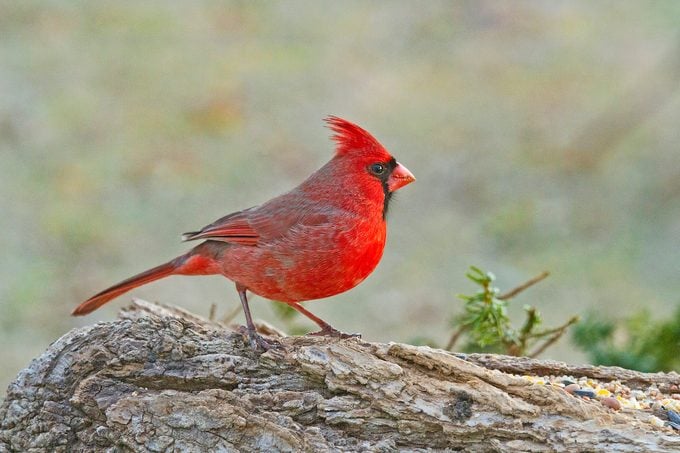
Cardinals can’t resist black oil sunflower seeds. With about a dozen bird feeders scattered about the yard that we keep keep busy filling them with sunflower seeds.
It is a delight to watch cardinal mating behavior. We’ve watched the male bring his lady love to a suet or seed feeder and daintily offer her seeds. Once a deal is struck, the female goes to work on a nest, usually in thick brush between three and ten feet off the ground. Surprisingly, lat year female nested in a rosebush about eighteen inches off the ground.
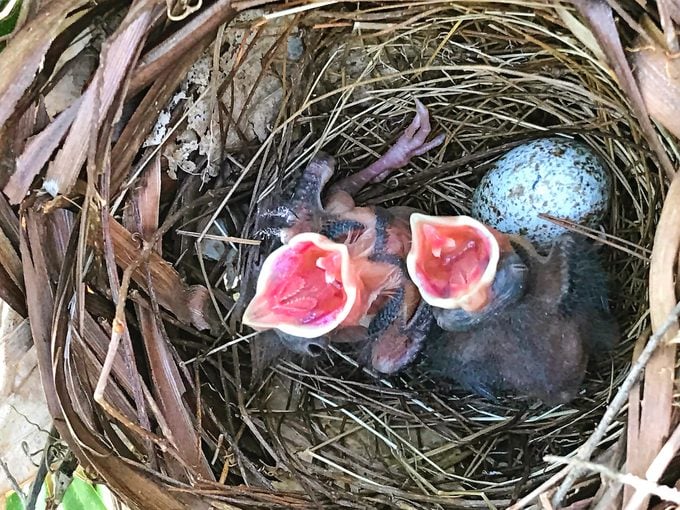
Cardinal eggs
Young cardinals
Amazingly, the parents coaxed the young ones out of the nest at eleven days, long before they could fly. The little guys fell to the ground where the parents helped them scurry to safety under a low-growing scrub. Over the next couple of days they got flying lessons. Had we had a greedy cat, they’d have met a sorry end.
A common call is a shrill “Cheater, cheater, cheater!!”
Range maps provided by Kaufman Field Guides, the official field guide of Birds & Blooms.
Did You Know: There are some regional variations in the species, especially in the Southwest and Mexico. Some scientists suggest that cardinals in the Sonoran Desert might be a different species from those found elsewhere in the United States, despite their proximity to northern cardinals in other southwestern deserts. Cardinals in the Sonoran Desert are somewhat larger, with longer crests, and the males are a paler red color. They also have slightly different songs.
Northern cardinals are territorial during breeding season.
The roles among cardinals are clear. As resident birds, males establish and defend their territory through song—though they cross borders when food is scarce in the fall and winter. “This is when you see a lot of cardinals at your feeder together,” David says. Otherwise, “each pair owns a territory and generally keeps the others out.”
Birds & Blooms reader Mark Bolinger counted as many as three dozen cardinals at one time in his yard last winter, a mix of males and females. “Is this normal?” he asks.
Birding experts Kenn and Kimberly Kaufman explain, “Northern cardinals are flexible in their social behavior. During the breeding season, each pair is very defensive of their own territory, driving away other cardinals. But in fall, after breeding season ends, they become more tolerant of others. A flock may begin with a pair and their offspring from that year, and then other neighboring families may join them, concentrating where the most food is available. Cardinal flocks with as many as 100 birds have been reported, but these are rare, and gatherings of six to 20 are more typical. Your flock of three dozen was bigger than average.”
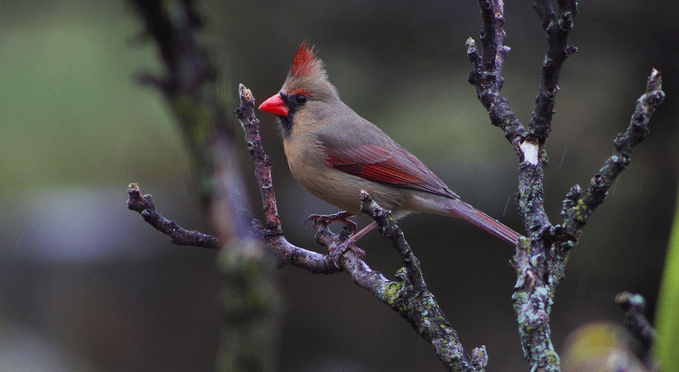
One fascinating northern cardinal bird fact—according to the Cornell Lab of Ornithology, cardinals are among the female North American songbirds that sing. They often do so while incubating their eggs to communicate to their mate to return with food for their family.
Female cardinals will also sing back and forth to reinforce pair bonding early in the breeding season.
Males sing at least nine months a year. Only during the deepest of winter months do they take a break from singing.
Cardinals sing more than 24 different songs. The most common is “What cheer! What cheer! What cheer!” Also listen for a repetitive pew, pew, pew, pew song. A cardinal’s call sounds like a high-pitched “chip!”
Bird songs provided by the Cornell Lab of Ornithology.
Cardinals Eat Seeds From Bird Feeders
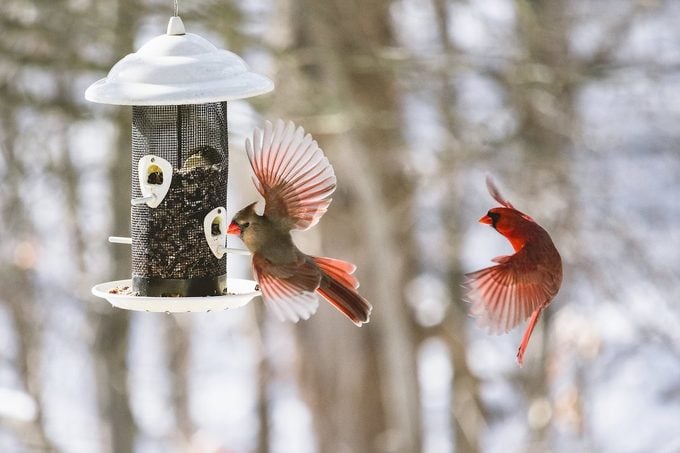
Female and male cardinal at a tube bird feeder
Attracting cardinals to your backyard feeding station is simple. Try a tube feeder or a tray feeder with large seeds such as sunflower or safflower, or sprinkle these seeds directly on the ground for cardinals to forage. They also devour dark-colored berries such as mulberries and blueberries.
Cardinals generally stay in the same area, which helps get a jump-start on nesting, with some laying eggs by February. For their first nests in early spring, cardinals often choose the protection of evergreens. This long breeding season allows for multiple broods each year and ensures the survival of at least a few offspring. Cardinals aren’t too particular when it comes to nest location, and this generalist approach makes them susceptible to predation.
It takes three to nine days for a cardinal pair to build a nest, with the female cardinal doing most of the work. She lays three to four whitish-gray cardinal eggs with brown speckles in a nest of twigs and grasses hidden in a dense tree or shrub. Compared to other birds, their nests are low, only 4 to 8 feet off the ground.
The male cardinal bird dad stays near the nest. “Males become active parents when chicks hatch,” David says.
Young baby cardinals are pretty demanding—in the first days after they hatch, their parents feed them up to eight times an hour!
About 20% of mated pairs separate each year; however, most cardinal couples stick together for several breeding seasons. During the winter they are not as attentive to each other, and often feed separately.
“What have we gotten into?” moaned Andrew after three days locked in the hold. “Why did we Ever do this? I’ve got to figure a way out.”
“No! We wouldn’t be here if we had any other choice. We were starving and near to death. Things will have to be better in the colony. We’ll be on a farm again and free with land in four years. It’s the only way.” Molly’s optimism was wearing thin, but she held out hope. “Listen! We’re moving!” Sure enough, the chains creaked as the anchor was lifted and they were obviously leaving the harbor.
An hour or so later, after they were too far to swim for shore, the doors to the hold were thrown open. The incarcerated rushed for the door and stood on deck for a last, long look at England. Many wailed as land slipped out of sight, knowing they’d never see home again nor maybe even the new country.
Time on deck made the long journey more bearable, except for the miserable days of rain and storms. though it didn’t improve the quality or quantity of the rations. Fighting and attacks were common in the hold, though few had anything but weavilly biscuits to steal. Coughing and moaning broke their guarded sleep.
Andrew never left Molly for a moment, knowing she’d be assaulted. Almost every morning, a cold body or two was pulled from the hold. The stench became more horrendous as the weeks passed. Neither suffered from sea-sickness till mid crossing when a storm raged. Both wretched miserably, not even attempting to make it to the bucket. Many passed and were slid into the raging sea. Andrew would have gladly sought death had it not been for Molly.
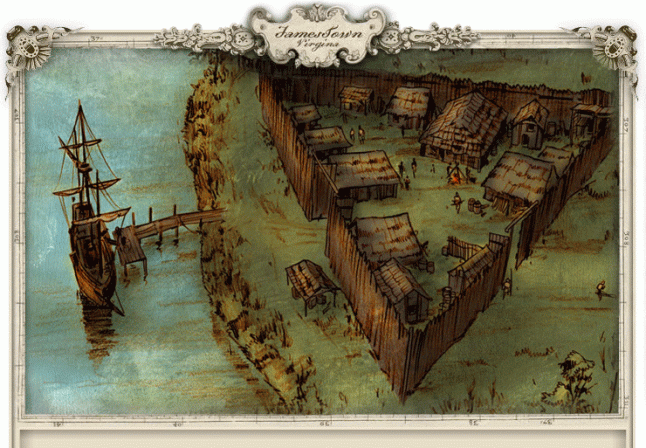
Finally, the weather cleared and they were able to go above board again, feeling hope for survival. After seven weeks, a shout rang out. The Jamestown Colony was sighted!
I won’t bother to lie. That was me you saw on the side of that country road or on that old home place in the country digging up plants..and that little, bitty old lady you saw with me; that was my mama. She’s my look out and spotter. When arrested, I won’t even be able to claim the act was spontaneous, since I keep a nice little camping shovel and plastic bags under my truck seat especially for my thieving excursions.
I’ll probably try to explain that Mother has Alzheimer’s and escaped from me, but that might not fly, since I’ll be the one out wading in the muck while she’s standing by the truck, but I guess I’ll cross that bridge when I get to it. Just so you know, I’m not the only thief she raised. My sister, Connie, makes raids just like I do. We both make sure to get enough to share, since it’s inevitable one of us will eventually get caught. Bud swears he won’t bail me out, but I suspect he’ll come get me when he gets hungry. Mother is on her own. She should have raised us better.
Though I have read The Adventures of Tom Sawyer and its sequel many times, I particularly love Huckleberry Finn. The young vagabond for his moral development in his treatment of Jim, an escaped slave. Though Huck ascribes to the values of the pre-Civil South and believes he should turn Jim in, he chooses to sacrifice his soul rather than betray his friend. I wish we all had Huck’s purity.
After filling their starving bellies with greasy stew and quarts of ale, Andrew and Molly signed away their next four years, too sated to consider the uncertainty of the life facing them. In fact, they were signing away the certainty of poverty, degradation, and possible imprisonment had they remained.
In that time, people could not expect to rise above their station. Having lost the position as farm servants to which they were born, it was unlikely they’d ever find anything more than seasonal farm employment, working mostly at planting or harvest when the workload was heavy. Starvation would likely have been their eventual lot. Should they stay in the city, it’s unlikely they’d find work. Many in their situation drifted into prostitution and crime. It is likely Molly would have dried of disease, drink, or victimization on the streets and Andrew would have ended up on the gallows or bound over as an involuntary indentured servant. Their best chance for a better life lay with the choice they’d made.
Once they’d signed, the agent wasted no time escorting them on board the Elizabeth Ann. She looked imposing from without, but her charm faded as Mr. Peabody led them deep into the bowels of the ship. Their quarters in the lowest level were dark, wet, and malodorous. There was no provision for privacy. They’d be relieving themselves in the communal slop jar, which would ostensibly be dumped periodically, unless it tipped over first.
Hammocks served for sleeping. There were no other furnishings. Restricted below deck until after sailing to avoid defection, they got a measure of beer and weevilly biscuits three times a day. The smell was horrendous. After their first exhausted sleep, they awoke to find themselves a part of a growing crowd of voluntary and involuntary holdmates ranging from bonded servants like themselves to young children scooped up off the street all the way to prostitutes and hardened criminals who’d barely escaped the gallows. The strong preyed on the weak. Their miserable sleep was interrupted by vomiting, moaning, and the occasional fight. Periodically, the door above opened and another unfortunate joined their miserable lot.
In truth, indentured servants were enslaved for the period of their indenture, usually four to seven years, children till the age of twenty-one. Their bondage could be sold without their consent. Marriage required the master’s consent. Should women become pregnant, their period of servitude could be extended due to decreased productivity during the pregnancy. Children of unwed mothers were born free, but subject to being placed in the care of the church. Unlike slaves, the indentured could appeal to the courts to contest mistreatment and did receive twenty-five to fifty acres of land, some tools, seed, and clothing upon completing their service. Like slaves, they were most often ill-treated. Having come to the colony in this way was no impediment to their future.
Many bonded servants prospered and got a good start to a free life. It definitely could be a road to a better life.
If you could be a character from a book or film, who would you be? Why?
Mark Twain’s Huckleberry Finn seems to be a most admirable character. Having been brought up motherless by an alcoholic, abusive father, he is objective about relationships but accepting of true friendship. He is totally independent and nonjudgmental as evidenced by his treatment of the slave, Jim. The only time he shows a bit of loneliness is at his and Tom’s funeral when no one welcomes him home but is is accepting of loving kindness when it presents itself.
This pair of bluebirds is considering taking up residence in our bluebird house. I hope we make the cut. Earlier today, three lady blue birds were fighting over the property.
We have probably had a box in this spot for fifteen to twenty years about ten feet from our back door. We only put this box here because a pair tried to nest in a hanging basket there. I’m pretty sure one pair came back as much at least five years. The last few years they raised as many as five clutches. They paid very little attention to us after the first day or so.
Bluebirds may live several years and possibly mate for life. However, this does not preclude either bird from mating with others, particularly if the Bluebird population in an area is high. Bluebird divorces may happen particularly if if first mating period is unsuccessful.
Mama bluebird usually spends about twenty minutes on the nest when laying. Papa sirs on a tree branch are rooftop guarding her. I don’t envy the constant parenting once the fledglings hatch. The parents constantly fly back and forth bring increasingly larger mouthfuls then carrying poop away.
Most Eastern Bluebirds Mate for life, But there is More to It
In this article, I explore whether Eastern Bluebirds mate for life. Bluebirds are known for their colors and soft songs, but their love lives hold some intriguing secrets. It turns out that most bluebirds mate for life, forming strong bonds that can endure as long as they survive. However, don’t let their seemingly monogamous nature fool you, as there’s more to their relationships than meets the eye.
Male and female Eastern Bluebirds. Photo: Patricia Pierce/Flickr/CC by 2.0.
Most Bluebirds (95%) mate for life, and mated pairs can stay together for as long as they survive. In the event of the death or disappearance of the male or female, the remaining bird replaces it with a new mate. Despite long-term relationships between mated pairs, studies have shown that both males and females routinely engage in extra-pair copulations. Genetic analysis of nestling bluebirds demonstrated that a male bluebird sired 20-30% of multiple broods analyzed.
Bluebird divorces may occur when a mated pair has repeated nest failures or when females attempt multiple broods with more than one male. After a divorce, the pair splits, and each bird tries with a new partner.
Only on rare occasions, one male pairs up with two females, or two males pair up with one female.
Do bluebirds mate for life?
Studies on Western Bluebirds found that most mated pairs stay together for life.
In long-term studies of Western Bluebirds’ natural history, scientists found that only about 6% of 117 pairs studied changed partners when both members of the pair were still alive.
A separate study conducted by Dickinson et al. (1996) found that only 3% of the 106 mated pairs studied switched partners. The switching of partners took place as females attempted multiple broods in a single breeding season and changed males between attempts.
Not such a study exists for Eastern Bluebirds, but field observations suggest that most bird pairs mate for life while both male and female are alive.
There is a lot we do not know about the mated life of the bluebird.
Bluebird pair formation?
Field observations indicate that many birds arrive on the breeding grounds as pairs. It appears that they begin to form pairs either while still in the wintering grounds or during the migration north when they congregate in flocks.
Field observations suggest that migratory bluebirds that are not paired upon arrival in the breeding grounds establish a breeding territory and find a mate within about a week.
Non-migratory Bluebirds generally pair up with the last year’s partner. Even though mated pairs appear not to interact very much after the breeding season, year-round resident or non-migratory Bluebirds are likely to re-mate with the same partner.
The timing of pair formation varies with latitude.
Pairs start forming first during mid-January in the warm southern states. Birds in the northern regions begin to form pairs approximately during February and March.
When is the pair bond official?
An indication that bluebirds are mated is when both the male and female interact and are seen together. But perhaps the most telling sign of pair formation is when both the male and female enter together a nesting cavity or nest box.
But whether the initial association is to remain as a breeding pair depends on additional pair interactions.
The male performs a nest demonstration consisting of bringing nesting material to the cavity. Once she enters the cavity for a first inspection of the interior, the deal appears to be sealed.
The female then accepts the demonstration and approves of the cavity, and starts bringing nesting material herself.
The male can change his mind about a female and reject her by removing the nesting material she started to bring to the nesting cavity.
If the male accepts the female as a mate, he will start offering her food as a sign of reaffirming acceptance of the breeding mate. Then they both enter the nesting cavity confirming the pair formation for the breeding season.
Copulatory Behavior
After pair formation and territory establishment, bluebirds start copulating. Mated pairs copulate for approximately eight days before the first egg is laid and continue six days after the clutch’s last egg has been laid.
The female appears to initiate a copulatory event. While perched, she crouches, keeping her back horizontal while dropping and shaking her wings and slightly cocking her tail. This action is called a female’s solicitation posture.
Eastern Bluebird copulations are seldom observed in the field.
The male mounts the female’s back and tries to make cloacal contact. Copulations generally last about 3 to 5 seconds.
Most copulations take place on perches. Although sometimes males try to mount females within the nesting cavity, these attempts are unsuccessful as females do not show interest while in the nest.
Mating for life does not mean copulating with only one partner.
Field ornithologists seldom report copulations outside the mated pair. However, genetic analysis of broods in several Eastern Bluebird populations studied showed that 20-30% of nestlings are sired by more than one male (Gowaty 1996 and Gowaty and Bridges 1991b).
This relatively high percentage of chicks sired by other males suggests that both males and females evade each other’s attention to sneak extra-pair copulations with neighboring birds.
Interestingly, this is the period when the construction of the nest and copulation are occurring, and the male keeps a close watch of the female to precisely keep her from straying and mating with another male to ensure that the brood he is going to raise is his. However, the males do the same and go around mating with other females.
This behavior is not rare among birds. Many studies have found similar behavior among several species of birds.
In areas densely populated by bluebirds where breeding territories are adjacent to each other, the percentage of nestlings sired by more than one male is higher than in areas less densely populated by bluebirds.
If breeding territories are of low quality, birds must travel outside their territories to find food.
Females in low-quality territories that traveled outside during their fertile period had more extra-pair copulations. The genetic analysis of their offspring determined this.
Mating with other birds outside the mated pair may be opportunistic rather than something sought after by the bird engaging in extra-pair copulations.
These studies took place in North Carolina, U. S., and Ontario, Canada. The wide separation between study sites suggests that the practice of extra-pair copulation is widespread across the bluebirds’ range.
The male Bluebird tries to make sure the brood is his.
Males guard their females closely during the period of high fertility, which is when the mated pair is copulating before and during egg-laying.
Interestingly, males that guard their females more closely have more young sired by other males. Perhaps these males are familiar with their mate’s tendencies to stray onto other territories. It may also suggest that males do not guard females all the time.
Another interesting fact regarding bluebird extra-pair copulations is that first-time breeders have a higher percentage of broods sired by more than one male than pairs that have been together and bred for an extended period of time.
There are limits to staying together
There is conflicting evidence on whether pairs that fail to succeed on a nesting attempt split to try again with another partner.
Ornithologists have found that most pairs that had successful nesting attempts stayed and re-nested with the same partner.
The same study also found that only 30-50% of pairs that failed on a nesting attempt stayed together and re-nested with the same partner.
Said it differently, 70 to 50% of the pairs that failed on a nesting attempt will switch partners hoping for a successful nesting attempt with another partner.
Eastern Bluebirds re-mate with another partner if one dies. Surprisingly, re-mating with another partner can happen within hours after one member of the pair’s death.
Rarely, two males form a breeding arrangement with a single female. All participants help with all breeding activities.
More than two birds in a mated pair?
The vast majority of breeding Bluebirds are monogamous. Gowaty (1980) observed 177 nesting attempts by color-banded birds. The majority of pairs (95.5%) were composed of males and females.
On rare occasions, and perhaps due to the lack of nesting cavities, two females and a male form a breeding family. The two females build the nest and lay eggs in the same nest. Both partake in the incubation of the eggs taking turns or often sitting on the eggs simultaneously.
In the case of one male and two females breeding arrangement, it is not clear if the second female or both females mate exclusively with the one male or if one female comes from elsewhere with already fertilized eggs.
Even rarer is when two males breed with a single female, as with the other breeding arrangements, all members of the family help with all breeding activities.
For me, dogs make the best pets. I’ve had so many to love over the years. They fill the hole in my heart that my children left as they grew up. So many have found me when I wasn’t looking for them. One strayed up to my house and stole my heart. I picked one up on a freezing morning when I know she wouldn’t have lasted the day. We adopted one when just before he was euthanized. They are endlessly loving.
CrocIzzy
On the opposite end of the scale, I think snakes make horrible pets.



 “What have we gotten into?” moaned Andrew after three days locked in the hold. “Why did we Ever do this? I’ve got to figure a way out.”


 After filling their starving bellies with greasy stew and quarts of ale, Andrew and Molly signed away their next four years, too sated to consider the uncertainty of the life facing them. In fact, they were signing away the certainty of poverty, degradation, and possible imprisonment had they remained.




 Nutsrok