Andrew and Molly Part 5

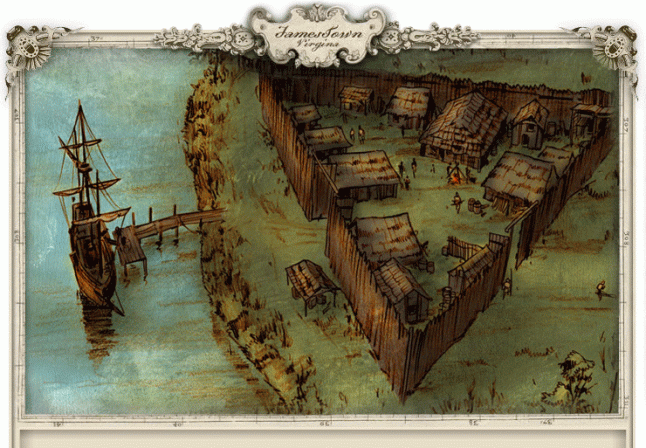
JAMESTOWN. Female convicts transported from English prisons arriving in Jamestown, Virginia as indentured servants, although often becoming wives in mass weddings with the male settlers: colored engraving, 19th century.

JAMESTOWN.
Female convicts transported from English prisons arriving in Jamestown, Virginia as indentured servants, although often becoming wives in mass weddings with the male settlers: colored engraving, 19th century.

Immediately upon disembarking, Andrew and Molly along with others not already engaged were escorted to warehouse lodgings and given beer and a heartening stew of squash, beans, corn, yams, and meat, their first meat in seven weeks.  

The men and women were separated and instructed to choose clothing from a pile of castoffs before bathing and delousing with some herbal concoction whose noxious odor was helpful in warding off mosquitoes. When the men were led off to be locked away for the night, Molly wept and clung to Andrew, fearing she’d never see him again.  She had no faith in the agent’s assurance that they’d be placed together.  Despite her grief, she slept hard in the deep hay that served as bedding for the exhausted women.  For the first night in months, she didn’t fear assault.

The next morning, the colonists gathered just after daybreak to choose among servants.  Molly, along with the other women, ate a hearty breakfast of beer and bread, made a hasty toilet, and prepared for selection, praying Providence would be kind. As the men turned out, Andrew hurried to Molly’s side.  

As the selection began, the agent presented the bonded, praising their health, intelligence, and skills, real or concocted on the spot.  Some were labeled distillers, others as cabinet makers, or boat-builders.  True to his word, he proclaimed Andrew and Molly must go to the same master.  To their surprise, they heard the agent confide to Master Wharton that Andrew was a skilled blacksmith and that Molly could weave and spin.  

The colonists were legally forbidden to forge their own tools and ironwork, so this would have to be a clandestine operation.  Like most forbidden practices, smithing was made more attractive.
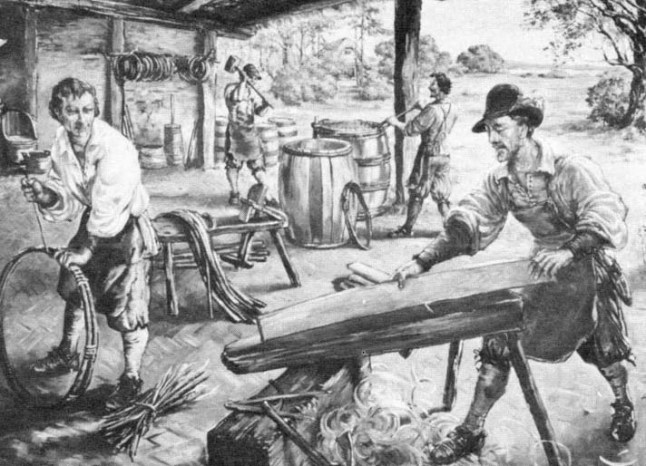
img_1745

Encouraged to think he was engaging a blacksmith and a woman who could weave and spin, Master Wharton spoke directly to Andrew.  “You look right, enough.  My blacksmith will soon work free, but might have long enough to teach you some. Do you think you can pick it up fast?  I’ll not tolerate a slacker.  If you give me your pledge, I’ll take you and your wife.  Should you fail, I’ll sell your bond.”

“I’ll not fail if you take us both, that I swear.” Andrew asserted, looking him in the eye. “I’m no smith and my wife never learned weaving nor spinning.  I’d not have you expect that.  I know farming and she tended dairy and is skilled at butter and cheese-making, nothing more.”

“I have no need of a weaver, just a housekeeper.  I’ll bond you.  You’ll get lodging, food, and a new suit of clothes now and once a year.  You will work dawn to dusk every day with Sunday for worship and rest. Give me value and we’ll have no trouble.”  Their new master strode off to tend his business, leaving them to wait together.

images downloaded from internet

Positive Change

Describe one positive change you have made in your life.

Since I got older and retired, I am able to focus more on myself. This is not a change in philosophy, just the natural order of things. When my children were young, their needs came first. In addition to that, I was a nurse. I had heavy responsibilities to my patients. Now that my children are grown and I’m retired, my time is my own.

Andrew and Molly Part 4

img_1742The site of Jamestown Colony was nothing like the home they’d left. They’d felt pride in their natal farm though they’d belonged to it, not the other way around.  Born to its manicured meadows, neat hedgerows, and trim outbuildings, its upkeep had been a part of every day.  Born to thatched stone cottages in the shadow of the imposing barns and carriage house, they’d attended the chapel attached to the mossy, old manor house.  They felt pride of place by virtue of family tradition; it was their work and the work of their fathers before them that stretched behnd them.

They were often in need and sometimes Ill-treated, but they had a tie to the land.  Had not fate intervened, their children would have worked and lived as they had.

Jamestown of 1643 was not a welcoming site.  The vessel had tied to a crude wooden wharf.  At the site of the rough timber fence surrounding the town, they didn’t have to be warned not to rush to disembark.  A rutted, muddy trail led into the fort of nondescript houses.  Blazing sun beat down as men in tattered rags, both black and white, gathered to await their turn unloading cargo from below.  Mosquitoes buzzed around their heads and bore down, appreciative of the new blood.  

The humid air was thick with the smell of newly-turned earth, smoke, and manure from the enclosed animals.Instead of fields of grain butting up to hedgerows, unfamiliar plots of large-leaf tobacco stood in large patches outside the high walls.  Lesser squares of corn , beans, and squash clustered around nearby cabins built close enough that occupants could easily reach the enclosed settlement as needed.  

Enormous forests of tall trees pushed up to the farms and fields.

img_1741As they surveyed all that lay before them, the forests were most impressive.  England’s  sparse woodlands could not compare. Though the settlement was raw and unfamiliar, they realized the intimidating forest held the future for those hardy enough to wrest it out.  All they had to do was serve out their next four years to claim their portion, not thinking those same forests were home to indigenous people who’d thrived there for millennia.

 

Images pulled from internet


https://atomic-temporary-73629786.wpcomstaging.com/wp-admin/post.php?post=12291&action=edit L

Getting Ready for the Majors

This is my nephew, Henry, an avid baseball fan.

Exercise

What’s the most fun way to exercise?

Gardening gives me a workout. There’s the digging, hauling, bending. It keeps me active and makes my muscles complain but the reward is wondrous.

Fascinating Cardinals

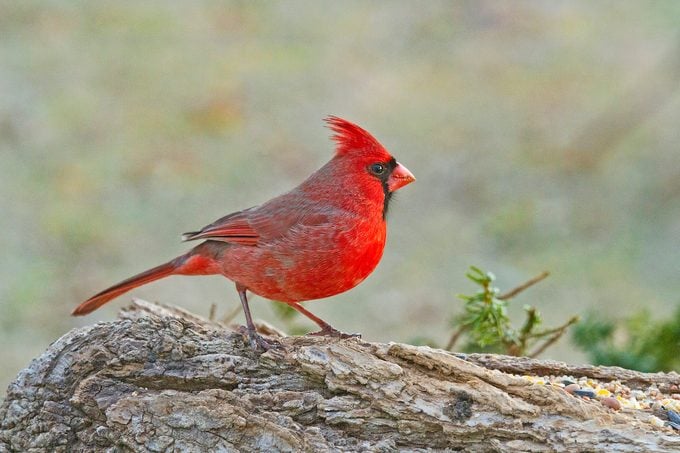
Cardinals can’t resist black oil sunflower seeds. With about a dozen bird feeders scattered about the yard that we keep keep busy filling them with sunflower seeds.

It is a delight to watch cardinal mating behavior. We’ve watched the male bring his lady love to a suet or seed feeder and daintily offer her seeds. Once a deal is struck, the female goes to work on a nest, usually in thick brush between three and ten feet off the ground. Surprisingly, lat year female nested in a rosebush about eighteen inches off the ground.

Cardinal eggs

Young cardinals

Amazingly, the parents coaxed the young ones out of the nest at eleven days, long before they could fly. The little guys fell to the ground where the parents helped them scurry to safety under a low-growing scrub. Over the next couple of days they got flying lessons. Had we had a greedy cat, they’d have met a sorry end.

A common call is a shrill “Cheater, cheater, cheater!!”

11 Fascinating Northern Cardinal Bird Facts

By Kelsey Roseth and Ken Keffer

Updated On May 03, 2024

Range maps provided by Kaufman Field Guides, the official field guide of Birds & Blooms.

Did You Know: There are some regional variations in the species, especially in the Southwest and Mexico. Some scientists suggest that cardinals in the Sonoran Desert might be a different species from those found elsewhere in the United States, despite their proximity to northern cardinals in other southwestern deserts. Cardinals in the Sonoran Desert are somewhat larger, with longer crests, and the males are a paler red color. They also have slightly different songs.

Meet the 3 types of cardinals in North America.

Are Cardinals Territorial Birds?

cardinal bird
Male cardinals are very vocal songbirds.

Northern cardinals are territorial during breeding season.

The roles among cardinals are clear. As resident birds, males establish and defend their territory through song—though they cross borders when food is scarce in the fall and winter. “This is when you see a lot of cardinals at your feeder together,” David says. Otherwise, “each pair owns a territory and generally keeps the others out.”

Birds & Blooms reader Mark Bolinger counted as many as three dozen cardinals at one time in his yard last winter, a mix of males and females. “Is this normal?” he asks.

Birding experts Kenn and Kimberly Kaufman explain, “Northern cardinals are flexible in their social behavior. During the breeding season, each pair is very defensive of their own territory, driving away other cardinals. But in fall, after breeding season ends, they become more tolerant of others. A flock may begin with a pair and their offspring from that year, and then other neighboring families may join them, concentrating where the most food is available. Cardinal flocks with as many as 100 birds have been reported, but these are rare, and gatherings of six to 20 are more typical. Your flock of three dozen was bigger than average.”

Do cardinals eat suet from bird feeders?

Both Male and Female Cardinals Sing

cardinal meaning and symbolism
Female cardinals sing to communicate with males.

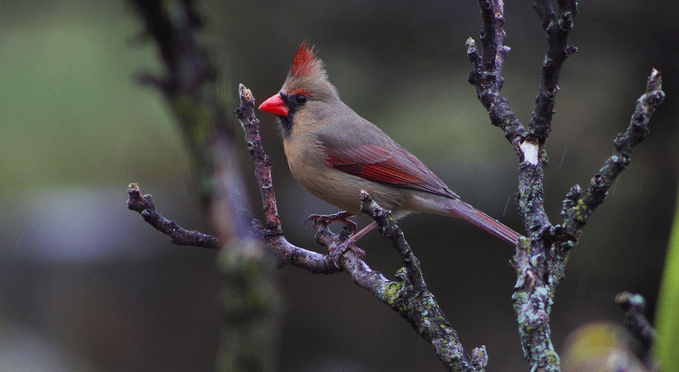
One fascinating northern cardinal bird fact—according to the Cornell Lab of Ornithology, cardinals are among the female North American songbirds that sing. They often do so while incubating their eggs to communicate to their mate to return with food for their family.

Female cardinals will also sing back and forth to reinforce pair bonding early in the breeding season.

Males sing at least nine months a year. Only during the deepest of winter months do they take a break from singing.

Cardinals sing more than 24 different songs. The most common is “What cheer! What cheer! What cheer!” Also listen for a repetitive pew, pew, pew, pew song. A cardinal’s call sounds like a high-pitched “chip!”

Bird songs provided by the Cornell Lab of Ornithology.

Cardinals Eat Seeds From Bird Feeders

what do cardinals eat
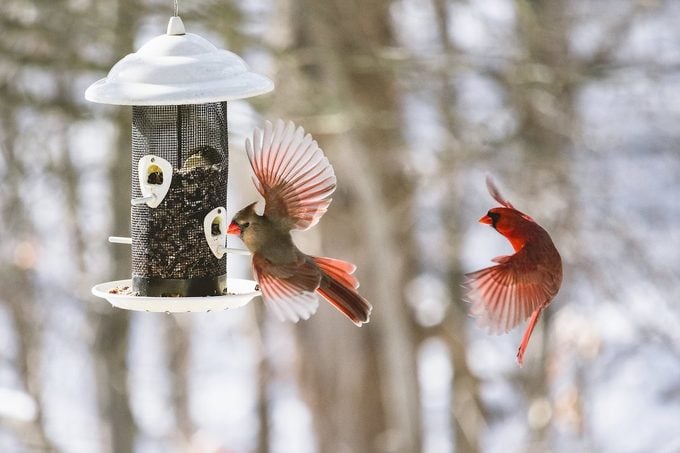
Female and male cardinal at a tube bird feeder

Attracting cardinals to your backyard feeding station is simple. Try a tube feeder or a tray feeder with large seeds such as sunflower or safflower, or sprinkle these seeds directly on the ground for cardinals to forage. They also devour dark-colored berries such as mulberries and blueberries.

Psst—here’s how to choose the best cardinal bird feeders and birdseed. Oh, and check out this DIY platform bird feeder you can make yourself to attract more cardinals to your backyard.

Northern Cardinal Nesting Habits

cardinal nest and babies
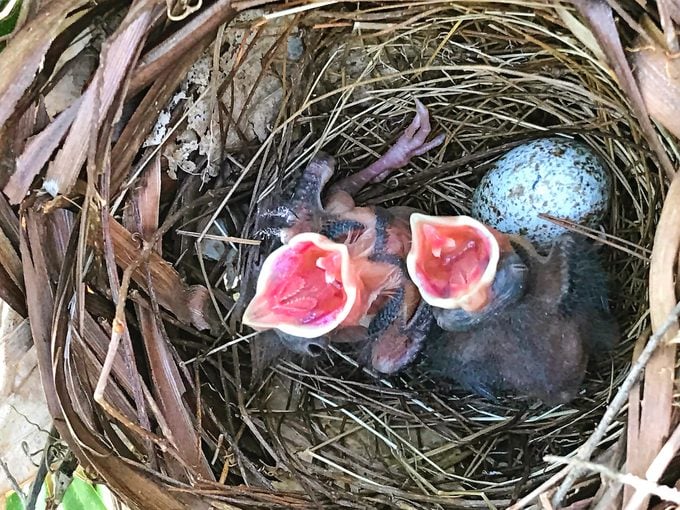
Baby cardinals and egg in a nest

Cardinals generally stay in the same area, which helps get a jump-start on nesting, with some laying eggs by February. For their first nests in early spring, cardinals often choose the protection of evergreens. This long breeding season allows for multiple broods each year and ensures the survival of at least a few offspring. Cardinals aren’t too particular when it comes to nest location, and this generalist approach makes them susceptible to predation.

It takes three to nine days for a cardinal pair to build a nest, with the female cardinal doing most of the work. She lays three to four whitish-gray cardinal eggs with brown speckles in a nest of twigs and grasses hidden in a dense tree or shrub. Compared to other birds, their nests are low, only 4 to 8 feet off the ground.

The male cardinal bird dad stays near the nest. “Males become active parents when chicks hatch,” David says.

Young baby cardinals are pretty demanding—in the first days after they hatch, their parents feed them up to eight times an hour!

About 20% of mated pairs separate each year; however, most cardinal couples stick together for several breeding seasons. During the winter they are not as attentive to each other, and often feed separately.

Andrew and Molly Part 3

img_1740“What have we gotten into?”  moaned Andrew after three days locked in the hold.  “Why did we Ever do this?  I’ve got to figure a way out.”

“No!  We wouldn’t be here if we had any other choice.  We were starving and near to death.  Things will have to be better in the colony.  We’ll be on a farm again and free with land in four years.  It’s the only way.”  Molly’s optimism was wearing thin, but she held out hope.  “Listen!  We’re moving!”  Sure enough, the chains creaked as the anchor was lifted and they were obviously leaving the harbor.    

An hour or so later, after they were too far to swim for shore, the doors to the hold were thrown open.  The incarcerated rushed for the door and stood on deck for a last, long look at England.  Many wailed as land slipped out of sight, knowing they’d never see home again nor maybe even the new country.

Time on deck made the long journey more bearable, except for the miserable days of rain and storms. though it didn’t improve the quality or quantity of the rations.  Fighting and attacks were common in the hold, though few had anything but weavilly biscuits to steal.  Coughing and moaning broke their guarded sleep.  

Andrew never left Molly for a moment, knowing she’d be assaulted.  Almost every morning, a cold body or two was pulled from the hold.  The stench became more horrendous as the weeks passed.  Neither suffered from sea-sickness till mid crossing when a storm raged.  Both wretched miserably, not even attempting to make it to the bucket.  Many passed and were slid into the raging sea.  Andrew would have gladly sought death had it not been for Molly.

Finally, the weather cleared and they were able to go above board again, feeling hope for survival. After seven weeks, a shout rang out. The Jamestown Colony was sighted!

Maybe they’d live after all!

Links to Parts 1 and 2

https://atomic-temporary-73629786.wpcomstaging.com/2017/01/04/andrew-and-molly-part-1/

https://atomic-temporary-73629786.wpcomstaging.com/2017/01/06/andrew-and-molly-part-2/


The Adventures of a Wildflower Thief

I won’t bother to lie.  That was me you saw on the side of that country road or on that old home place in the country digging up plants..and that little, bitty old lady you saw with me; that was my mama.   She’s my look out and spotter. When arrested, I won’t even be able to claim the act was spontaneous, since I keep a nice little camping shovel and plastic bags under my truck seat especially for my thieving excursions. 

I’ll probably try to explain that Mother has Alzheimer’s and escaped from me, but that might not fly, since I’ll be the one out wading in the muck while she’s standing by the truck, but I guess I’ll cross that bridge when I get to it. Just so you know, I’m not the only thief she raised.  My sister, Connie, makes raids just like I do.  We both make sure to get enough to share, since it’s inevitable one of us will eventually get caught.  Bud swears he won’t bail me out, but I suspect he’ll come get me when he gets hungry.  Mother is on her own.  She should have raised us better.

Mart Twain

What book could you read over and over again?

I have read Mark Twain’s works over and over.

Though I have read The Adventures of Tom Sawyer and its sequel many times, I particularly love Huckleberry Finn. The young vagabond for his moral development in his treatment of Jim, an escaped slave. Though Huck ascribes to the values of the pre-Civil South and believes he should turn Jim in, he chooses to sacrifice his soul rather than betray his friend. I wish we all had Huck’s purity.