
Cardinals can’t resist black oil sunflower seeds. With about a dozen bird feeders scattered about the yard that we keep keep busy filling them with sunflower seeds.
It is a delight to watch cardinal mating behavior. We’ve watched the male bring his lady love to a suet or seed feeder and daintily offer her seeds. Once a deal is struck, the female goes to work on a nest, usually in thick brush between three and ten feet off the ground. Surprisingly, lat year female nested in a rosebush about eighteen inches off the ground.

Cardinal eggs

Young cardinals
Amazingly, the parents coaxed the young ones out of the nest at eleven days, long before they could fly. The little guys fell to the ground where the parents helped them scurry to safety under a low-growing scrub. Over the next couple of days they got flying lessons. Had we had a greedy cat, they’d have met a sorry end.
A common call is a shrill “Cheater, cheater, cheater!!”
11 Fascinating Northern Cardinal Bird Facts
Birds & Blooms Editorial Policies
Updated On May 03, 2024
Range maps provided by Kaufman Field Guides, the official field guide of Birds & Blooms.
Did You Know: There are some regional variations in the species, especially in the Southwest and Mexico. Some scientists suggest that cardinals in the Sonoran Desert might be a different species from those found elsewhere in the United States, despite their proximity to northern cardinals in other southwestern deserts. Cardinals in the Sonoran Desert are somewhat larger, with longer crests, and the males are a paler red color. They also have slightly different songs.
Meet the 3 types of cardinals in North America.
Are Cardinals Territorial Birds?
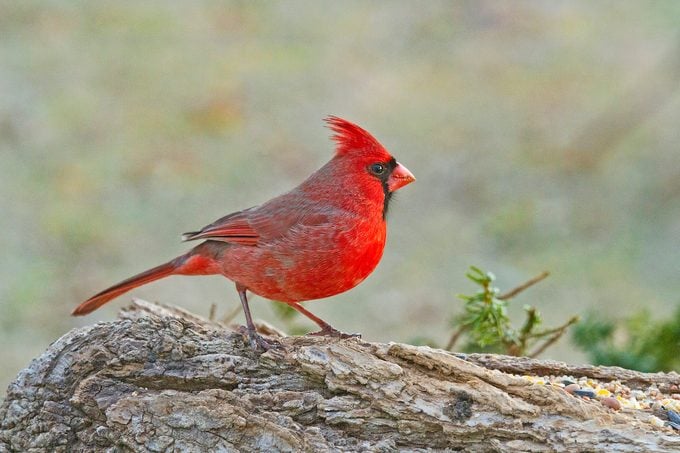
Northern cardinals are territorial during breeding season.
The roles among cardinals are clear. As resident birds, males establish and defend their territory through song—though they cross borders when food is scarce in the fall and winter. “This is when you see a lot of cardinals at your feeder together,” David says. Otherwise, “each pair owns a territory and generally keeps the others out.”
Birds & Blooms reader Mark Bolinger counted as many as three dozen cardinals at one time in his yard last winter, a mix of males and females. “Is this normal?” he asks.
Birding experts Kenn and Kimberly Kaufman explain, “Northern cardinals are flexible in their social behavior. During the breeding season, each pair is very defensive of their own territory, driving away other cardinals. But in fall, after breeding season ends, they become more tolerant of others. A flock may begin with a pair and their offspring from that year, and then other neighboring families may join them, concentrating where the most food is available. Cardinal flocks with as many as 100 birds have been reported, but these are rare, and gatherings of six to 20 are more typical. Your flock of three dozen was bigger than average.”
Do cardinals eat suet from bird feeders?
Both Male and Female Cardinals Sing
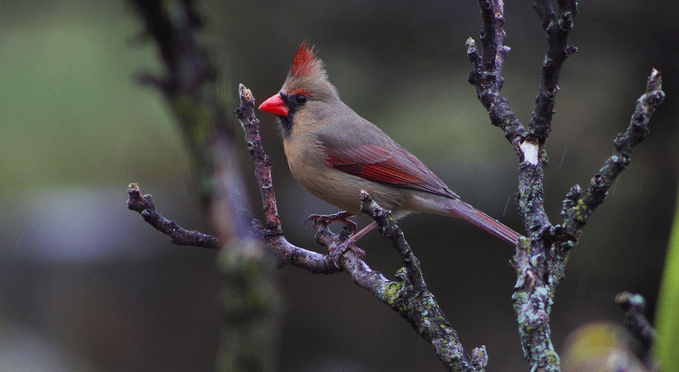
One fascinating northern cardinal bird fact—according to the Cornell Lab of Ornithology, cardinals are among the female North American songbirds that sing. They often do so while incubating their eggs to communicate to their mate to return with food for their family.
Female cardinals will also sing back and forth to reinforce pair bonding early in the breeding season.
Males sing at least nine months a year. Only during the deepest of winter months do they take a break from singing.
Cardinals sing more than 24 different songs. The most common is “What cheer! What cheer! What cheer!” Also listen for a repetitive pew, pew, pew, pew song. A cardinal’s call sounds like a high-pitched “chip!”
Bird songs provided by the Cornell Lab of Ornithology.
Cardinals Eat Seeds From Bird Feeders
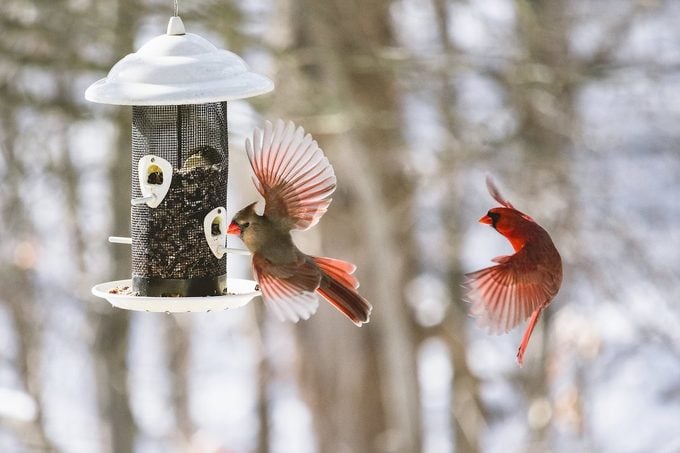
Attracting cardinals to your backyard feeding station is simple. Try a tube feeder or a tray feeder with large seeds such as sunflower or safflower, or sprinkle these seeds directly on the ground for cardinals to forage. They also devour dark-colored berries such as mulberries and blueberries.
Psst—here’s how to choose the best cardinal bird feeders and birdseed. Oh, and check out this DIY platform bird feeder you can make yourself to attract more cardinals to your backyard.
Northern Cardinal Nesting Habits
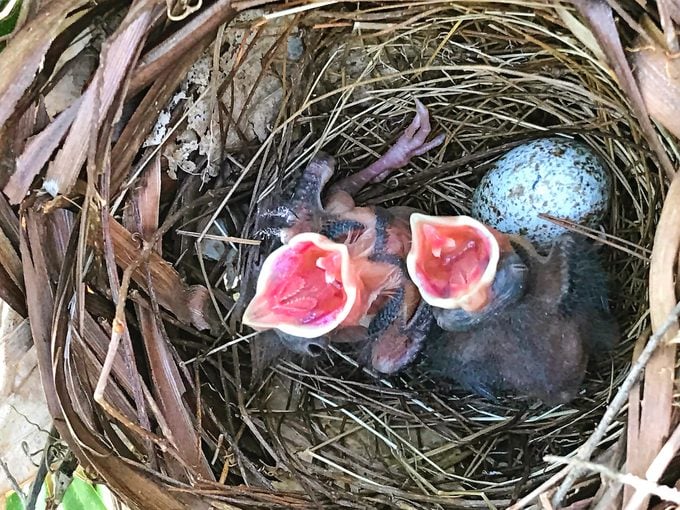
Cardinals generally stay in the same area, which helps get a jump-start on nesting, with some laying eggs by February. For their first nests in early spring, cardinals often choose the protection of evergreens. This long breeding season allows for multiple broods each year and ensures the survival of at least a few offspring. Cardinals aren’t too particular when it comes to nest location, and this generalist approach makes them susceptible to predation.
It takes three to nine days for a cardinal pair to build a nest, with the female cardinal doing most of the work. She lays three to four whitish-gray cardinal eggs with brown speckles in a nest of twigs and grasses hidden in a dense tree or shrub. Compared to other birds, their nests are low, only 4 to 8 feet off the ground.
The male cardinal bird dad stays near the nest. “Males become active parents when chicks hatch,” David says.
Young baby cardinals are pretty demanding—in the first days after they hatch, their parents feed them up to eight times an hour!
About 20% of mated pairs separate each year; however, most cardinal couples stick together for several breeding seasons. During the winter they are not as attentive to each other, and often feed separately.
 Nutsrok