
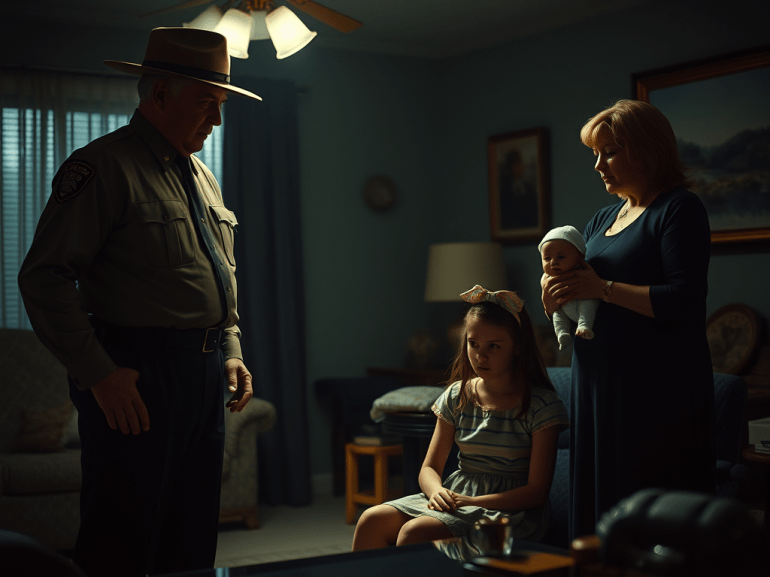
Lou and Lynn Part 12 Escalating Tensions: Family Vs. Sheriff in a Small Town

As soon they finished breakfast, the menfolks headed outdoors. The dogs kicked up a ruckus. The sheriff was back.

Al invited him in. Everyone gathered in the living room, anxious to hear what he had to say. He addressed the adults. “None of this gal’s story checks out.” He said “gal” like it was something nasty on his shoe. “ I need to ask her a few questions. I called the Houston Police Department to ask about a missing kid and old lady. There ain’t no record of Eloise Daly or her grandmother reported missing. Besides that, there is no 3412 Crawford Road in Houston. Crawford Road numbers stop at 242. After that it runs out to the country. There’s nothin’ but cows out there. That phone number you gave me ain’t no good. How come I can’t find out about nothin’ you told me?”

Lynn’s daddy looked hard at her. The sheriff shifted in his chair, looking at her hard. “Now I’m gonna ask again an’ I don’t want anymore of your lyin’. “What’s your name and birthdate?”

Lou was scared now. “My name is Eloise Daly. I was born July 2, 2015. I just had my ninth birthday a couple of weeks ago. I live at 3412 Crawford Road, Houston, Texas, just like I told you.” She waited.

The sheriff’s face flushed. He stood up. I guess you think you real smart don’t you? You know as well as I do it’s 1964, You know what I think? I think your grandma put you out here so you could you could open the door for her. Y’all are plannin’ on robbin’ folks. There’s been some break ins last week. Don’t be lying no more about Houston or being born in 2015. You might be crazy, but I ain’t. I’m takin’ you in till your grandma shows up: Then I’ll deal with her. Come on.”

“Now hold on a minute.” said Lynn’s daddy. “This kid may be telling crazy stories but you can’t take a kid to jail for that. She ain’t hurt nothing. She ain’t no bigger than my girl. You can’t put a kid in jail.” he said.

“You’re steppin’ over the line here,” said the sheriff. Do you really want to get arrested over this lyin’ kid?”

Aunt Kat interrupted. “He’s right, Al. You don’t want to go to jail over this. Lou, come with me. We’ll get your stuff.” Lou looked like she’d been slapped but she followed Aunt Kat, to the back of the house still holding the baby.

Aunt Kat got two belts from her husband’s closet. She looped them together and fastened one around herself and the infant, and the other around Lou. They could only move together. She stuffed a few diapers in the diaper bag. “Now don’t you say a word. You’re not going anywhere. Come on.” They walked in lockstep back to the living room.

“Sheriff, you know me. I’m a decent woman and a church member. I can’t let you take this child off by herself. It’s not right. Me and the baby have to go with her. I’m the only one that can feed the baby. You can lock us all up together. She doesn’t cry too much. Al, you and Lynn can manage somehow with Connie. She’s on the bottle.” Al panicked. He’d never been responsible for the house or baby.

“No! Sheriff. You can’t take my wife and baby. She’s never done a wrong thing in her life. Kathy, you can’t go off! You’ve got a family to take care of.” Al was determined not to let her go. Little Connie clung to her mother’s leg screaming. Right on cue, she soiled her diaper.

“Al, I’m not letting a nine-year-old girl go off alone with the sheriff. You’ll just have to manage.” She responded. Al thought she’d lost her mind.

“Sheriff, This family can’t manage without her. If you’ll leave the girl here I’ll take responsibility for her. If her grandma shows up, I’ll get you word. You know I am a man of my word. I’ve never been in any trouble.” Al held out his hand.

The sheriff actually looked relieved. He’d opened a can of worms. He held out his hand to shake. “I expect to hear from you if her grandma shows up.

To be continued:

Hard Times and Tough People

Cousin Kathleen had a hard time coming up. She was the oldest of seven children ranging from three to fourteen when her father died in 1934. He farmed a few acres he’d gotten from his father in the Virginia hills. Aunt Winnie had no idea how they’d manage. She and the kids struggled to get the crops in that year with the help of the neighbors, knowing that was the last help she could count on in the hard times of The Great Depression. The thought of the work facing her was overwhelming. A friend gifted her with the crop from one of his bean patches, other neighbors contributed a ham, a few hens, some produce, and what little bit they could spare. Others offered to hire the kids when they needed help from time to time.
After the crops were in, the beans picked and canned, Aunt Winnie made inventory. She owned the farm with its tiny three-room house with beds in every room, including a couple in the attic. She had a good well, a tight barn, a smokehouse, a toilet and a chicken house. Her livestock included a sow and a few fattening shoats, a few chickens, a mule, a cow, a few goats, a dog and a couple of barn cats. Her farm equipment included a wagon, a plow, hand-tools, harness, and the various other things Ed had managed to acquire. She sold the mule to a neighbor with the promise that he’d loan it back to her to plow garden every spring, giving her a bit of cash. Darryl, the oldest boy was twelve and big as a man. Between the kids, and herself, they’d have to get the work done. Aunt Winnie took a days’ work when she was lucky enough to get it, though it was sporadic since there were no real jobs. The neighbors called her to help harvest, can, or help with the sick, but she had to be home at night to care for her own young children.
Cousins Kat and Darryl never lived at home or went to school after that, taking whatever work they could, their board part of their pay. Darryl was home only for heavy work plowing, planting, and getting crops in, though Kat only got to come home on weekends. He did farm work, cleared land, cut wood, helped butcher or did whatever he could get, moving from farm to farm as the job was finished, though he had to be home long enough to plow, plant, and get in the crops on his mother’s place.
Cousin Kat took whatever jobs helping out mothers with new babies, staying with the sick or elderly, helping with farm, housework, or sewing, anything she could get. The word got around the kids were hard-working and reliable, and cheap. Kat said she never got more than two dollars a week, when she was lucky. Sometimes she worked for produce and old clothes for herself and the family. Darryl often had to take his pay in produce to take home. There were many mouths to feed back at Mama’s place.
In this way, the family scraped by. Ed’s parents had moved to Texas where they moved in on Lizzie and Roscoe, my grandparents, in the meantime. Roscoe split his farm equipment, and gave them a wagon and mule to help them get started. Upon learning of her brother, Ed’s death, my grandmother, Lizzie, wrote her sister-in-law Winnie, to sell the farm and come to Texas, where they could be of some help to them. Nobody had much, but they could all manage together. Lizzie and Winnie had been life-long friends, even before Winnie married Ed. They had stayed in touch by letter at least weekly ever since Lizzie left Virginia. She looked forward to being with her again.
Winnie, who had no other family, was looking for a buyer for the farm and planning to move her family to Texas, when she got a nasty letter from her mother-in-law telling her she had no business moving to Texas, burdening herself and her husband with that “bunch of kids.” These were her own grandkids, by the way. Winnie had “made her bed and now she had to sleep in it.” This was really cold, considering this same woman had moved her own family in on her daughter and son-in-law. Maybe she was afraid more family would put an end to their generosity. My grandmother, Lizzie, never found out the reason till she and Winnie reunited on Lizzie’s first visit to Virginia fifty years later.
Insulted, Winnie and her family stayed in Virginia where they struggled by. Things got better when Darryl was able to join the Civilian Conversation Corp and send money home. The third daughter went out to work, bringing in a little money. When World War II started, Darryl enlisted, then the other boys in turn. They lived through some hard times. The younger children got to go to school.
Cousin Kat said it was a great sorrow that she never got to live at home after her father died, missing her family’s’ twilight suppers, never getting to finish school, and getting to sleep with her sisters under her mama’s quilts in the attic. The rest of her life, she never spent a penny she could save, fearing she’d need it soon.
Darryl made the Navy his career and was very proud to have served as boson the Hornet in World War II. All Aunt Winnie’s children did well, contributing till their mother got her “old age pension.” As her health failed, the children cared for her, hiring help to get them through times they couldn’t be there, quite an expense. Despite this, when she died, she left ten-thousand dollars to be divided among her children. She must have been so frugal!
cabin

Thoughts on Presidents Day

After studying Abraham Lincoln, John F. Kennedy, and Martin Luther KIng, Jr, my little grandson came home pondering their stories. He told his mother. “I want to do great things and help people, but I don’t want to get killed.” What a thing for a child to have to think!