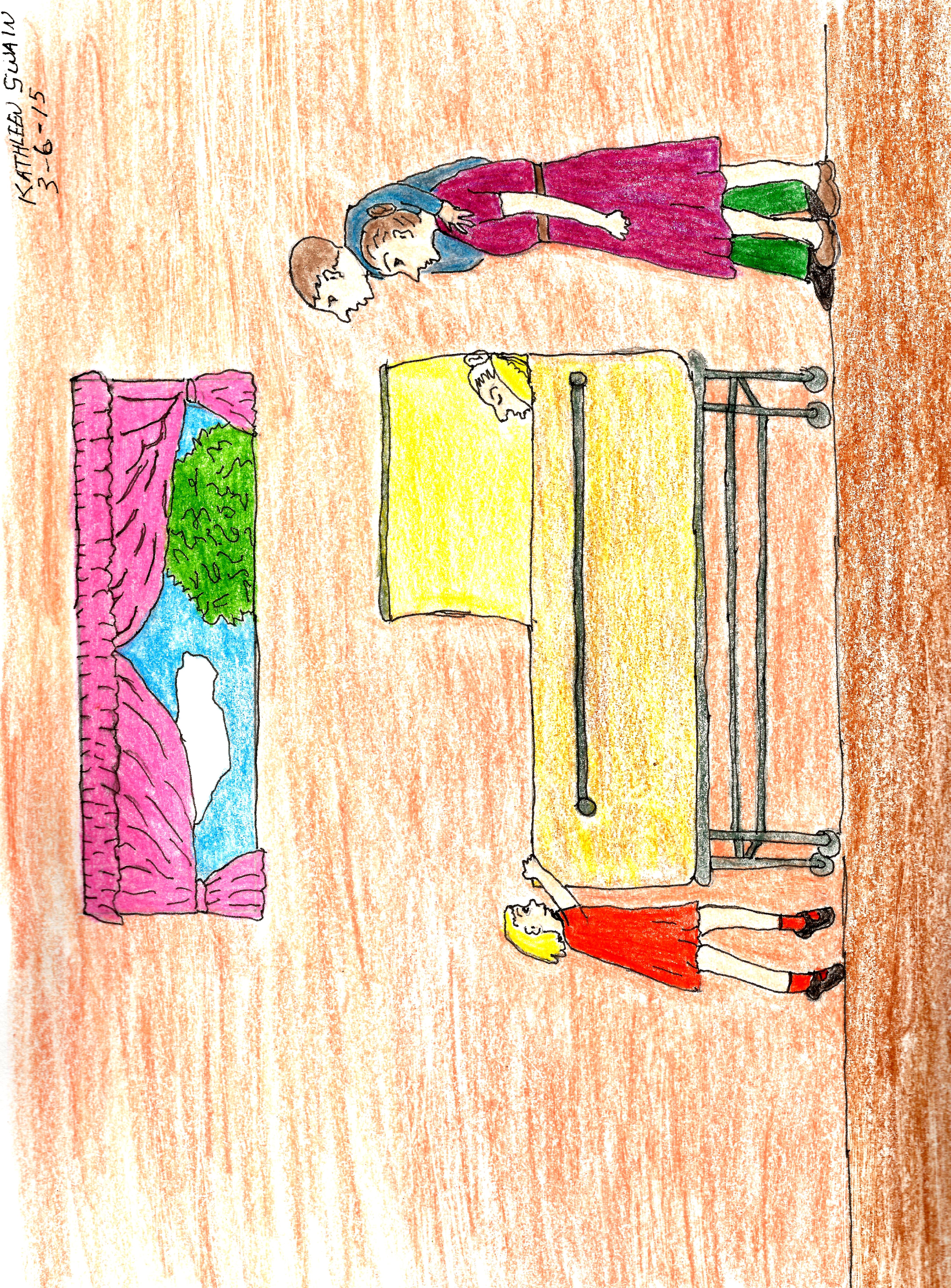
My mother was raised during The Great Depression. This is her story and illustration of her Aunt Ellie’s funeral.
The events surrounding Aunt Ellie’s death were a real treat for me since the two of us hadn’t invested much affection in each other. The wake was unforgettable with all its glorious food: fried chicken, peach cobbler, deviled eggs, bread ‘n butter pickles, dainties not seen outside “dinner on the grounds.” Sprinkled with carbolic acid, Aunt Ellie lay in a pine box stretched across two sawhorses in our living room. Folks tiptoed through, speaking in reverent whispers, “Don’t she look natural?” and “Ain’t she purty?”
Luckily for me, Mama couldn’t read minds or I’d have been eating standing up the next couple of weeks. She might ‘a been purty a hunnerd years ago, but I hadn’t never seen nothing “purty” ‘bout ‘er, bony and wrinkled as a prune, ol’ dry snuff ‘round ‘er mouth” Her ol’ crazy hair stuck up like a nest ‘a sting worms. She’d a skeert a person to death had if they’d ‘a met ‘er in the dark. Least she smells better dead.’
All the family came. The men sat with the body round the clock to protect it from the horror of desecration by varmints or house cats. Women-folk bustled in the kitchen, initially sharing woeful tales of death and illness, before branching off into ever-lasting business of child-bearing. New brides and rosily pregnant young wives studied snaggle-toothed old women, either dried-up and stick-thin, or walking barrels with pancake breasts hanging to their waists sure, they could have never been young or pretty enough to catch a man’s eye. In return, they were rewarded with horrifying tales of five-day labors and gruesome deformities, enough nightmares for the rest of their pregnancies. Folk sat around talking and parents weren’t quite as likely to run kids outdoors. Perhaps “not speaking ill of the dead” relaxed the old standby “children should be seen and not heard.” Old family stories were dusted off and embellished for the new generation. The best storytellers theatrically saved their best till the moment was right: Grampa Holdaway and his starving buddies roasting an unfortunate turtle over a campfire as they were marched to a Union Prison Camp in Illinois; Uncle George gored by a stampeding Longhorn cow; Daddy and Uncle Jim tossing cats and dogs off the roof of the Primitive Baptist Church during revival, making folks think the rapture had come. Kids hung on every word, never realizing their own great-grandchildren would beg for these same stories long after their ancestors were dust.
Ah, the funeral! Up till now, though I’d attended dozens, I’d never enjoyed the prestige of being a “member of the family,” though I knew the order of the funeral service by heart. The dearly departed lay in state on altar, surrounded by all the flowers the community could heap on them. The front pews were saved for “the family”, their grief showcased to best advantage. All eyes followed as they somberly took their places in the seats of honor. Strong men supported those most devastated, either by love or guilt, a topic of open debate by attendees. Following a eulogy so lovely the honoree couldn’t have recognized him or herself, the saddest hymns known to Christendom, and exhortations for the lost to mend their sinful ways. Next, the community filed by to pay their last respects, ostensibly leaving the family to their last private moments with their loved one. In fact, many intrigued guests filed back in and took their seats to see how the family “took it”, noting every utterance, cry, or wail to interpret at leisure for those unfortunate enough not to have made it to the entertainment. With any luck, mourners shrieked, fainted, rent their clothes, climbed in the coffin, confessed their sins to the corpse, or just generally made it worth the time it took to go to a funeral. Just once, I’d tried to join the line that circled back to see “how they took it” but Mama convinced me not to try that again. She usually towed me out the door to the home of the mourners to red up for the after funeral dinner and often left as soon as the family got back without even a bite of the luscious fried chicken or a crumb of chocolate cake. ‘Boy!! Was Mama mean!!’
Finally, finally, I was a fully qualified mourner, a member of the family, entitled to a front pew. Of course, Cousin Katie got the seat of honor, with that mean Johnny, right next to her. Daddy, Aunt Ellie’s only living brother was next to Johnny, then Mama, where she had a straight shot at me and John if we even looked like we might wiggle. For as long as I could remember, Margaret Lucille, the preacher’s little girl and Sarah Nell Bond had run up and down the aisles during church services as much as they pleased. Sometimes their mamas sat together and the girls giggled and played together, digging in their Mama’s purses till they were separated. Then they’d put their heads in their mama’s laps and go to sleep, showing everybody their bloomers. I’d always admired them, and one Sunday morning worked my nerve up to join them. As I leaned forward to slip off the pew, I felt a fearsome presence next to me and an iron grip on my arm. I looked up and Mama pinned me to the pew with a deadly look, shook her finger, and hoarsely threatened, “MAY YOU BUH!” I was never foolish enough to rock the boat to later to ask what “MAY YOU BUH!” meant, but it had to be terrible. . I’d never tried to roam during church again, but Mama still didn’t trust me. Years later,when I got the nerve to ask Mama what that fearsome phrase “May you buh!” meant she had no idea what she might have really been saying.
Sitting still throughout the long church service was usually torment, but today I made the most of being “a bereaved family member” and concentrated on looking sad and pale. I considered trying to faint but figured Mama would warm my britches up for me if I messed it up. I’d never kissed Aunt Ellie when she was alive with snuff in the wrinkles around her mouth and wasn’t about to start now, even if it would make a good impression. ‘That was just creepy.’ I hoped the neighbors didn’t notice how much Cousin Katie looked like a purple eggplant as she stood before the coffin, supported by my poor, skinny daddy. I caught my breath when Katie leaned over coffin to kiss Aunt Ellie. Thank Goodness, she didn’t flop like a fish in front of the coffin like a fish, thrilling the neighbors. I’d always enjoyed watching other people clown around at funerals, but didn’t want people poking fun at my family.
After the service, folks filed out to the cemetery for the graveside service, usually an anticlimactic postscript to the funeral: a brief message, a sad hymn or two, and a prayer, but today, Margaret Lucille livened things up a bit. She’d brought her beautiful colored baby-doll along for company, and decided to conduct a funeral of her own off to the side. As always, her parents pointedly ignored her behavior. I seemed to be the only one who noticed. Margaret Lucille dug a little hole in the soft sand nearby, buried her doll and sang along with Aunt Ellie’s service. In fact, she enjoyed the singing so much, she kept right on singing after everyone else was through. Her song only had one verse and no apparent tune. The longer she sang, the louder she got. Her daddy, Brother Sanders went right on with Aunt Ellie’s service, patiently raising his voice to be heard over Margaret Lucille’s caterwauling. Not to be outdone, she sang louder. Each time he raised his voice; she sang ever louder. After a few competing rounds, Brother Sanders gave up and concluded his service as Margaret Lucille enthusiastically sang on.
“OH! My poor little baby’s dead.
My poor little baby’s dead.
I ain’t never gonna see my pore little baby
No more! No more! No more!
As the service ended and mourners filed away from the grave, I looked backed, hoping Margaret Lucille had left the doll buried, planning a grave robbery. No such luck. That baby came straight out of the ground and went home with her. Of course, Mama dragged me home with her as soon as the funeral was over. That night in bed, the two funerals, Aunt Ellie’s and the beautiful colored baby doll’s replayed in my mind till I went to sleep. Even though I knew I’d seen Margaret Lucille disinter and reclaim her baby doll, I still had to go back to the cemetery first thing the next morning and check to be sure. I wasn’t concerned about Aunt Ellie.



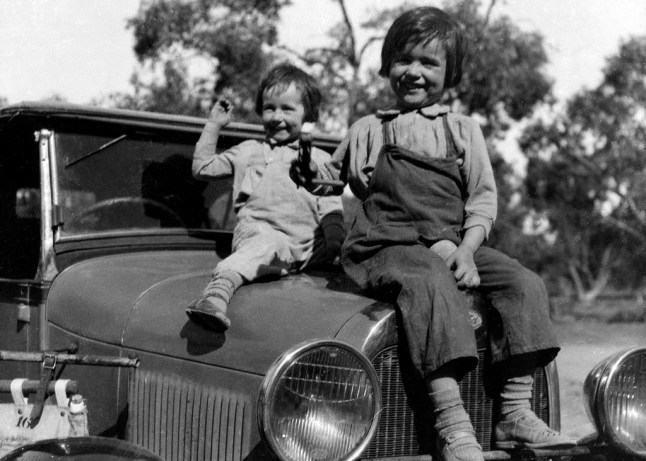 Cousin Bobo was footloose and fancy-free, unperturbed by the economic responsibilities of four children in three years. He doted on his child-bride, Inez, living quite happily with her and their family in an old unpainted, farm house on her mama’s place. Despite his aversion to a regular work schedule, he and Inez managed fine. There was no power to the house, so no bills. The wood stove and fireplace provided heat and cooking. The house was abandoned when they moved in, so he tacked wire over the open windows to keep varmints out, shuttering the windows for bad weather. Mama was real proud he did the right thing and married Inez, so she wasn’t about to stir up trouble, especially after the young’uns started coming. Bobo plowed and planted Mama’s garden, later helping get the peas picked and corn cut. Except for the few days he spent plowing, and cutting firewood, he fished and hunted every day, often harvesting turtles for the table. He happily peddled watermelons, fish, and turnip greens out of his old ’49 Ford Truck. They never ran short of game or fish. Sometimes he’d help a neighbor butcher a beef or hog, bringing in extra meat. He wasn’t averse to helping family with a little painting or carpentry work from time to time, as long as it was understood that his labor included a few days’s hospitality for his brood. He kept Mama’s freezer full. That along with Mama’s chickens, eggs, milk, and butter kept them going just fine. Getting clothes for the kids wasn’t a challenge. Inez was the youngest of six spectacularly fertile sisters. Their cousin’s hand-me-downs were plentiful. All those little blonde tykes lined up in overalls year round was awe-inspiring. Most of the time, they wore shirts under their overalls in winter. Plenty of old tennis shoes lay casually around, should any of the kids decide they needed footwear. Some even had mates. Size wasn’t an issue. Should a shoe be too big, it worked fine to slide-style and let it flop. The kids weren’t partial to shoes anyway, unless they were picking around in a trash dump with old cans or broken glass. Strings were scarce, but I never noticed anybody complaining.
 Nutsrok