Andrew and Molly Part 12

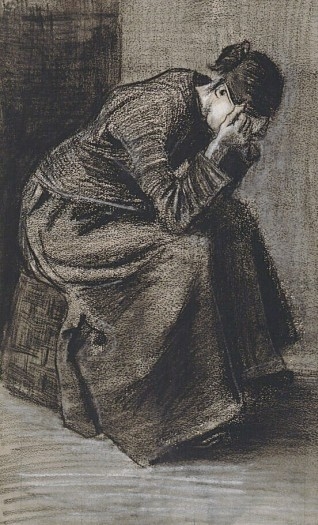
vincent_van_gogh_-_mourning_woman

Vincent Van Gogh’s Mourning Woman

Molly shrieked Andrew’s name, hoping he’d come out of hiding, till Aggie coolly took control, quickly aware of the danger to them all.  “Quiet yourself, woman!  Go for Master Wharton.  You may bring them down on us!  We must tend the one at hand and let the men seek the others.”

Terrified, Molly raced for the cabin rousing Master Wharton to the calamity.  He was dealing with a neighbor who raced for reinforcements among the other settlers.  It had only been a brief twenty years since the Jamestown Massacre and there had been trouble several times recently.  Master Wharton and a party of twenty or followed a trail into the woods.   From broken branches, it was clear someone was being dragged.  Other women joined Aggie and Molly, helping get Bartles into the cabin.

Though he’d lost blood and was in shock from scalping and  other grave injuries, he was able to confirm they’d been attacked by Indians.  With that, he slipped into unconsciousness, unable to give any word of the other men.  Aggie  covered his head wound with a poultice bandage and treated him the best she could with herbal remedies.  He lingered between life and death for days.  When he finally roused, he remembered nothing about the incident.

The men were gone through the night while the two wives tended Bartles.  Fearing attack, the other women returned to the enclosure of the settlement, promising to return the next day with supplies and medicine.  Toward morning, the party returned with Benjamin White, barely alive, suffering from broken ribs and broken legs and arms.  The Indians had no doubt intended him for slavery, but apparently when he couldn’t keep up, they’d broken his legs, kicked in his ribs and left him for dead.  He’d also been scalped and could tell them nothing. The women and the injured returned to the safety of the settlement while the injured men fought for their lives.  Amazingly, Bartles, the older, recovered while the younger man who’d languished in the woods for hours perished from a suppurating head wound and fever.

Naturally, the colonists were terrified of a return to hostilities and remained cloistered together for days.  Molly was wild with grief at Andrew’s abduction, but held a little hope he’d survived and might somehow escape to return to her, though the hope dwindled day by day.  She’d heard enough tales to be aware he might have already been slaughtered or was enslaved at the very least.  If he didn’t manage to get away soon, he’d not likely survive long.

After the initial terror, life had to go on.  Crops had to be worked, animals tended, and work donei.  The settlement could not support the influx of outsiders for long, so they returned to their homes and lives.  Molly stayed with Aggie and Bartles in their tiny cabin to help tend Bartles during the night for a time, returning to her duties during the day.  She repaired to the barn room left vacant by Benjamin’s death as soon as Aggie could spare her, not wanting to share a cabin with Master Wharton.  A bondswoman could easily to fall into trouble that would continue her servitude.

Molly moved through her days woodenly, lost in her grief.  At first, she tried to imagine scenarios where Andrew escaped and would be returning to her.  In her dreams, he held her in his arms as they counted off the days till they’d be free with their own land, just as he’d always done.  They’d have a fine farm, extend their acreage, engage servants of their own, and have many strong sons and sweet daughters to share their lives.  They’d looked forward to growing old surrounded by loving family.  She was always devastated to awake to the reality of continuing a life of servitude alone.   Through gossip, she even learned that Master Wharton could compel her to complete Andrew’s contract when she finished her own.  The possibility of six more years faced her.  In her fear, she avoided any conversation about her future situation with Master Wharton.  She prayed he’d continue to treat her kindly, but understood he’d have to acquire a new bondsman or couple.  He’d lost two workers.  Where would that leave her?  The barn room would be needed if he only engaged a man.  Should he engage a couple and a single man, he might sell the remainder of her time to another.  God only knew what a new master might demand.  There weren’t many single women in the colony.  A woman was in danger of being abused then punished should she fall pregnant.  The best she could hope was that a fair man would buy her time and offer her marriage.  The thought of her future was terrifying.


Andrew and Molly Part 11

img_1866Image pulled from internet

Master Wharton bought the indenture of Benjamin White, a recently arrived bondsman, in anticipation of Bartles and Aggie’s completed contract.  As soon as their cabin was complete, the older couple moved over, though they’d continue to work another month for Master Wharton.  The young couple moved into the house, looking forward to the comfort of the fireplace the next winter.   They took their precious bed-linens but left their furniture in the barn-room.  Aggie passed her old bedding on to Benjamin since she and Molly had made all new for Aggie’s new home.  Molly had proudly presented Aggie with toweling of her own making, the first gift she’d ever been able to give anyone.  Aggie and Bartles would go to their new home on twenty-five acres with a cow, horse, plow, bed-linens, seed for their first crop, and a suit of clothes each, their entitlement for completing their indenture.

Bartles, Benjamin, and Andrew planned to work on Bartles’s barn roof as long as the light lasted one August evening.  Aggie and Molly served Master Wharton’s dinner and did needlework as they waited for their men.  As the light faded they strolled over to the unfinished barn to see what progress they’d made.

“You must be looking forward to be working for yourself,” Molly said companiably.  “I’ll miss working by your side, but am glad to see you ready to move to your own place.”

“The four years have been long , it’s true. But if we’d stayed in England, we’d never have come to all this.  I never thought to have my own house and land.  In three years, you will move to your own place.”

“That will be a fine day.” Molly agreed.

The men were nowhere in sight when they entered the clearing, not answering when the women called out.  Rounding the house, they found Bartles unconscious with his bloody body lying amid scattered tools. His bare skull showed through clotted blood where a wide strip bare of scalp.  There was no sign of the other two men.

Aggie perceived instantly that the men had been attacked by the Native Americans indigenous to the area. The colonists had a long history of difficulties with the neighbors they considered savages. In 1622, three-hundred-forty colonists were massacred, nearly ending the settlement. Colonists had long felt God intended the land for them, a concept the natives had difficulty embracing. As a result of many lies and betrayals, hostilities often erupted to rupture the friable peace.

The three bondsmen had fallen victim, two missing and one clinging to life.

Andrew and Molly Part 10

I finally got Part 10 up after a long absence.

https://atomic-temporary-73629786.wpcomstaging.com/2017/01/14/andrew-and-molly-part-6/

https://atomic-temporary-73629786.wpcomstaging.com/2017/01/15/andrew-and-molly-part-7/

https://atomic-temporary-73629786.wpcomstaging.com/2017/01/16/andrew-and-molly-part-8/

https://atomic-temporary-73629786.wpcomstaging.com/2017/01/19/andrew-and-molly-part-9/

Aggie lived up to Molly’s first impression, a terse and demanding taskmaster.  She worked Molly hard, setting her to bread-making, sausage making, ironing, washing and ironing. Then came the spinning and weaving.  No wonder Master Wharton hadn’t been concerned, knowing he had an expert in house. From the wool not needed by the house, Aggie told the master sold her blankets and yarn for good prices, earnings they shared. When Molly looked discouraged at her tasks, Aggie was quick to remind her “Idle hands are the devil’s workshop.”  It seemed Aggie begrudged her even a breath of fresh air at the back door.  Aggie was kind enough to give her a blanket and some mattress ticking for their lodgings in the barn, for which Molly was very grateful. Nights buried up only in the hay would have been very uncomfortable.  Covers over and under hay proved a great boon.  Aggie also gave her some of her fine homespun for drawers and petticoats. Molly was trying hard to like her, but found it hard going when Aggie abraided her for clumsiness or ignorance at her new tasks. Molly found little in the dour woman to recommend her beyond her gifts.  Despite her taciturn nature, Aggie began to share a few bits of their life before coming to Jamestown.  Learning they’d lost three children to a fever in one week made Molly more understanding of her distance and left her feel more warmly toward Aggie, though she never broached a personal remark, expecting a rebuff.  Master Wharton never interfered in the running of the house, only advising if there would be a guest for dinner or an order for weaving.

With good food, both Molly and Andrew filled out.  With the hard work of timbering and farming, Andrew’s muscles bulged.  He enjoyed the days working with the voluable  Bartles.  Master Wharton sometimes joined them at their tasks, swinging an ax or harvesting tobacco. In the late afternoons, they spent a couple of hours at the forge.  After a few tries, Andrew was turning out the precious nails and learning to shoe horses. Should they finish early enough, Bartles helped Andrew a bit with the room he was constructing in the barn. Andrew used some of the first lumber to build a rope-bed for himself and Molly.  The straw-stuffed ticking and blanket finished off a fine bed, soon to be joined by a table, chairs, and chest.  They often took their suppers and Sunday meals in their snug room. Aggie helped Molly weave a second blanket before the cold winds of winter moved in, which Molly appreciated despite her resentment.

Andrew and Molly had their Sundays to themselves attending church and socializing with others of their class, soon learning they were in a good situation.  Many indentured servants were poorly fed and abused, not living long enough to work out heir time.  Should an unmarried bondswoman fall pregnant, she could be punished with up to thirty lashes or levied a fine of the equivalent of thirty-seven dollars, as well as have up to two hundred forty days service could be added to her time for lost work and the master could petition to have her child placed out for care.  Quite often, women were raped then punished should they become pregnant.  Should an English bondswoman give birth to a mulatto child, the punishment could be greater.

Andrew and Molly practiced withdrawal during sex, fearing pregnancy, despite the Biblical injunction against it.  Their time already looked far too long for them to chance increasing it by having a child.  Despite these precautions, a few months in, Molly’s courses were several days late.  She kept her worry to herself, not wanting to trouble Andrew unnecessarily.  One Saturday, her anxiety came to a head when she and Aggie went to the post to deliver some weaving and saw a young girl publicly flogged  for the crime of pregnancy out of wedlock.  Molly wept at the cruelty.  When she could not be consoled, Aggie guessed the reason for her distress.  “Are you breeding?”  Molly dropped her eyes, not answering.  “I’ll make you a tea that will fix you right up.  You’ll drink a cup a day and these things won’t trouble you.  Our lives are not our own.” 

Gratefully, Molly drank her tea and bled the next day.  Every day thereafter, she had a cup of Aggie’s tea and had no more scares.  She felt closer to Aggie after that, knowing she was softer than her crusty exterior belied.

Andrew and Bartles spent their mornings laboring over the money crop, tobacco.  When John Rolfe had introduced tobacco to England, colonists had gone wild over tobacco, devoting all their efforts and land to its cultivation.  They’d nearly starved after refusing to plant food crops needed to make the colony self-sufficient, till a law was enacting requiring them to plant food crops to be added to public larder.  In addition to tobacco, they grew corn, beans, squash, pumpkins, yams, and several other vegetables.  They raised, cows, pigs, goats, and sheep as well as availing themselves of game and fish to enrich their diet.  In the afternoons, they cleared timber, always leaving some time for blacksmithing.  Soon Andrew was turning out the priceless nails, latches, hinges, and horseshoes colonists were desperate for.  Bartles confided his own share from the sales would soon be sufficient to set himself a forge and smith when he worked his time out.  Andrew should have skill enough by the time he left to take over.  They always saved a little time back to work on the room Andrew was framing up in the barn for himself and Molly, even knocking together a table, benches and rope bed.  They took their meals alone in their home on Sundays. 

Though Jamestown was not established on the principles of religious freedom, it was assumed colonists would attend Anglican services, the established English religion.  Andrew and Molly eagerly attended, using the opportunity to mingle with other indentured servants, learning they were fortunate in their master.  Starting out as a bondsman was no impediment to moving up socially once a servant worked out their time, but they wouldn’t have expected to socialize in the homes of colonists.  Unfortunately, disease was rampant and conditions so harsh, that almost half died before working out their time.

Unlike slaves who had also been transported to Jamestown, indentured servants did have rights and could appeal to the legal system, though it was most often relatives who appealed successfully on their behalf.  They had no say in who indentured them, could be beaten, and earned no wages nor could they marry without the master’s consent. 

Though they weren’t free, they had a good master and the last year of Bartles and Aggie’s service passed quickly.  The two would be soon moving to twenty-five acres where Bartles and Andrew had built a cabin with an outbuilding that would serve as a blacksmith shop and barn.  The barn and smithy were much more commodious than the cabin, since they were necessary for their livelihood.  The twelve by twelve foot cabin could be expanded at any time.  For the present, it was tight and sufficient to their simple needs with its fireplace stretching half-way across one end, its rope bed, a table with benches, and a chest for linens.  A couple of shelves held a few crocks and pots.  It would be easy enough to add rooms with the rich store of available timber.


Andrew and Molly Part 8

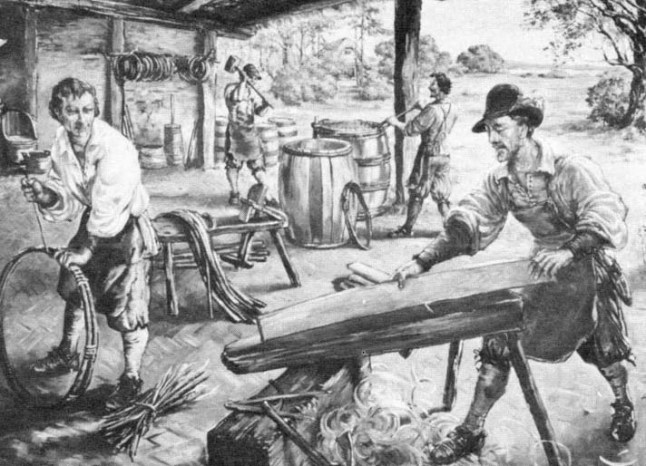
img_1779While Wharton had other matters to attend, Andrew and Bartles worked for hours that afternoon sawing trees with a cross-cut saw, chopping off branches with an ax, then piling the brush for later burning.  Andrew’s back ached and the muscles of his arms screamed.  At the end of the day, they were rewarded with a half-dozen stumps, a huge pile of brush, and a stack of logs.  The timber would be transported to a nearby sawmill for processing into lumber.  Wharton told Andrew he could take what he needed to fashion a room in the barn.  The remainder would be used on the place or sold in the colonies or shipped back to England.  Timber was one of the most important crops shipped back to England since her forests had been stripped.  Ship-building, an important trade, was always hungry for lumber. During a brief break, Bartles told him they usually worked the crops in the early morning, then split the afternoon between lumbering and blacksmithing as the need and weather permitted.  Blacksmithing was illegal in the colonies, but since their product was not great enough to impact the demand from England, they’d not had a problem yet.

Aggie sent Molly out with a pewter pitcher of beer and the men paused for a short break.  Battles spoke to the two of them.  When she turned to leave them, Bartles bade her stay. ” I came here as a bondsman almost four years ago.  I’d done blacksmithing on an estate in England.  Like you, my master died and I had to move on.  We’d have starved if we hadn’t bonded. It was a devilish passage we made, more than twelve weeks.  That’s when we met Master Wharton, but he warn’t no master then.  He was a sailor what broke his leg two days out and couldn’t work.  We took care of him or he’d have never lived.  When we got here, ship’s captain bound him over for lost work owed.  We was all bound to Mistress Ipswich when we landed, the woman that owned this farm. She was a hard, God-fearing woman, the meanest Christian I ever knew.  She took a fancy to Master Wharton not long after.  Once she was set on marrying him, he had no choice.  She meant to have him, one way or another.  He give up and married her after awhile, even though he didn’t have no fondness for her.  It was a hard bargain with never a minutes’ peace.  After a year or so, she fell out with a fit and died three days later.  He was Master after that.  When he found out I could smith, he got me a forge and helped me get a start.  I get to keep half I make.  He don’t have to let me keep nothing.  My time will be up in a few months and I’d be proud to teach you.  I’m telling you this so you’ll know you’ve got a chance.  Didn’t me nor Wharton have nothing when he got here.  Now he’s got a fine farm and soon, me and Aggie will be worked our time out an able to make a living.  Do right by Wharton and he’ll do right by you.  He don’t need to know we talked.  Lots of bondsman die before they finish their time, but you got a good place.”

Molly and Andrew were greatly heartened by Bartle’s story.  “I thank you for telling us, Bartles.”  Andrew told him.  “We are grateful.”  Molly flashed him a smile as she turned back to the house with the pitcher.

“I’d best get back in the house before Aggie skins me.”

“That she will,” chuckled Bartles.  “She don’t tolerate no slacking in herself nor nobody else, but she’s a good woman.”

Andrew and Molly Part 7

img_1779Master Reeve’s bondsman gestured for Andrew and Molly to follow while he bundled their order. He wrapped cord around the linsey-woolsey so it could be packed more easily.  The rest of the items went into a neat paper-wrapped bundle of a weight Molly could manage, talking to the all the while.  “I am Jeffers and bound for six more years.    Wharton seems a hard but fair man.  I hope to see you in town sometimes, or on Sunday when our time is our own.  I wish you Godspeed.”  With that, he hoisted and settled the heavy bundle of yard goods on Andrew’s back and loaded Molly’s arms with her parcels.

The two labored under their burdens as they made their way along the rutted track.  The morning sun was already hot, the air muggy.  Andrew hadn’t gone far before the weight of the pack ate into his shoulders.  He rested his weary back by leaning against a tree a time or two, knowing he’d never get the pack back on if he took it off.  Molly shifted her bundles frequently as she fatigued.  After a half a mile, they rounded a curve to see the Wharton farm in a stump-filled clearing.  A hearty stand of tobacco took up most of the cleared ground, a patch of corn and a kitchen garden the rest.  Clearly, tobacco was the major crop.  Early on, the colony had nearly perished when farmers opted to plant all their ground in tobacco, the lucrative option, rather than food crops. A law was passed requiring each farm to provide a portion of corn to the community storehouse, enabling them to feed themselves, rather than rely on England to import food.

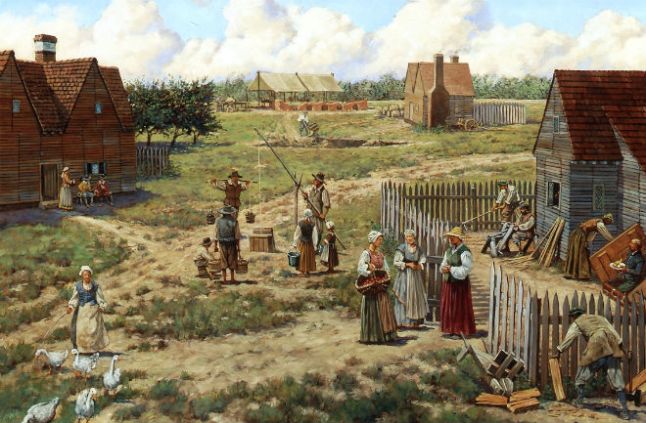
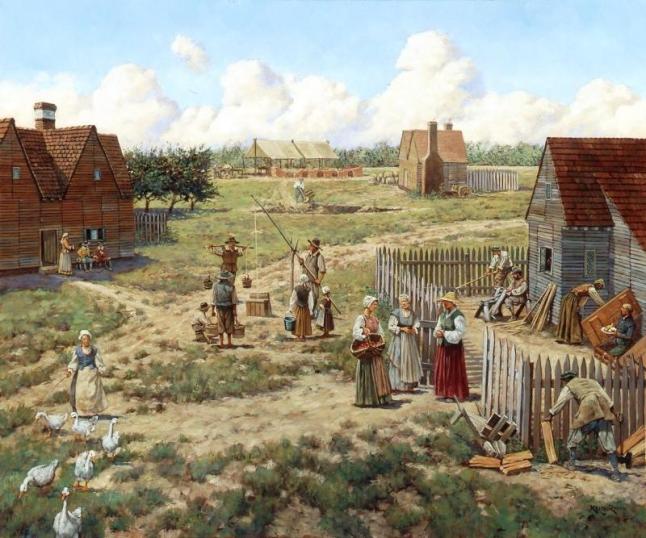
The cabin was strictly utilitarian, a modest one-story dwelling of rough timber, a well in the dooryard.  The garden plots crowded up to the house, no cleared ground wasted.  A rough outbuilding stood to the rear of the house.  The stumps attested to farmland wrenched from the forest.  Andrew got a glimpse of his future beholding the forest eager to reclaim the cleared ground.  Master Wharton would be granted an additional fifty acres each for paying the transport his servant’s passage to the colony, a good deal indeed.  The colony was desperate for cheap labor to work the farms, relying on the indentured and enslaved.  Sadly, only about forty percent of the indentured lived to work out the terms of their service.

Master Wharton was waiting as they walked up.  A gray-haired woman and an emaciated man in his fifties stood with him.  “This is my bondsman, Bartle and his wife Aggie.  They are about to work out their time.  He will be teaching you smithing and your woman will work under Aggie.”  If he knew their names, he didn’t bother using them.  “They will show you to your quarters and get you started after supping.”

Andrew and Molly Part 6

img_1746“Come with me.”  Master Wharton led them across a dusty street to a store fronted by a long verandah.  “Caleb Reeves, I am back to do my trading.  I left off two smoked hams, a side of bacon, a bushel of yams, five pounds of nails, and that bale of tobacco over there with your man on my way in this morning. I am ready to settle up and I’ll take one hundred pounds of flour, two pounds tea, a pound of salt, a pack of needles, six spools of blue thread, and twelve yards on of blue Linsey-Woolley.  My goods ought to cover it, by my reckoning.”
“Master Wharton, that won’t cover all you ordered.  I’ll take all the nails you can bring me.  Your hams and tobacco are good.  I don’t get that much call for bacon or yams, but I’ll take them as a favor to you, anyway.  The way I figure it, I’ll need seven pounds of nails to settle your order.”  Caleb Reeves studied Master Wharton expectantly.

Wharton stared him down.  “Have you found another source for nails, then? I can get my price elsewhere if you don’t want to do business.  There will probably be a ship in from England this summer with all the nails you need.  You can pay the English price instead of mine.”  Reeves winced.  The law forbade manufacture of iron products in the colonies, so with the tariff, the English price was far too dear.  It was good to have a source who was willing to take the risk.

“No need for that.  You are beggaring me, but I’ll take your trade.  Pearson, measure up his twelve yards of the blue.  No, make it fourteen.  I’ll not be known as a miser. ”  Pearson carefully measured fourteen yards of the blue reserved for indentured servants, the same blue of his rough garments.

Master Wharton addressed Molly.  “Woman, do you knit?  If you are to have stockings, you’ll make them”

She addressed him.  “I knit well, sir.  I can make all the stockings the house needs.”

“That’s good.  Reeves, give her enough black yarn for two pair for me and two pair of blue for them.  That should outfit them as required.”

“Thank you, Sir.”  Andrew told him.

“You needn’t thank me.  It’s my duty and your due, no more and no less.”  Turning to Reeves he instructed him without introducing the two men,  “This is my new bondsman.  If I send him with an order, fill it, but keep careful count.  I’ll not be swindled by any man.”

“”I always take care in my accounts.”  Reeves appeared offended.

Master Wharton addressed Andrew.  “Load the flour behind my saddle.  You will carry the rest.  My farm is a half mile on the right.  I’ll go ahead.  You won’t be trying to escape.  There’s nowhere to go.  If you run, the Indians will get you if the swamps don’t ”  With this, he urged his horse home, leaving the two to make their way with his parcels.


Andrew and Molly Part 5

JAMESTOWN. Female convicts transported from English prisons arriving in Jamestown, Virginia as indentured servants, although often becoming wives in mass weddings with the male settlers: colored engraving, 19th century.

JAMESTOWN.
Female convicts transported from English prisons arriving in Jamestown, Virginia as indentured servants, although often becoming wives in mass weddings with the male settlers: colored engraving, 19th century.

Immediately upon disembarking, Andrew and Molly along with others not already engaged were escorted to warehouse lodgings and given beer and a heartening stew of squash, beans, corn, yams, and meat, their first meat in seven weeks.  The men and women were separated and instructed to choose clothing from a pile of castoffs before bathing and delousing with some herbal concoction whose noxious odor was helpful in warding off mosquitoes. When the men were led off to be locked away for the night, Molly wept and clung to Andrew, fearing she’d never see him again.  She had no faith in the agent’s assurance that they’d be placed together.  Despite her grief, she slept hard in the deep hay that served as bedding for the exhausted women.  For the first night in months, she didn’t fear assault.

The next morning, the colonists gathered just after daybreak to choose among servants.  Molly, along with the other women, ate a hasty breakfast of beer and bread, made a hasty toilet, and prepared for selection, praying Providence would be kind. As the men turned out, Andrew hurried to Molly’s side.  As the selection began, the agent presented the bonded, praising their health, intelligence, and skills, real or concocted on the spot.  Some were labeled distillers, others as cabinet makers, or boat-builders.  True to his word, he proclaimed Andrew and Molly must go to the same master.  To their surprise, they heard the agent confide to Master Wharton that Andrew was a skilled blacksmith and that Molly could weave and spin.  The colonists were legally forbidden to forge their own tools and ironwork, so this would have to be a clandestine operation.  Like most forbidden practices, smithing was made more attractive.

img_1745

Encouraged to think he was engaging a blacksmith and a woman who could weave and spin, Master Wharton spoke directly to Andrew.  “You look right, enough.  My blacksmith will be soon work free, but might have long enough to teach you some.  Do you think you can pick it up fast?  I’ll not tolerate a slacker.  If you give me your pledge, I’ll take you and your wife.  Should you fail, I’ll sell your bond.”

“I’ll not fail if you take us both, that I swear.” Andrew asserted, looking him in the eye. “My wife never learned weaving nor spinning.  I’d not have you expect that.  She tended the dairy and is skilled at butter and cheese-making, nothing more.”

“I have no need of a weaver, just a housekeeper.  I’ll bond you.  You’ll get lodging, food, and a new suit of clothes now and once a year.  You will work dawn to dusk every day with Sunday for worship and rest. Give me value and we’ll have no trouble.”  Their new master strode off to tend his business, leaving them to wait together.

images downloaded from internet

Andrew and Molly Part 4

img_1742The site of Jamestown Colony was nothing like the home they’d left.  They’d felt pride in their natal farm though they’d belonged to it, not the other way around.  Born to its manicured meadows, neat hedgerows, and trim outbuildings, its upkeep had been a part of every day.  Born to thatched stone cottages in the shadow of the imposing barns and carriage house, they’d attended the chapel attached to the mossy, old manor house.  They felt pride of place by virtue of family tradition; it was their work and the work of their fathers before them that stretched behnd them.  They were often in need and sometimes Ill-treated, but they had a tie to the land.  Had not fate intervened, their children would have worked and lived as they had.

Jamestown of 1643 was not a welcoming site.  The vessel had tied to a crude wooden wharf.  At the site of the rough timber fence surrounding the town, they didn’t have to be warned not to rush to disembark.  A rutted, muddy trail led into the fort of nondescript houses.  Blazing sun beat down as men in tattered rags, both black and white, gathered to await their turn unloading cargo from below.  Mosquitoes buzzed around their heads and bore down, appreciative of the new blood.  The humid air was thick with the smell of newly-turned earth, smoke, and manure from the enclosed animals.

Instead of fields of grain butting up to hedgerows, unfamiliar plots of large-leaf tobacco stood in large patches outside the high walls.  Lesser squares of corn , beans, and squash clustered around nearby cabins built close enough that occupants could easily reach the enclosed settlement as needed.  Enormous forests of tall trees pushed up to the farms and fields.

img_1741As they surveyed all that lay before them, the forests were most impressive.  England’s  sparse woodlands could not compare. Though the settlement was raw and unfamiliar, they realized the intimidating forest held the future for those hardy enough to wrest it out.  All they had to do was serve out their next four years to claim their portion, not thinking those same forests were home to indigenous people who’d thrived there for millennia.


Images pulled from internet


https://atomic-temporary-73629786.wpcomstaging.com/wp-admin/post.php?post=12291&action=edit L

Andrew and Molly Part 3

img_1740“What have we gotten into?”  moaned Andrew after three days locked in the hold.  “Why did we Ever do this?  I’ve got to figure a way out.”

“No!  We wouldn’t be here if we had any other choice.  We were starving and near to death.  Things will have to be better in the colony.  We’ll be on a farm again and free with land in four years.  It’s the only way.”  Molly’s optimism was wearing thin, but she held out hope.  “Listen!  We’re moving!”  Sure enough, the chains creaked as the anchor was lifted and they were obviously leaving the harbor.    An hour or so later, after they were too far to swim for shore, the doors to the hold were thrown open.  The incarcerated rushed for the door and stood on deck for a last, long look at England.  Many wailed as land slipped out of sight, knowing they’d never see home again nor maybe even the new country.

Time on deck made the long journey more bearable, except for the miserable days of rain and storms. though it didn’t improve the quality or quantity of the rations.  Fighting and attacks were common in the hold, though few had anything but weavilly biscuits to steal.  Coughing and moaning broke their guarded sleep.  Andrew never left Molly for a moment, knowing she’d be assaulted.  Almost every morning, a cold body or two was pulled from the hold.  The stench became more horrendous as the weeks passed.  Neither suffered from sea-sickness till mid crossing when a storm raged.  Both wretched miserably, not even attempting to make it to the bucket.  Many of the emancipated passed and were slid into the raging sea.  Andrew would have gladly sought death had it not been for Molly.

Finally, the weather cleared and they were able to go above board again, feeling hope for survival.  After seven weeks, a shout rang out. The Jamestown Colony was sighted!

Maybe they’d live after all!

Links to Parts 1 and 2

https://atomic-temporary-73629786.wpcomstaging.com/2017/01/04/andrew-and-molly-part-1/

https://atomic-temporary-73629786.wpcomstaging.com/2017/01/06/andrew-and-molly-part-2/