Andrew and Molly Part 2

img_1702 img_1704After filling their starving bellies with greasy stew and quarts of ale, Andrew and Molly  signed away their next four years, too sated to consider the uncertainty of the life facing them.  In fact, they were signing away the certainty of poverty, degradation, and possible imprisonment had they remained.  In that time, people could not expect to rise above their station.  Having lost the position as farm servants to which they were born, it was unlikely they’d ever find anything more than seasonal farm employment, working mostly at planting or harvest when the workload was heavy.  Starvation would likely have been their eventual lot.  Should they stay in the city, it’s unlikely they’d find work.  Many in their situation drifted into prostitution and crime.  It is likely Molly would have dried of disease, drink, or victimization on the streets and Andrew would have ended up on the gallows or bound over as an involuntary indentured servant.   Their best chance for a better life lay with the choice they’d made.

Once they’d signed, the agent wasted no time escorting  them on board the Elizabeth Ann.  She looked imposing from without, but her charm faded as Mr. Peabody led them deep into the bowels of the ship.  Their quarters in the lowest level were dark, wet, and malodorous.  There was no provision for privacy.  They’d be relieving themselves in the communal slop jar, which would ostensibly be dumped periodically, unless it tipped over first.  Hammocks served for sleeping.  There were no other furnishings.  Restricted below deck until after sailing to avoid defection, they got a measure of beer and weevilly biscuits three times a day.  The smell was horrendous.  After their first exhausted sleep, they awoke to find themselves a part of a growing crowd of voluntary and involuntary holdmates ranging from bonded servants like themselves to young children scooped up off the street all the way prostitutes and hardened criminals who’d barely escaped the gallows.  The strong preyed on the weak.  Their miserable sleep was interrupted by lighting, moaning, and the occasional fight.  Periodically, the door above opened and another unfortunate joined their miserable lot.

In truth, indentured servants were enslaved for the period of their indenture, usually four to seven years, children till the age of twenty-one.  Their bondage could be sold without their consent.  Marriage required the master’s consent.  Should women become pregnant, their period of servitude could be extended due to decreased productivity during the pregnancy.  Children of unwed mothers were born free, but subject to being placed in the care of the church.  Unlike slaves, the indentured could appeal to the courts to contest mistreatment and did receive twenty-five to fifty acres of land, some tools, seed, and clothing upon completing their service.  Like slaves, they were most often ill-treated.  Having come to the colony in this way was no impediment to their future.  Many bonded servants prospered and got a good start to a free life.  It definitely could be a road to a better life.

Andrew and Molly Part 1

img_1700Andrew Wharton was born to be a farm servant like his father and grandfather before him, the line extending back much further than anyone bothered to remember.  His work was not a choice; he was born to work Hampton Grange and expected to die there.  The only surprise was when pretty Molly Peace chose him.  Ecstatic in his luck, he couldn’t believe the rollicking dairy maid favored him above all the hopeful lads pursuing her when he’d done no more than sneak shy peeks at her in Chapel.  The confusion of love and glorious sensuality overwhelmed the young man who’d never contemplated the possibility that life could hold pleasure. Molly saw joy in everything, the sweet breath of the cows she milked, the warmth of the sun on her face, and the sweet sent of the hay she bundled, not seeming to notice the manure in the cow’s tail, the slogging rains, or the sneezing brought on by the hay.

Their life at Hampton Grange offered the couple little beyond a small hovel, milk and cheese from the dairy, a daily ration of bread and beer, the privilege of wood gathering, and scant wages. Once a year, they were due a measure of wool for their own use. Compared to the conditions many experienced, it was adequate under Old Squire John’s management. Left to his gambling heir, it was soon lost to bankruptcy, leaving them adrift.

Andrew and his new wife Molly found themselves standing in the freezing rain wearing all they owned before a pub in Liverpool. After three days’ starving, they were easily persuaded to join an agent for The Virginia Club for food and drink. With no prospects, they were Signed papers of indenture pledging the next four years of their lives in exchange for passage to the Jamestown colony in Virginia. For their volunteer bondage they would receive lodging, food, and clothing, the quality to be determined by their master. They were fortunate in being bound four years. Most were bound seven years. including involuntary prisoners or abductees. At the end of their service, they were entitled to tools, money, and land. Like so many other indentured servants, they could expect years of unrelenting labor and uncertain treatment. In truth, the next few years wouldn’t be greatly different to the life they were accustomed to if they were fortunate enough to be bound to a good master. At least they’d have a start at the end of their time.

Two Roads, Finale

Eddie seemed to rally for several years after his accident, but well into his forties, his excruciating headaches returned and he had some behavior changes, becoming increasingly violent.  Neeley and the children avoided him as much as possible in an effort not to agitate him.  He began sleeping a great deal of the time.  Neeley knew something was terribly wrong, but Eddie would not seek medical care.  She and the boys were able to get the crop in when he could no longer got out of bed.  Not long after his  forty-seventh birthday, he suffered a major seizure from which he never recovered.  Since he was unable to object, Neeley sent word for the doctor to visit.  He examined Eddie in great depth and diagnosed a brain tumor, based on his history and physical exam.  There was nothing to be done except keep him comfortable.  He lingered a couple of weeks in a semi-comatose condition till a final seizure finished him off.

Though Neeley grieved for the man she had married and loved for many years, her gravest concerns were how she would manage to raise the children on her own.  All she had in the world was one-hundred twenty-eight dollars from the sale of their crop, the canned and dried produce from their garden, the hams and bacons in the smokehouse, and two milk cows. She sold one cow for one-hundred dollars, figuring she could milk one of Albert’s goats when the cow went dry. The two oldest girls had married and had homes of their own.  Her sixteen and fifteen year-old sons both went in the Civilian Conservation Corps in 1933 as a part of Roosevelt’s New Deal. They were each paid thirty-dollars a month, twenty-five of which had to be paid directly to their mother.

Naturally, Neeley was unable to rent the farm after Eddie’s death.  She moved thirteen year-old Will and the two little girls back to the house on her brother Albert’s place.  With what the CCC sent her, she managed pretty well till they left that program.   Fortunately, In 1935, she was able to get thirty-seven dollars a month from Aid to Families with Dependent Children. On the farm, she was able to feed the kids from her own garden.  Mama’s  husband died not too long after Eddie, so Neeley made a place for her.  It seems ironic that Neeley took care of Mama much longer than Mama cared for her, but it filled a place in her sore heart.  Young Will soon dropped out of school and worked as a day laborer or seasonal worker, bringing home whatever he could.  He was a big fellow and got a job as a night watchman on a drilling rig at fifteen by lying about his age.  In 1941, he joined the Navy at the age of seventeen after the bombing of Pearl Harbor.

He had an allotment sent home for his mother, making her easier than it had been been with a rent-free place to live and a bit of steady cash.  As the kids married and settled, she lived first with one, then the other, sometimes opting to rent from a widowed friend in town who made half her house available when Neeley tired of drama and grandkids.  They shared the bath, porches, and sometimes meals.  They watched their soaps with great intensity, especially railing against conniving men exploiting innocent young women.  Perry Mason and Gunsmoke were in a league of their own.  For some reason, she enjoyed moving and was able to save a little money by staying with her kids a while.  She’d always yearned for the ease of town life, so these were golden times.  She started drawing her old-age pension as soon as she was eligible.

Neeley lived a good forty years after Eddie’s death. To her great surprise, when she was in her fifties, her long-lost father showed up at her house wanting to see her just once before he died.   She never saw hm again, but did kindle a relationship with the unknown brother who brought him.  That relationship grew close and lasted the rest of her life. A few men came courting, but she quickly put them on the road, having no wish to be dominated by a man again.  Her children were supportive and protective of her, cognizant of the sacrifices she’d made for them.  Having her mother spend her last days with her did a lot to ease her soul.  Toward the end of her life, Neeley remarked, “I went through some rough times, but I got my younguns, an’ it all worked to a happy life.  God’s been good to me.”


Two Roads Part 14

img_1697Over the next few years, their brood grew to include seven.  The boys were tall and strong, a lot of help to Eddie, so he didn’t need Neeley’s help so much.  A stern taskmaster, he was apt to take his belt to the boys should they dally.  When Will, their third son was about eight, he was given the task of planting corn as his older brothers made up the rows on either side of him.  The rows seemed to stretch on forever and his back ached with bending and planting four kernels per hills ten to twelve inches apart. He fell further and further behind.  Desperate to catch up, he buried a big pile of seed in one hill and caught up to his brothers.  It rid him of so much of the accursed seed, he repeated the process up and down the rows, finishing up in time with the rest.  He thought no more about it, glad to be done with the onerous task of planting.  Several evenings later, Eddie went out one bright moonlit night to check to see if his corn had sprouted late that afternoon.  Indeed it had, but not all in rows like he expected.  Big clumps of corn sprouts stood in patches up and down the rows.  Infuriated, he knew immediately what Will had done.  He strode toward the house, determined to set the boy straight.  In their exhaustion, the three boys had gone to bed immediately after supper.  Eddie stomped into the room snatching the covers back from the sleeping boys and started beating them with his belt. Though Will got the worst of it, the other boys suffered welts, too.  Neeley heard the screams from the kitchen and burst in to stop Eddie.  In his fury, he didn’t seem to notice her.  Neeley ..  got the fireplace poker and got between him and the boys, beating him about the shoulders. Finally, she stood him off.  Threatening to crack him over the head, she assured him she’d kill him if she had to. In the face of her ferocity, he backed down, putting himself on one side of a wall and herself and the kids on another.  This was repeated several times over the next few years, made worse as the boys’ hormones kicked in and Eddie aged. Neeley wondered if his meanness was due to his head jury or his nature.  It could have been a combination since Eddie had learned violence at he hands of his own father, many years earlier.

Eddie didn’t deal a lot better with the girls.  As they entered  puberty, he suspected them of all manner of misbehavior.  Always on the lookout for trashiness, they couldn’t smile at a boy without inciting his anger.  In view of Eddie’s violent tendencies, Neeley  always lined up on the side of her children, creating anger on both sides.  As Neeley became more defensive, the boys became more undisciplined.  Neeley had the girls firmly under control, determined they not be led astray as she had been.  Though Eddie never voiced it, Neeley feared he’d make reference to her dalliance before their marriage. Like any mother, she wanted her children to hold her in high regard. It was an uncomfortable situation.  Not only that, fearing more pregnancies, Neeley refused to have sex except immediately before or after her “curse,” increasing the tension between them.


Two Roads Part 11

img_1685Image pulled from the internet

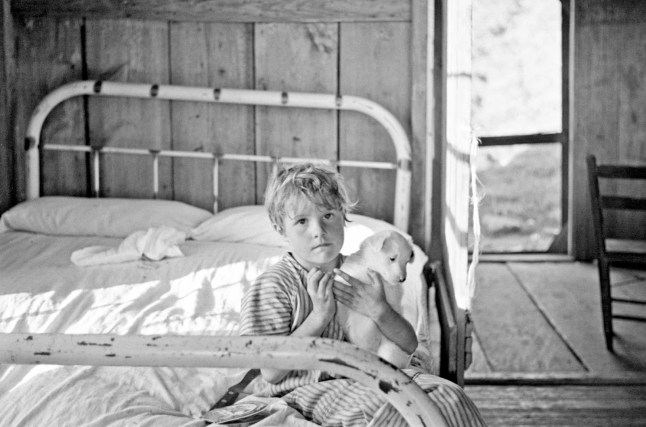
Eddie made a good crop that year. Neeley canned and dried all her garden produced. The children cheeks filled out with the good food and all the milk they wanted. Once the crop was put by that fall, Neeley’s brothers Albert and Willie, and Eddie’s cousins came over to help with the well-digging. They’d dug down about twenty feet and were just starting to see water seep in, when Eddie broke his shovel handle and called out for a replacement. As one of the men was lowering it, he lost control and dropped it, hitting Eddie in the head. They dragged Eddie out of the well unconscious and hauled him ten miles to town in the back of a wagon.  He was transferred to Charity Hospital forty miles away by ambulance.  He awoke after a couple of days later, to their great relief, though he was never quite the same. He suffered from debilitating headaches and frequent seizures that left him confused. Worst of all, he raged and had little impulse control. He would have beaten the children if Neeley hadn’t gotten between him and them. Fortunately, she was larger than Eddie and able to control him.

Despite his problems, he was determined to take care of his family.  He’d work till a headache or seizure disabled him, then go to bed and get up and try again the next day.  Neeley’s brothers helped him get his crops in the next spring, hoping he’d rally with time.  Neeley and the children worked beside him, the baby toddling right along behind.  When it came time to pick the cotton, they all picked with the baby either riding along on their cotton sacks or playing between the rows.  Despite their best efforts, they barely made enough to pay the rent for the next year.  They’d be able to eat what Neeley canned or dried from the garden, but there was only enough money for shoes for the the oldest kids, the ones in school.  The others were resoled, reheeled, and passed down.  Neeley always bought brown lace-up oxfords, so they could be worn by boys and girls.  They had fattened six shoats to put in the smokehouse, but decided they’d best sell three for supplies and next spring’s seed.

It would be a hard winter, but they’d squeak by.  Neeley was exhausted from picking up Eddie’s extra load as well as keeping up her own work.  She was relieved to anticipate things easing up till she started throwing up in the mornings and realized she hadn’t had a visit from “her friend” in a couple of months.

Two Roads Part 10

The day after Christmas, Neeley miscarried and was shamed at her relief.  She already had five children and faced an uncertain future.  Mama Cassie came to help out for a few days bringing her youngest daughter, Cynthia.  At nine, Cynthia was about the age Neeley was when Ma died.  Seeing the child playing with her children was bittersweet, remembering Mama had long abandoned her by that point in her life.

Mama Cassie was a sharp-spoken, bitter woman, not given to tenderness.  In the way of many neglected children, Neeley basked in any affection her mother showed and would have never antagonized her.  Cassie must have sensed her questions, since she brought the subject up one morning over coffee.  “I always felt bad I left you.  I wanted you with me an’ felt real bad when I found out Ma died an’ you was with Jep.  I was a’living with my husband Jeb Cox then in Smackover, Arkansas.  He was a mean one. He drank an’ beat me till I lost a baby right about that time.  I knowed if I brung you there he’d a’done you wrong.  I felt just awful about losing that baby, but that wasn’t a fit home to bring another youngun into.  Soon as I was able, I left Willie and Albert with their Grandma Cox an’ slipped off from him.  I just had to live however I could till I married Joe Miller.  I just want you to know I would’a raised you iffen I could.” A tear slid down her cheek.

Neeley understood how hard it was trying to do right by children.  Her heart melted.  “I’m glad you told me, Ma.  You ain’t had no easy life neither.”  Any resentment she’d still held melted away in light of her mother’s contrition.

Eddie made arrangements to rent a farm about six miles down in the low country, eighty acres with a creek.  The only problem was, there wasn’t a good well.  They would have to haul water about three hundred yards till Eddie could get a well dug.  Willie, Albert and a couple of cousins would help.  By March, they’d moved onto the place.  Neeley was sorry to leave her brothers’ place, especially since Eddie told her the house wasn’t as tight and they’d be hauling water for a while, but at least it would be their own place and it was reasonably close to family.  The school was only two miles away, so the kids could get there in good weather.  She was a little down in the mouth when she saw the house.  She could see daylight through cracks in the walls, but she got to work tacking cardboard, newspapers, catalog pages and anything else she could get her hands on over the cracks. Every house she’d ever lived in had paper tacked over cracks, so that wasn’t a problem. There was a good iron cook stove in the kitchen and a wood heater in the front room. That made up for a lot. The first time it rained, they had to set pots around to catch the drips, but Eddie split shingles and fixed the roof right away. The chimney had pulled away from the house, but they tipped it back and braced it before mixing red clay mortar and hay to daub up the seams and cracks. By the time they were through, it was a decent place for the family. Eddie never let her run out of water, hauling in a barrel from the creek
images pulled from internet
childnewspaper-on-walls

Two Roads Part 9

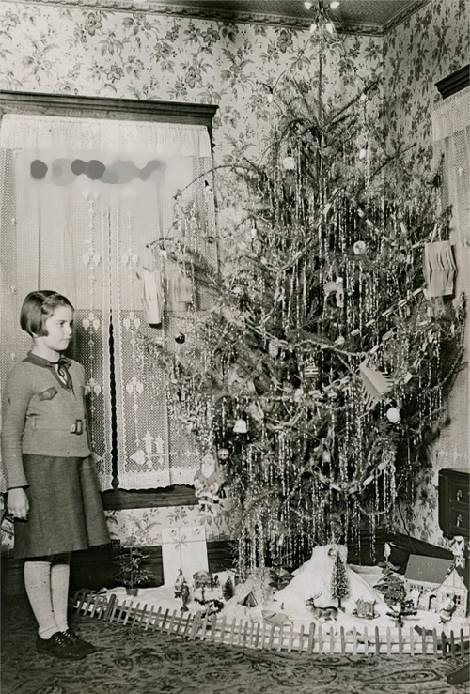
1920-treeImage pulled from internet. Note the handmaid ornaments and paper chains.  The house nor the gifts are representative of Neeley’s tree.
Eddie and Neeley packed their family up and moved to the farm her two brothers Albert and Willie had inherited from their father.  For once, it worked out well that Mama Cassie had had a few husbands. The brothers were a few years younger than Neeley and were batching it in the main house on the place, leaving a decent second house on the place vacant.  It was much  better than the place they’d just left and would give the young family a place to live while Eddie looked for a place to rent.  It was a happy time for Neeley.  The boys were happy to pitch in on food so they could enjoy Neeley’s fine cooking, having tired of their own pitiful efforts.  Eddie helped them out when they needed him and found whatever day work he could.  Had the place been big enough, they would have loved to stay forever, but forty acres would barely support one family.  Willie planned to marry in the spring.  His girl’s daddy was setting them up on eighty acres, so his prospects were good.

That was the first Christmas Neeley got to celebrate with family. Eddie cut a cedar tree, which they decorated with chains of colored paper the kids had made and carefully saved from past years.  Foil-covered sweetgum balls added sparkle.  Pictures carefully cut from Christmas card and magazines served as ornaments.  The children were enchanted.

Eddie and Neele made a trip into town the Saturday before Christmas.  Neeley was waiting for the grocer to fill her list when Mrs. Hathaway approached her, handing her a bag of penny candy.  “This is for your kids.  Eddie raised a good crop.  My husband ain’t give up your cabin yet if you folks is havin’ a hard time findin’  somethin’ else.”

Neeley set the candy back on the counter.  ” I already planned to git the younguns Christmas candy, but thanks.  We are doin’ fine.  My brothers made a place for us on their farm.  We got a good tight house.  Eddie’s found a place just down the road to rent.”  She turned to Mr. White, the store owner.  “I am gonna need a bag of them Brazil nuts, seven peppermint sticks, and that big box of raisins.”

Eddie walked up to the counter.  His mouth flew open when he saw the fruit and candy stacked next to the flour, meal, and coffee, the only items they’d agreed to buy.  “Neeley……”

She cut him off, something she’d never done before.  “Pay the man, Eddie!”  She spoke firmly.  “Our kids is gonna have a nice Christmas this year.”

Seeing the look on Mrs. Hathaway’s haughty face was worth every penny as Eddie counted out the cash.

Two Roads Part 8

img_1681They anticipated a bumper crop that August.  Eddie’s forty acres were white with the swelling cotton bolls.  An experienced farmer, he’d been at it long enough to know what his crop would bring.  Even though he’d only be paid for two-thirds of the yield, this should be one of his better years.  After settling up with Mr. Hathaway and the grocer, he ought to be able to put away enough to start renting the next fall.  He had his eye on a farm close to Neely’s mama.  The house wasn’t much better than this one, but at least he wouldn’t be sharecropping.

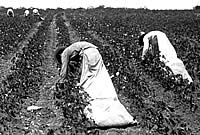
The whole family picked from daylight to dark for days, only breaking to eat buttered sugar biscuits and rest a few minutes at noon.  Their hands bled from the sharp points on the dried bolls.  Neeley had the oldest two girls trade out watching the baby while she picked. The weather held till they got the drop in.  Mr. Hathaway was there to weigh every bag they emptied before having it hauled to the gin.

After the last wagon load of cotton rolled out, they waited anxiously for Mr. Hathaway to get back to pay them their share.  They knew he was coming early that Saturday,  so they already had the wagon hitched up and the kids ready to go so they could settle their grocery bill and get the kids some shoes.  The little guys had gone barefoot all summer, but with school ready to start and winter coming, they’d need shoes.

Mr. Hathaway and his foreman got out of his truck and walked over to where they waited.  “I got bad news for you folks.  The price of cotton fell and seed cost way more than I thought it would.  Y’all didn’t clear but about fifty dollars on this crop.”

Eddie was stunned, taking long to speak.  “That don’t hardly seem right.  Cotton’s been selling for fourteen cents a pound.  We had a fine crop.  The way I figure it, we got just over three-hundred dollars clear.  You was s’posed to pay for the seed, not me.  We got to talk about this.”

“That’s all they is to it.  You just got a tough break on the seed.” Mr. Hathaway dismissed him and turned to go, encountering Neeley standing between him and his truck.  She had a bull whip in her hand. At six feet and near two-hundred pounds, the enraged woman was an imposing figure, especially to a small, wiry older man.  He and his foreman were trapped between the house and the wagon.

“No, that ain’t how it’s gonna go.”  She looked him in the eye.  “You owe us at least three-hundred twenty-seven dollars and that’s what you gonna pay us.  I’ll whip you if I have to, but you ain’t starvin’ my younguns.”

Mr. Hathaway dropped his eyes in the face of the furious woman with the whip.  Reaching in his pocket, he dug out a thick roll of bills.  He counted out three-hundred fifty-three dollars and handed it to Eddie.  “I forgot you have your own mule and equipment. This will make us square.”  He and the foreman edged their way around Neeley and scurried to the truck.  He called back to Eddie once he was in the truck, “I want you and that woman off the place.  I got somebody else in mind.”

Eddie was still shocked at what his wife had done, so Neeley answered for him.  “Don’t you worry none about that.  We already got somethin’ lined up.”


Two Roads Part 7

img_1675

Image from photos of The Great Depression

Sharecropping was a big come-down after losing the farm.  Neeley felt it every time she saw family or bumped into a neighbor in the store.  They’d been extended credit again since the boss-man vouched for them, but it was humiliating when the owner’s wife, Mrs. Hathaway saw Neeley admiring fabric and snidely remarked, “Now don’t you go runnin’ up the bill with fancy stuff like that. You gonna have to be savin’ since we vouchin’ fer you.”

“I ain’t gonna cost you nothin’,”  Neeley assured her.  “I got enough sense to know what I owe, but it don’t cost nothin’ for me to look.”  With that, she asked the storekeeper for two yards of unbleached muslin, the cheap stuff women used for their monthly needs.  She turned to the storekeeper.  “Please take this out of my egg and butter money, an’ got each of the young’uns gits a peppermint stick.”

“Yes, Ma’am.” the storekeeper said.  He was amused at Neeley’s spunk, having seen plenty of Mrs. Hathaway’s hateful attitude toward her husband’s workers.  He cut Neeley an extra yard and grinned.

“I didn’t mean no harm.  I just didn’t want you running up no big bill for us to got stuck with. ” Mrs. Hathaway tried to turn the awkward situation around.

“You don’t never have to worry about me.”  Neeley looked her dead in the eye.  “Save your worry for somebody else.”

Eddie was loading feed as she came out of the store.  “Now don’t you go crossing Miz Hathaway.  We don’t need them throwin’ us out.”

“Huh, they need us worse than we need them.  You ain’t seen nobody lined up at their door looking for a place, have you?”   she queried.

img_1679

All spring Neeley worked alongside Eddie, helping him get the cotton crop in.  A few weeks later, she helped him chop the weeds out.  Because Eddie furnished his own mule and plow, Mr. Hathaway allowed him an acre for a vegetable garden and let Neeley’s cow graze in with his cows.  Eddie built Neeley a chicken house out of scrap lumber to shut her chickens up at night.  They ran free all day.  Once the cash crop was in, they got their own patch planted.  Many landowners didn’t allow their croppers room for a garden, so this was a boon.  The landowner was to get one-third of the cotton crop, Eddie two-thirds.

The crop was thriving.  They were hopeful they’d clear enough to get far enough ahead to rent a farm with their share.  Eddie still had his mule, equipment, and wagon.  By now, Cassie was back in Neeley’s life.  She and her third husband had settled a few miles away with their twin boys and little girl.  The two older boys were    out of the house and working.  It was a comfort to have Cassie nearby.  She had settled down some as she aged, though she and her husband still managed some pretty good fights.  It probably helped that men didn’t pay much attention to her as she “lost her looks.”  Neeley had even started calling her “Mama” after Ma died.

Things were going a lot better than Neeley expected until her milk dried up and she realized she was pregnant again.  Damn, Eddie!  Why couldn’t he leave her in peace. The baby was only eight months old!  She wouldn’t need that unbleached muslin for a while, anyway.  Counting Clara Bea, this would be her sixth child and she wasn’t even twenty-five.  She didn’t think she could stand it.