Andrew and Molly Part 7

img_1779Master Reeve’s bondsman gestured for Andrew and Molly to follow while he bundled their order. He wrapped cord around the linsey-woolsey so it could be packed more easily.  The rest of the items went into a neat paper-wrapped bundle of a weight Molly could manage, talking to the all the while.  “I am Jeffers and bound for six more years.    Wharton seems a hard but fair man.  I hope to see you in town sometimes, or on Sunday when our time is our own.  I wish you Godspeed.”  With that, he hoisted and settled the heavy bundle of yard goods on Andrew’s back and loaded Molly’s arms with her parcels.

The two labored under their burdens as they made their way along the rutted track.  The morning sun was already hot, the air muggy.  Andrew hadn’t gone far before the weight of the pack ate into his shoulders.  He rested his weary back by leaning against a tree a time or two, knowing he’d never get the pack back on if he took it off.  Molly shifted her bundles frequently as she fatigued.  

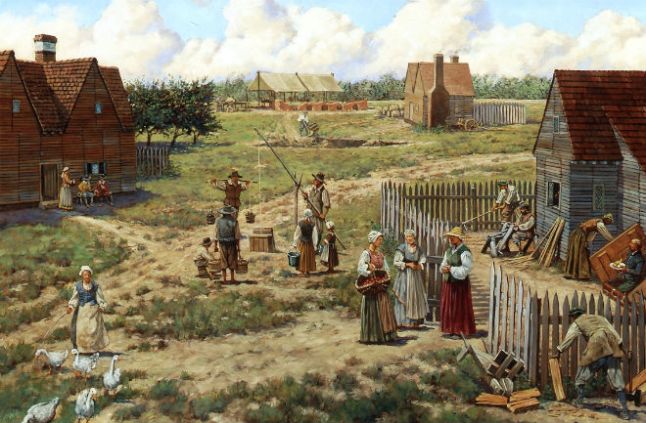
After a half a mile, they rounded a curve to see the Wharton farm in a stump-filled clearing.  A hearty stand of tobacco took up most of the cleared ground, a patch of corn and a kitchen garden the rest. Clearly, tobacco was the major crop.  Early on, the colony had nearly perished when farmers opted to plant all their ground in tobacco, the lucrative option, rather than food crops. A law was passed requiring each farm to provide a portion of corn to the community storehouse, enabling them to feed themselves, rather than rely on England to import food.

The cabin was strictly utilitarian, a modest one-story dwelling of rough timber, a well in the dooryard.  The garden plots crowded up to the house, no cleared ground wasted.  A rough outbuilding stood to the rear of the house.  The stumps attested to farmland wrenched from the forest.  Andrew got a glimpse of his future beholding the forest eager to reclaim the cleared ground.  Master Wharton would be granted an additional fifty acres each for paying the transport his servant’s passage to the colony, a good deal indeed.  The colony was desperate for cheap labor to work the farms, relying on the indentured and enslaved.  Sadly, only about forty percent of the indentured lived to work out the terms of their service.

Master Wharton was waiting as they walked up.  A gray-haired woman and an emaciated man in his fifties stood with him.  “This is my bondsman, Bartle and his wife Aggie.  They are about to work out their time.  He will be teaching you smithing and your woman will work under Aggie.”  If he knew their names, he didn’t bother using them.  “They will show you to your quarters and get you started after supping.”

Miss Laura Mae’s House Part 2

https://wordpress.com/post/nutsrok.wordpress.com/9332

Be sure to go back and read part 1

houseMiss Laura Mae’s stories always held my interest, though they certainly weren’t intended for my ears.

“The twins come about a month after Floyd left. To tell the truth, I was kind of glad he wasn’t there to get me “that way” again right off the bat like he done before. They was a few weeks early, so I was up all hours of the day and night a’nursing ‘em. Floyd’s mama, Miz Barker was gittin’ kind of childish, so I brung her to come stay so I didn’t have to try to watch her, too. Turns out, she was purty good help, a’rockin’ one of them babies all the time instead o’ tryin’ to run off all the time. Seems like it kind of settled her. She was a sweet ol’ lady.

The garden was a’comin’ in an’ we had plenty to eat without buyin’ much groceries. Miz Barker, Floyd’s mama told me I could git her pressure cooker to do the cannin’ and that shore helped, not havin’ to worry about my beans and tomaters goin’ bad no more. I had got a check or two, so I was able to get a kerosene stove and git rid of that ol’ wood stove. I got Joe Smith to set it up out in the yard so I could do my cannin’ on it. It shore was better not heatin’ the house up.

I had always took in ironin’ at a nickel a piece to help us over times when Floyd was drinkin’. I was real careful to go straight an’ pay on my grocery bill soon as I got paid so Floyd couldn’ git in my ironin’ money. Sometimes that was all that was comin’ in. I got Betty Lou, Myrt, and Glomie started ironin’ as soon as they was tall enough. I tried to let’em keep a quarter a week of the ironin’ money when I could. I’d let ‘em play about an hour after school, then soon as they was through with their homework, put ‘em to ironin’. We’d all listen to the radio while we was ironing long as the batteries lasted. Purty soon, they was savin’ their part of the ironin’ money for batteries.

Things was good till Jody got burnt. He follered Jimmy out to burn to trash and caught his clothes on fire. He was burned bad all over his back, big ol’ blisters everwhere. Doctor Garnett come out to see him and gave me some salve and pain syrup and told me to keep them burns covered. He couldn’t say if Jimmy’d make it or not. It was right in the heat of the summer. Pore little Jimmy suffered so. I had all I could do takin’ care of him and them babies. I don’t know what I’d a done without Miz Barker a’rockin ‘em like she done. With Jimmy so sick, I couldn’t nurse ‘em all the time like I needed to, so I got ‘em on the bottle some to help out. Mr. Jones down at the store let me run my bill up purty high a time or two when I had to keep Carnation Milk without complainin’ a bit. The girls kept right up with the ironin’, never passin’ a word when I couldn’ give ‘em nothing.

My sisters Oly and Ory helped the boys keep the garden goin’ and when it come in, they done most of the cannin’, leavin’ me to take care of Jimmy and the babies. Bessie an’ Joe Smith took to milkin’ the cow in the mornin’ so I didn’t have to get up before daylight after being up so much at night. I don’t know how I’d a’made it if I hadn’ had all that help. In a month or so, Jody was doin’ purty good. By that time, I had them babies purty much on the bottle, and I was able to pick my work back up. I don’t know what I’d a’done without good neighbors, but I was so glad when I could pick my ironin’ and my garden back up and take care of my own young’uns. I was proud for the help, but ever’body needs to make their own way and not be worryin’ other folks.

To be continued

Surviving Hardship: Cousin Kat’s Life Lessons from Virginia

Cousin Kat was born the eldest of seven in 1916 in the mountains of Western, Virginia. Her father died of a cerebral aneurysm when she was only twelve. Her father and my grandmother were siblings. Sadly, Cousin Kat and her brother, only one year younger, had to leave school. They went to work immediately upon their father’s death. Neither of them ever got to live at home again after that. They took whatever jobs they could get. She did housework and canning. She helped with the sick or the elderly. She assisted with children and helped with gardening. She took on whatever tasks she could find. Her brother did whatever work he managed to find, usually on a farm.

Her widowed mother was left with five small children, the youngest on three. A kind-hearted neighbor allowed her and the children to harvest his bean field. Other neighbors helped harvest their fields, saving them from starvation. Another neighbor gave them a pig to fatten. These kindnesses saved them from starvation. Her father-in-law allowed them to move in a laborer’s house on his farm so they wouldn’t have to pay rent.

As the other children were old enough, they went to work for a dollar or two a week and their board, just as the older children had. Their happiest times were when they got to come home and be together on weekends.

Things got better for the family during Roosevelt’s New Deal. The oldest boy went into the CCC and was able to more money home. Kat got work with NYC and was able to get a earn some cash and get a little schooling. Eventually, there were benefits for women and orphans, easing the pressure. One after the other, the children joined the military or moved away to get better jobs. Cousin Kat married at eighteen. She and her husband moved to Maryland for five years to work and save every penny. They came back home and bought a small farm next to her mother. Her husband farmed and Kat took a job in a garment factory.

Cousin Kat was frugal her whole life, never spenting a penny she if she could avoid it, influenced by her hard early years.

Bumps in the Road

Though I most frequently talk about the amusing things our family experienced, of course there was another side.  Mother is a lovely lady, cheerful, fun-loving, and totally centered on her family, still at ninety-six.  She is and always was, scatterbrained, a trait she generously shared with her children.  It provided comic relief in otherwise hard times and sometimes precipitated hard times. I know now Daddy was bipolar, though he never went off the deep end.  As a young man, he was a binge drinker and gambler, though he gave it up to save his marriage.  Before setting out to establish a farm in his early forties he was always hunting or hanging with his cronies.  When I was a small child, Billy and I frequently got to tag along.  It was heaven! Upon his return from work we rushed joyously rushing to meet him shrieking, “Daddy’s home! Daddy’s home.” Then we’d likely be off for an adventure. Unfortunately, for his older two girls, Daddy made a point of  establishing an emotional and physical distance as we approached puberty.  He wanted no hint of inappropriate behavior in his family.  God only knows how he was influenced by his early life. 

About the time Daddy was nine, his sick father had moved into the home of his own mother. Suffering with a brain tumor, he lay abed for four years, unable to do anything for his poor family.  That grandma wanted nothing to do with her daughter-in-law and the starving children.  The fourth of seven, Daddy, along with his two older brother’s, took any work they could get, often for nothing more than the chance to put their feet under someone else’s table.  Daddy said one day he chopped bushes all day for a bag of meal. 

None of his father’s family wanted to be saddled with their ravenous appetites either.  They were all struggling. Daddy told of helping his uncle with the harvest one late fall day.  The three barefoot boys got there before daylight, hoping for breakfast.  Their shoeless condition was not slovenliness.  They’d have gladly worn shoes had they had them. Sadly, his aunt was plunging the breakfast dishes in hot water as they shuffled up to the back door.  She’d had no intention of feeding them, shooing them out to the field with Uncle Robert and their cousins. At noon, Annie Mae sent one of her girls to the field with a bag of biscuits slathered with cold gravy and a jug of water.  The biscuits were bland but filling, but the boys had been hoping for milk, and maybe a cookie or a pear

The weather turned about four that afternoon, a cold sleety rain.  The hungry boys followed their uncle to the house, looking forward to a hot supper and a cozy bed for the night.  Their mother wouldn’t be worried, knowing they were at Uncle Robert’s.  Surely, Uncle Robert would hitch up the wagon and bring them home in the morning.  They didn’t have shoes or coats!  In the days before their Daddy got sick, they’d often stayed at Uncle Robert’s with their cousins.

Again, the heartless Annie Mae met them at the door.  “You boys git on home before it gits any worse.  Your Mama’s gonna be worried about you.” Aunt Annie made it clear they and their appetites had no welcome at her table. Uncle Robert gave them each a quarter and a tow sack full of the corn they’d just helped harvest. He sadly watched his nephews head to their poor home, clearly having had his orders. The shoeless boys cried with misery as they gingerly stumbled the long three miles home on frozen feet.  Daddy vowed then never to turn a hungry visitor away.  He never did.  Mother was often angered when Daddy insisted she come up with a meal for drop-in company, even hours after mealtime.  It’s surprising how often Daddy’s offer was accepted, especially  by ne’er do wells. Meanwhile, Mother fumed at the stove. “Nobody with any raising would expect someone to drop in and be offered a meal!” Mother never had sandwich makings or quick food so a meal meant cooking.

On a further further note, the penurious Annie Mae made each of her own children raise heir own garden contributing to the family larder.  She benefitting further, selling off the excess.

Just Folks Getting By Part 8

img_1990

Shot of a sweater I am crocheting my granddaughter.

“Now that’s some purty crochet.  You’re getting real smooth with them stitches.  Does it feel like your hands is gittin’ the idea?”  Lucille and Jenny were at the kitchen table with Lucy resting in a basket at their feet.  “Just look how sweet she looks with this pink.”  Lucille held a skein of pink baby yarn next to her little granddaughter’s face.  “Don’t tell Shirley, but I was always hopin’ for a girl ever’ time she got that away.  I wonder if it was because I just never got enough of you when I had to put you in the Hope Home. The thing was, I never even cried.  I just had to toughen up to get by.  I was afraid if I started, I’d fall apart.  I had to work and get the three dollars a week to the home or I might lose you.  That’s all I kept thinkin’ when the work got hard and the hours got long.”

“I can’t even imagine how hard that must have been, especially with Daddy in jail.  How did you find out what happened to him?  Weren’t you at Aunt Lucy’s?” Jenny was trying to piece her family’s past together along with learning to crochet.

“Let me show you how to do a double crochet so you can practice while I tell the story.  It’s a long one.  Okay, watch this.” Lucille demonstrated slowly, then picked up speed.  “Keep the tension on and git a rhythm.  There, now you are doing good.  Do a few till it gits easy, then I’ll show you how to turn for the next row.”  Jennie concentrated on her crochet while her mother picked up her own crochet and started her tale.

“You remember your daddy had sent us to Aunt Lucy’s on the bus to git us out of the dust when Jimmy was sick.  Well, Jimmy never did git another good breath.  He coughed up muddy stuff and kept getting worse.  We propped him up to sleep and built him a tent so he could breathe steam from a tea kettle with a few drops of kerosene in it.  We even give him three drops of kerosene in a spoon of sugar to ease the coughin’ and it worked some, but he still died about four days after we got there.  I didn’t have no way to git in touch with your daddy in time, so we had to go ahead and bury him on Aunt Lucille’s place.  We put him right near the creek, where you could hear the water running all the time.  The sound of that running water give me some comfort, at least knowing he wouldn’t be breathing dust no more.  Anyway, I wrote your daddy.  A few days later, I got a letter from Uncle Melvin lettin’ me know your daddy and his boy, Luther, had got caught runnin’  moonshine.  I was never so shocked in my life.  I thought Russ was drivin’ a truck. Uncle Melvin said they both got five years at Huntsville.  That just about kilt me, comin’ right on top of losin’ Jimmy.  He’d sent my letter back and gave me an address where I could write Russ in jail.  He’d been a’hopin’ I’d write ’cause he didn’t have no idear how to reach me.  It like to broke my heart to write your daddy in jail.

I didn’t know what to do.  I went straight to bed a’cryin’ my eyes out.  You followed me to bed, just a’pattin’ my face with your little hands.  I never got up that day.  Your Aunt Lucille left me alone, but the next mornin’ she come in and told me to git up and cook you some eggs.  You was hungry.  Then I had to help her get a wash out.  She was takin’ in washin’ then to make the rent.  I told her I didn’t feel like it, to leave me alone.  She said, “Gal, git your behind outta that bed before I take a broom to you.  You got a baby to raise.  It ain’t her fault her brother died and her daddy’s in jail.  I didn’t take you to raise!”

Lucille laughed,”I believe she’d a done it, too.”  I mean to tell you I jumped outta that bed and got to cookin’.  Soon as I got done with the dishes, she set me to drawin’ water for the wash.  I had to fill two of them big ol’ iron wash pots.  We shaved in homemade lye soap and scrubbed dirty spots on a rub board before puttin’ clothes to boil a while.  Then we dipped ’em out with a stick and put ’em in the rinse water.  We done the whites first, then good clothes, and finally towels and work clothes.  You had to go from cleanest to dirtiest or you’d mess up your whites.  When the wash water got too dirty, we’d put soap in the rinse water and finish the wash with it.  ‘Course I had to fetch clean rinse water.  I hated wringin’ them clothes.  They was so heavy.  The sheets, towels, diapers went straight on the line.  The dresses, aprons, shirts, and overalls had to be starched before dryin’.  Aunt Lucille stirred some corn starch in cold water, mixed it real smooth, and stirred it in the boilin’ rinse water.  When it was smooth, she dunked the clothes and poked ’em around with her stick till they was soaked up good.  We fished them steamin’ clothes out an’ wrung ’em out when they cooled enough.  We had four long lines of clothes flappin’ in the breeze by the time we was finally done.  The diapers and sheets was usually ready to take in by the time we got the last of the wash on the line.

By the time we got through washin’ and foldin’ I was whipped.  We ate cornbread crumbled in  buttermilk and sliced tomatoes for supper.  I thought I wouldn’t be able to keep my eyes open to eat, I was so tired.  The next mornin’ Aunt Lucille had me up at six to start the ironin’ while she picked beans.  That afternoon, we canned  beans.   She had two big pressure cookers so we put up twenty-eight quarts of green beans that afternoon.  If Aunt Lucille came in and caught me wipin’ tears, she’d set me to another task.  Every night, I was so tired, I just drug myself off to bed.  I still grieved, but it was kind of like I put my grief in a drawer and just took it out when I was free to be alone.  Aunt Lu knew what she was doing.  She’d  lost three children in one week.  She still had four to raise that needed more than a broken piece of a mama.

Just Folks Getting By Part 1

This story is not about my family, but from a time and place when my grandparents struggled to raise their family.  This is a picture of my grandparents Roscoe Gordon Holdaway and Mary Elizabeth Perkins Holdaway when they first married.  Mary Elizabeth Perkins and Roscoe Gordon Holdaway Wedding Pictu“Mama, how come I had to live in that orphanage for a while when I was little?  If you ever told me, I don’t remember.” Jenny sat in a porch rocker nursing her new baby.  Her mother Lucille sat across from her in another, crocheting a blanket for Little Lucy.
Oh, Jenny, I been wondering when you was gonna ask about that.  That like to broke my heart.  I don’t want you to think bad of your daddy.  He was a real good man, but got caught up in some trouble when you was just a baby.  We was a’farming the Henderson Place up in the Panhandle where The Dustbowl was the worst and he got caught moonshining.  You have to understand, back in The Great Depression, things was different.  They’d been a long drought an’ he hadn’t made a good crop in years.  Dust just kept a blowin’ ever’thing away.  It was just awful seein’ them dust clouds roll in, knowin’ we was gonna be a’smotherin’ and lose our crops..  That dust would git down in your lungs and turned to mud.   That’s what happened to your brother Jimmy when you was just a baby.  He died of the dust pneumonia.  Anyway, that’s what got your daddy moonshining.  We was a’starvin’ and then Jimmy got bad sick.  It was real flat out there and he put a still in the storm cellar.  The sheriff seen the smoke and come and broke it up and hauled him off to jail.  I didn’t know what I was gonna do.  Since I’m a’gonna be here a few days, it’d be a good time to tell you.  Now, you got a baby of your own, you ought’a be able to know what a hard thing it is to leave a young’un.  I always worried you’d hold it against me, but if I hadn’t a’put you in that orphanage, you’d a’died like Jimmy.  You almost did anyway.”  Lucille had difficulty speaking through her tears.

“Oh Mama.  I never held anything against you.” Jenny interjected.  “I remember you coming to get me on your days off.  I went there when I was so little, I didn’t know any other life.  I couldn’t wait to see you when Mama Margie and Mama Bertha told me you were coming.  Not many kids ever had anybody to come see them.  I thought I was real lucky, especially when you’d take me out on my birthday and Christmas every year.  Those were really special times.  Most kids never went out except when we all went.  I remember getting to sleep over with you a few times.  Those were the best times, snuggled close to you in your bed in your cute little-bitty room in that kitchen.”

“I’m glad you remember it that way, but that wasn’t a ‘cute little-bitty room.’  It was a cot in the pantry, but it’s a mercy that’s what you thought.  Mr. Jones let me clear out a space big enough for a cot.  Do you remember I had all them canned goods stowed up under the bed?  Till Mr. Jones let me git a cat, I had to set mousetraps all around and they’d be a’snappin’ all night.  I shore was proud of Ol’ Smoky.  She wouldn’t let a mouse stay on the place.  I sure slept a lot better after she come.  She was a good old cat.”  They both got a good chuckle out of that.

Your Money’s No Good Here!


It’s good to compare notes with your family.  My brother just told me my dad helped his brother-in-law counterfeit quarters back in the 1930s.  Daddy’s oldest sister, Aunt Jenny, married Uncle Chester, a bona fide reprobate, a rabble-rousing drunk who enlisted Daddy to help with his quarter counterfeiting business.  I don’t know if Daddy would have even qualified for reform school if he’d gotten caught, since he was just a hungry little kid trying to win a place at Aunt Jenny’s table for a few days. Mama and his younger sisters were about to starve since his own father was sick in bed at his mother’s house.  Grandma wanted nothing to do with her daughter-in-law and the grandkids, though she was willing to care for her son.  The boys were pretty much working for room and board anywhere they could.

At any rate, Uncle Chester made pretty good quarters, a time-consuming job requiring a steadier hand than his, since he was rarely sober.  According the Daddy, Uncle Chester made impressions of both side of quarters using Plaster of Paris casts lined with onion-skin paper.  The steady hands were needed to line the molds up and glue them together, leaving a tiny pour-hole at the top, where they could pour in Uncle Chester’s special melted alloy.  Once the ragged quarters set, a little artistry work was required to finish them off.  Voila!  Quarters!

Babbittquarter

Uncle Chester had no trouble passing his bogus quarters at the grocery store, the mercantile, and the hardware store. The problem came at the bar.  Though he was normally stingy and careful, one night he got a snootful and wanted to buy a round for everybody in the house.  Indiscreetly, he brought out a bag of quarters to pay his tab.  They didn’t ring true when he poured them on the counter.  The proprietor objected, Uncle Chester tore into him, and Uncle Chester ended up in Leavenworth.

That really wasn’t so bad.  His cell-mate taught him to make twenty-dollar bills.  Before long, Uncle Chester was out, but wasn’t able to pass his twenties because he couldn’t get the color just right.  After a number of frustrating attempts, he poured up some quarters and headed back to the bar.  When he poured his clinky quarters out on the bar, just as Uncle Chester anticipated, the bar-tender objected.  “Are you telling me my money’s no good?”  A fight and arrest ensued.  Uncle Chester went back to Leavenworth for a refresher, polished his craft, and never had any more counterfeiting troubles.

All’s well that ends well.

Hard Times and Tough People

Cousin Kathleen had a hard time coming up. She was the oldest of seven children ranging from three to fourteen when her father died in 1934. He farmed a few acres he’d gotten from his father in the Virginia hills. Aunt Winnie had no idea how they’d manage. She and the kids struggled to get the crops in that year with the help of the neighbors, knowing that was the last help she could count on in the hard times of The Great Depression. The thought of the work facing her was overwhelming. A friend gifted her with the crop from one of his bean patches, other neighbors contributed a ham, a few hens, some produce, and what little bit they could spare. Others offered to hire the kids when they needed help from time to time.
After the crops were in, the beans picked and canned, Aunt Winnie made inventory. She owned the farm with its tiny three-room house with beds in every room, including a couple in the attic. She had a good well, a tight barn, a smokehouse, a toilet and a chicken house. Her livestock included a sow and a few fattening shoats, a few chickens, a mule, a cow, a few goats, a dog and a couple of barn cats. Her farm equipment included a wagon, a plow, hand-tools, harness, and the various other things Ed had managed to acquire. She sold the mule to a neighbor with the promise that he’d loan it back to her to plow garden every spring, giving her a bit of cash. Darryl, the oldest boy was twelve and big as a man. Between the kids, and herself, they’d have to get the work done. Aunt Winnie took a days’ work when she was lucky enough to get it, though it was sporadic since there were no real jobs. The neighbors called her to help harvest, can, or help with the sick, but she had to be home at night to care for her own young children.
Cousins Kat and Darryl never lived at home or went to school after that, taking whatever work they could, their board part of their pay. Darryl was home only for heavy work plowing, planting, and getting crops in, though Kat only got to come home on weekends. He did farm work, cleared land, cut wood, helped butcher or did whatever he could get, moving from farm to farm as the job was finished, though he had to be home long enough to plow, plant, and get in the crops on his mother’s place.
Cousin Kat took whatever jobs helping out mothers with new babies, staying with the sick or elderly, helping with farm, housework, or sewing, anything she could get. The word got around the kids were hard-working and reliable, and cheap. Kat said she never got more than two dollars a week, when she was lucky. Sometimes she worked for produce and old clothes for herself and the family. Darryl often had to take his pay in produce to take home. There were many mouths to feed back at Mama’s place.
In this way, the family scraped by. Ed’s parents had moved to Texas where they moved in on Lizzie and Roscoe, my grandparents, in the meantime. Roscoe split his farm equipment, and gave them a wagon and mule to help them get started. Upon learning of her brother, Ed’s death, my grandmother, Lizzie, wrote her sister-in-law Winnie, to sell the farm and come to Texas, where they could be of some help to them. Nobody had much, but they could all manage together. Lizzie and Winnie had been life-long friends, even before Winnie married Ed. They had stayed in touch by letter at least weekly ever since Lizzie left Virginia. She looked forward to being with her again.
Winnie, who had no other family, was looking for a buyer for the farm and planning to move her family to Texas, when she got a nasty letter from her mother-in-law telling her she had no business moving to Texas, burdening herself and her husband with that “bunch of kids.” These were her own grandkids, by the way. Winnie had “made her bed and now she had to sleep in it.” This was really cold, considering this same woman had moved her own family in on her daughter and son-in-law. Maybe she was afraid more family would put an end to their generosity. My grandmother, Lizzie, never found out the reason till she and Winnie reunited on Lizzie’s first visit to Virginia fifty years later.
Insulted, Winnie and her family stayed in Virginia where they struggled by. Things got better when Darryl was able to join the Civilian Conversation Corp and send money home. The third daughter went out to work, bringing in a little money. When World War II started, Darryl enlisted, then the other boys in turn. They lived through some hard times. The younger children got to go to school.
Cousin Kat said it was a great sorrow that she never got to live at home after her father died, missing her family’s’ twilight suppers, never getting to finish school, and getting to sleep with her sisters under her mama’s quilts in the attic. The rest of her life, she never spent a penny she could save, fearing she’d need it soon.
Darryl made the Navy his career and was very proud to have served as boson the Hornet in World War II. All Aunt Winnie’s children did well, contributing till their mother got her “old age pension.” As her health failed, the children cared for her, hiring help to get them through times they couldn’t be there, quite an expense. Despite this, when she died, she left ten-thousand dollars to be divided among her children. She must have been so frugal!
cabin

Lessons of a Hard Life

Daddy was a pragmatist with a dim view of positive reinforcement. Throughout his life, he’d seen many of acquaintances make the expedient rather than the better choice. I don’t know whether he considered his choice of associates might have an effect on their decision-making but he did need a fix of low company from time to time, probably feeling they held a lofty view of him. He held himself apart from drinking and trashy behavior, but did appreciate hearing just enough to reinforce his self-view, also providing an opportunity for edification should these “friends in low places” need his help and guidance. They enjoyed his generosity far more than his immediate family. Taking care of one’s family is a thankless task, whereas news of “bread cast upon the waters” may be touted far and wide. Though not a minister, he frequently preached that a person trying to lift himself out of a “life of sin” is to be praised far above those never wallowed. I am sure, this was personal, since he took every opportunity to use his own early behavior and redemption as an example of all he’d overcome. For some reason, he never encouraged us to sample the delights of sin so we could ascend to sainthood as he had, just made sure we never enjoyed the opportunity to mess up.
It was heart-warming to hear of the improved behavior of Josey Johnson, who only two weeks earlier had abandoned a loving husband or wife and little children for the company of a hard-drinking friend. If Daddy could corner Josey and get in a little preaching and Josey came home, Daddy was ecstatic. Josey could count on all kinds of favors, till he or she took off again. Daddy wasn’t bad about letting us know when Josey backslid, but hastened to update us if Josie returned home for some rest and rehabilitation. It didn’t matter that Josey might have been kicked out of a den of iniquity and was roosting at home till something better came along.
Unfortunately, Daddy never understood that not all people seek the low life. Life is full of people who do the right thing, just because it is right. I still wish he’d learned that not everyone falls, given the opportunity. I know his difficult background shaped his attitude.

family3

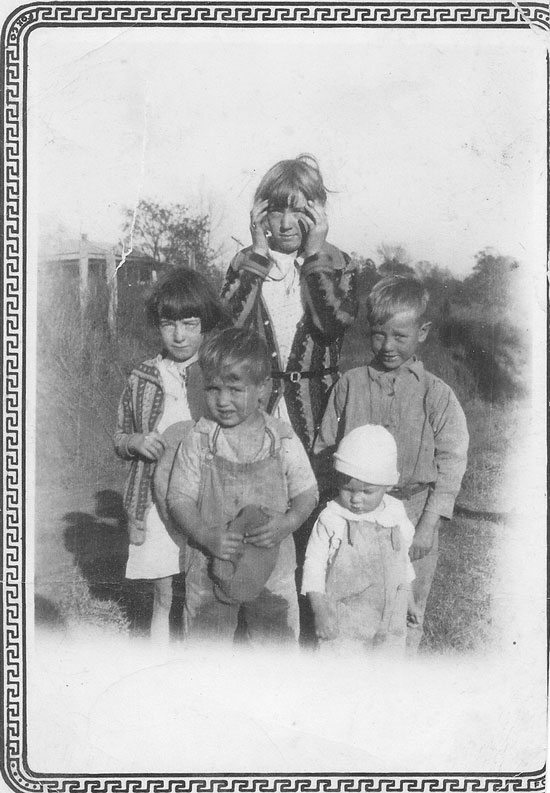
This photo pictures my father and several of his siblings. He is the boy in the middle holding the cap. I feel sure my grandmother seized the opportunity to have their pictures made by someone who happened by with a camera. They were sharecroppers. It is unlikely she was able to make any preparations for this photo. Times got even harder for the family when her husband died at forty-two, leaving her with five children between three and eighteen. The eldest had already married and left home. The oldest boy, at eighteen was working at whatever he could find. The fifteen-year-old boy went into the Civilian Conservation Corps as soon as he could. My father was thirteen and did farm work and odd jobs to help out till he got on as a night watchman at an oil rig at fifteen. The rig wasn’t too far from the house so he often slipped home to get something to eat and warm up, since he was too poorly clothed to keep warm.