
 Master Reeve’s bondsman gestured for Andrew and Molly to follow while he bundled their order. He wrapped cord around the linsey-woolsey so it could be packed more easily. The rest of the items went into a neat paper-wrapped bundle of a weight Molly could manage, talking to the all the while. “I am Jeffers and bound for six more years. Wharton seems a hard but fair man. I hope to see you in town sometimes, or on Sunday when our time is our own. I wish you Godspeed.” With that, he hoisted and settled the heavy bundle of yard goods on Andrew’s back and loaded Molly’s arms with her parcels.
The two labored under their burdens as they made their way along the rutted track. The morning sun was already hot, the air muggy. Andrew hadn’t gone far before the weight of the pack ate into his shoulders. He rested his weary back by leaning against a tree a time or two, knowing he’d never get the pack back on if he took it off. Molly shifted her bundles frequently as she fatigued.
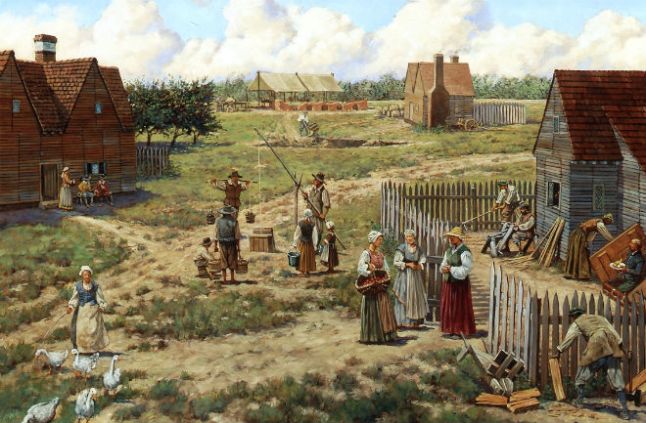
After a half a mile, they rounded a curve to see the Wharton farm in a stump-filled clearing. A hearty stand of tobacco took up most of the cleared ground, a patch of corn and a kitchen garden the rest. Clearly, tobacco was the major crop. Early on, the colony had nearly perished when farmers opted to plant all their ground in tobacco, the lucrative option, rather than food crops. A law was passed requiring each farm to provide a portion of corn to the community storehouse, enabling them to feed themselves, rather than rely on England to import food.
The cabin was strictly utilitarian, a modest one-story dwelling of rough timber, a well in the dooryard. The garden plots crowded up to the house, no cleared ground wasted. A rough outbuilding stood to the rear of the house. The stumps attested to farmland wrenched from the forest. Andrew got a glimpse of his future beholding the forest eager to reclaim the cleared ground. Master Wharton would be granted an additional fifty acres each for paying the transport his servant’s passage to the colony, a good deal indeed. The colony was desperate for cheap labor to work the farms, relying on the indentured and enslaved. Sadly, only about forty percent of the indentured lived to work out the terms of their service.
Master Wharton was waiting as they walked up. A gray-haired woman and an emaciated man in his fifties stood with him. “This is my bondsman, Bartle and his wife Aggie. They are about to work out their time. He will be teaching you smithing and your woman will work under Aggie.” If he knew their names, he didn’t bother using them. “They will show you to your quarters and get you started after supping.”
 “Come with me.” Master Wharton led them across a dusty street to a store fronted by a long verandah. “Caleb Reeves, I am back to do my trading. I left off two smoked hams, a side of bacon, a bushel of yams, five pounds of nails, and that bale of tobacco over there with your man on my way in this morning. I am ready to settle up and I’ll take one hundred pounds of flour, two pounds tea, a pound of salt, a pack of needles, six spools of blue thread, and twelve yards on of blue Linsey-Woolley. My goods ought to cover it, by my reckoning.”

 The site of Jamestown Colony was nothing like the home they’d left. They’d felt pride in their natal farm though they’d belonged to it, not the other way around. Born to its manicured meadows, neat hedgerows, and trim outbuildings, its upkeep had been a part of every day. Born to thatched stone cottages in the shadow of the imposing barns and carriage house, they’d attended the chapel attached to the mossy, old manor house. They felt pride of place by virtue of family tradition; it was their work and the work of their fathers before them that stretched behnd them.
 As they surveyed all that lay before them, the forests were most impressive. England’s sparse woodlands could not compare. Though the settlement was raw and unfamiliar, they realized the intimidating forest held the future for those hardy enough to wrest it out. All they had to do was serve out their next four years to claim their portion, not thinking those same forests were home to indigenous people who’d thrived there for millennia.
 After filling their starving bellies with greasy stew and quarts of ale, Andrew and Molly signed away their next four years, too sated to consider the uncertainty of the life facing them. In fact, they were signing away the certainty of poverty, degradation, and possible imprisonment had they remained.
  Nutsrok