Mother is ninety-seven and recently moved to an independent living facility. She has happily transformed her patio into a garden, already. She is at the garden center grabbing plants every time she can finagle a ride. My sister ,Connie and her husband, Tim, built this beautiful garden box and filled it with luscious flowers. They are currently her favorite family.
She is nurturing these beauties along a trellis adjacent to her patio. Mother had a lush garden at her little cottage before she moved here but I do believe she’s gone over the edge now.
Sadly for my budget, I inherited her obsession. I am on my way out now to put out hydrangeas and petunias.
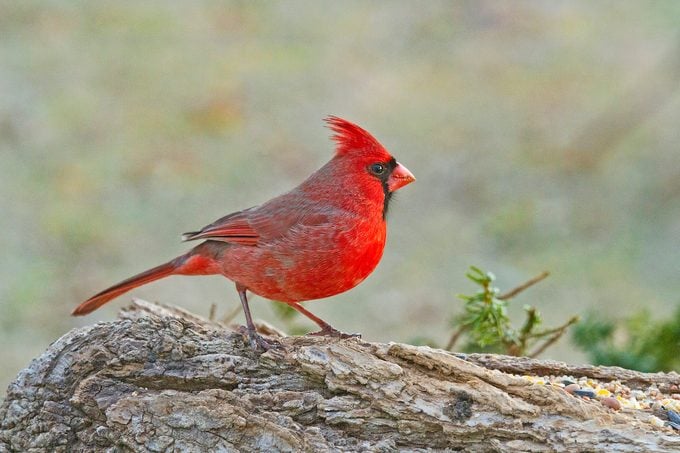
Cardinals can’t resist black oil sunflower seeds. With about a dozen bird feeders scattered about the yard that we keep keep busy filling them with sunflower seeds.
It is a delight to watch cardinal mating behavior. We’ve watched the male bring his lady love to a suet or seed feeder and daintily offer her seeds. Once a deal is struck, the female goes to work on a nest, usually in thick brush between three and ten feet off the ground. Surprisingly, lat year female nested in a rosebush about eighteen inches off the ground.
Cardinal eggs
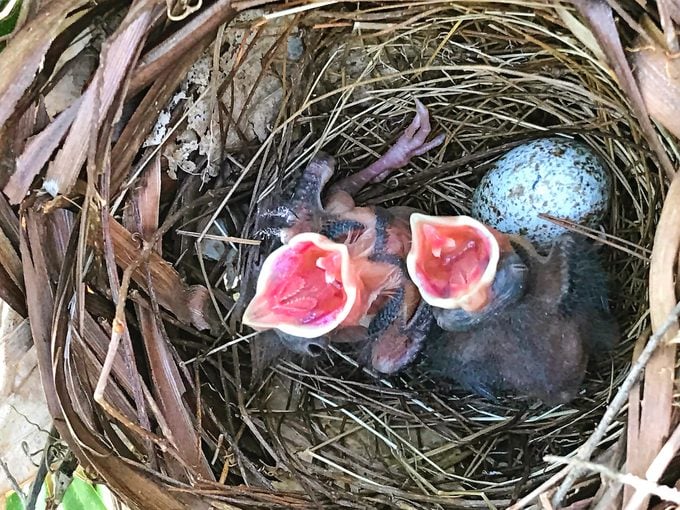
Young cardinals
Amazingly, the parents coaxed the young ones out of the nest at eleven days, long before they could fly. The little guys fell to the ground where the parents helped them scurry to safety under a low-growing scrub. Over the next couple of days they got flying lessons. Had we had a greedy cat, they’d have met a sorry end.
A common call is a shrill “Cheater, cheater, cheater!!”
Range maps provided by Kaufman Field Guides, the official field guide of Birds & Blooms.
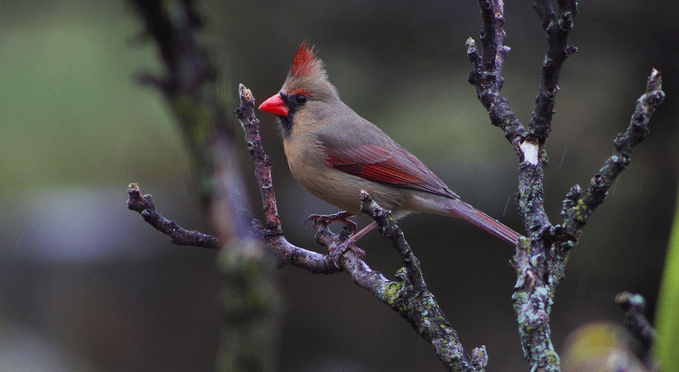
Did You Know: There are some regional variations in the species, especially in the Southwest and Mexico. Some scientists suggest that cardinals in the Sonoran Desert might be a different species from those found elsewhere in the United States, despite their proximity to northern cardinals in other southwestern deserts. Cardinals in the Sonoran Desert are somewhat larger, with longer crests, and the males are a paler red color. They also have slightly different songs.
Northern cardinals are territorial during breeding season.
The roles among cardinals are clear. As resident birds, males establish and defend their territory through song—though they cross borders when food is scarce in the fall and winter. “This is when you see a lot of cardinals at your feeder together,” David says. Otherwise, “each pair owns a territory and generally keeps the others out.”
Birds & Blooms reader Mark Bolinger counted as many as three dozen cardinals at one time in his yard last winter, a mix of males and females. “Is this normal?” he asks.
Birding experts Kenn and Kimberly Kaufman explain, “Northern cardinals are flexible in their social behavior. During the breeding season, each pair is very defensive of their own territory, driving away other cardinals. But in fall, after breeding season ends, they become more tolerant of others. A flock may begin with a pair and their offspring from that year, and then other neighboring families may join them, concentrating where the most food is available. Cardinal flocks with as many as 100 birds have been reported, but these are rare, and gatherings of six to 20 are more typical. Your flock of three dozen was bigger than average.”
One fascinating northern cardinal bird fact—according to the Cornell Lab of Ornithology, cardinals are among the female North American songbirds that sing. They often do so while incubating their eggs to communicate to their mate to return with food for their family.
Female cardinals will also sing back and forth to reinforce pair bonding early in the breeding season.
Males sing at least nine months a year. Only during the deepest of winter months do they take a break from singing.
Cardinals sing more than 24 different songs. The most common is “What cheer! What cheer! What cheer!” Also listen for a repetitive pew, pew, pew, pew song. A cardinal’s call sounds like a high-pitched “chip!”
Bird songs provided by the Cornell Lab of Ornithology.
Cardinals Eat Seeds From Bird Feeders
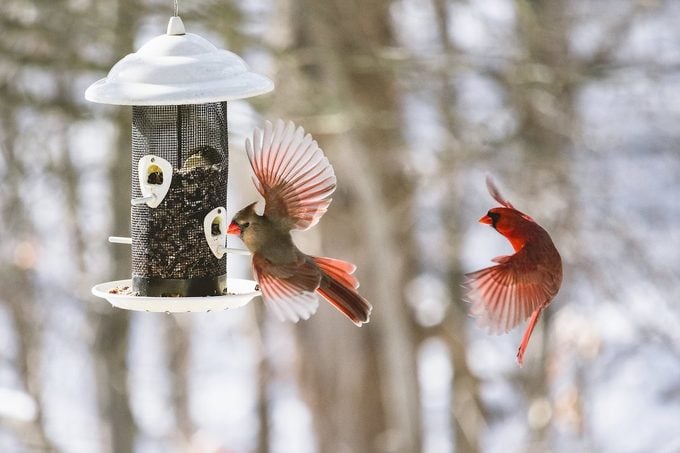
Female and male cardinal at a tube bird feeder
Attracting cardinals to your backyard feeding station is simple. Try a tube feeder or a tray feeder with large seeds such as sunflower or safflower, or sprinkle these seeds directly on the ground for cardinals to forage. They also devour dark-colored berries such as mulberries and blueberries.
Cardinals generally stay in the same area, which helps get a jump-start on nesting, with some laying eggs by February. For their first nests in early spring, cardinals often choose the protection of evergreens. This long breeding season allows for multiple broods each year and ensures the survival of at least a few offspring. Cardinals aren’t too particular when it comes to nest location, and this generalist approach makes them susceptible to predation.
It takes three to nine days for a cardinal pair to build a nest, with the female cardinal doing most of the work. She lays three to four whitish-gray cardinal eggs with brown speckles in a nest of twigs and grasses hidden in a dense tree or shrub. Compared to other birds, their nests are low, only 4 to 8 feet off the ground.
The male cardinal bird dad stays near the nest. “Males become active parents when chicks hatch,” David says.
Young baby cardinals are pretty demanding—in the first days after they hatch, their parents feed them up to eight times an hour!
About 20% of mated pairs separate each year; however, most cardinal couples stick together for several breeding seasons. During the winter they are not as attentive to each other, and often feed separately.
I live in a biome of extreme Northwest Louisiana. Ten months of the year, the weather is reasonably moderate. Winter assails us with a few frosty days, tantalizes the kiddies with an occasional impotent attempt at snow, and a rare, unwelcome ice event that deprives us of power, schools, and the robs the public of its ability to drive.
One memorable winter, we got six inches of ice. Bud drove the two of us to work in his Jeep, so we weren’t too much disfurnished. Mother is terrified of ice, so she moved in for the duration. The power and internet were off as expected. School was canceled so my kids were iced in with Mother. None of them were happy. Mother occupied herself by supervising them in the constant fetching of firewood and futilely trying to make the unmotivated kids do chores., reasoning it would be a nice surprise for us to come home to a spotless house. Indeed, it would have but not surprisingly, the lazy lumps didn’t share her vision. Her disappointment and their resistance grew each passing day.
Mother is cold-natured, so her firewood needs were extreme. She kept the temperature above eighty as much as possible. Frustrated at her demands, the unhappy, overheated kids escaped to their rooms where they threw the windows open. When not obsessing with keeping the home fires burning, Mother busied herself with cooking, though the kids were perfectly willing and capable of fending for themselves. Mother was confused by the variety and scope of my well-stocked pantry and gravitated toward combining multiple unrelated, easy choices. Her bizarre menu one lunch consisted of chili, fish sticks, and a tomato and okra combo she dubbed “gumbo,” despite the fact it contained no spices, chicken, sausage, or shrimp. The kids were repulsed and Mother judged them.
Time dragged for the prisoners. One the evening of day four, the street was slushy but well-trafficked. The kids suggested Mother could make it home. Irately, she refused. “I’d slide in the ditch. Besides, l’m out of firewood!” On day five, though the street was totally dry, Mother’s car tires were still encased in six inches of pristine ice. It wasn’t going anywhere.
Day six was balmy. As I pulled in the driveway, I was amused to see the kids industriously breaking up the ice behind Mother’s tires. I pitched in to help free it. I backed it out for her so she could head home. Coincidentally, Bud met her driving toward her house about twenty mph at the head of a long line of frustrated drivers.
I have been MIA for a couple of weeks. I’ve been having my house updated and had no space or heart to work. Thank goodness, it’s done, so I’m back with a lighter heart and wallet. The next time this house gets work, it will be the kind d’s problem.
We lived nextdoor to a charming toddler for a while. I believe she got the personality quotient intended for the entire family. Abby and her parents came over for coffee with us one morning. I opened my pot and pan cabinet and gave the tiny girl full access, much to her delight. Armed with a sippy cup of milk, a bowl of vanilla wafers, and a couple of wooden spoons, she set to, making a mess of the cookies and milk stirred into the pots. Her tidy mom was appalled at the mess but we hadn’t had a baby playing on our kitchen flooring a long time, so we enjoyed it.
Abby banged the pots and made a destroyed the snacks. When satisfied with her work, she took a long, hard look at the wooden spoons in her possession. With renewed purpose, she examined the larger spoon, toddled over to her mother and shook the spoon in Mom’s face.
Giving her mom a hard look, Abby gritted her teeth, shook the spoon at Mom, and pronounced sternly,” I’m SICK!” Immediately, she stepped up her aggression, “I meat it!” (I mean it!)
Her mother was mortified at Abby’s mimicry. We didn’t even try to explain away our laughing at the toddler’s behavior. We let her take the spoon home with her, figuring it might even the odds.
My son John was never an exemplary Sunday School student. Like me, he’d use any excuse to avoid it. He plunked down in the car, giving his Sunday School Book a dramatic sling one Sunday when he was seven or eight years old.
“I’m not going back to Sunday School any more!” he spouted emphatically. “Miss Mary Beth molested me in front of the whole class!”
I knew he had to be slaughtering the language. “I’m sure Miss Mary Beth didn’t molest you in front of the class. Exactly what did she do?”
“She made me read a Bible verse that had a lot of hard words.” he sputtered, disgusted.
“Well, I know that was aggravating but that’s not molesting.” Then I explained.
When me an’ my brother Jim was boys, we heard they was gonna be having a camp-meeting at one of them snake-handlin’ churches up in the hills. Now we didn’ want nothin’ to do with snakes, but we thought it might be interestin’ to stir them church folks up a little. We slipped out with the Rascoe boys an’ caught us up some cats an’ a dog or two an’ had’em in tow sacks. We slipped up on the back side of the church an’ climbed up, pullin’ them bags behind us. With all that singin’ and testafyin’, and speakin’ in tongues, them church folks couldna’ heard the devil comin’ up the river in a sawmill, so we didn’ have a bit o’trouble once they got started. Them folks was naturally doin’ some carryin’ on!
Well, we give’em time enough to get to really git serious about their religion before we turned them dogs and cats loose on ‘em. Them cats tore outa’ them sacks, like their tails was on fire, screechin’ and spittin’, with them dogs right behind ‘em. Some of ‘em ended up bustin’ right up in the middle of them snake-handlers. I mean to tell you, they threw them snakes down an’ they all run outside screamin’ an’ carryin’ on about the rapture. You wouldn’a thought anybody that messed with snakes would’a got so stirred up about a few dogs and cats!
Everything Smells Just Like Poke Salad is available on Amazon. To purchase, click on link above or image to right. Please be kind enough to leave review.










 Nutsrok