Andrew and Molly Part 10

Aggie lived up to Molly’s first impression, a terse and demanding taskmaster.  She worked Molly hard, setting her to bread-making, sausage making, washing and ironing. Then came the spinning and weaving.  No wonder Master Wharton hadn’t been concerned, knowing he had an expert in house. From the wool not needed by the house, the master sold her blankets and yarn for good prices, earnings they shared. When Molly looked discouraged at her tasks, Aggie was quick to remind her “Idle hands are the devil’s workshop.”  It seemed Aggie begrudged her even a breath of fresh air at the back door.  

Aggie was kind enough to give her a blanket and some mattress ticking for their lodgings in the barn, for which Molly was very grateful. Nights buried up only in the hay would have been very uncomfortable.  Covers over and under hay proved a great boon.  Aggie also gave her some of her fine homespun for drawers and petticoats. Molly was trying hard to like her, but found it hard going when Aggie abraided her for clumsiness or ignorance at her new tasks. Molly found little in the dour woman to recommend her beyond her gifts. 

Despite her taciturn nature, Aggie began to share a few bits of their life before coming to Jamestown.  Learning they’d lost three children to a fever in one week made Molly more understanding of her distance and left her feel more warmly toward Aggie, though she never broached a personal remark, expecting a rebuff.  Master Wharton never interfered in the running of the house, only advising if there would be a guest for dinner or an order for weaving.

With good food, both Molly and Andrew filled out.  With the hard work of timbering and farming, Andrew’s muscles bulged.  He enjoyed the days working with the voluable  Bartles.  Master Wharton sometimes joined them at their tasks, swinging an ax or harvesting tobacco. In the late afternoons, they spent a couple of hours at the forge.  

After a few tries, Andrew was turning out the precious nails and learning to shoe horses. Should they finish early enough, Bartles helped Andrew a bit with the room he was constructing in the barn. Andrew used some of the first lumber to build a rope-bed for himself and Molly.  The straw-stuffed ticking and blanket finished off a fine bed, soon to be joined by a table, chairs, and chest.  They often took their suppers and Sunday meals in their snug room. Aggie helped Molly weave a second blanket before the cold winds of winter moved in, which Molly appreciated despite her resentment.

Andrew and Molly had their Sundays to themselves attending church and socializing with others of their class, soon learning they were in a good situation.  Many indentured servants were poorly fed and abused, not living long enough to work out heir time.  

Should an unmarried bondswoman fall pregnant, she could be punished with up to thirty lashes or levied a fine of the equivalent of thirty-seven dollars, as well as have up to two hundred forty days service could be added to her time for lost work and the master could petition to have her child placed out for care.  Quite often, women were raped then punished should they become pregnant.  Should an English bondswoman give birth to a mulatto child, the punishment could be greater.

Andrew and Molly practiced withdrawal during sex, fearing pregnancy, despite the Biblical injunction against it.  Their time already looked far too long for them to chance increasing it by having a child.  Despite these precautions, a few months in, Molly’s courses were several days late.  She kept her worry to herself, not wanting to trouble Andrew unnecessarily.  One Saturday, her anxiety came to a head when she and Aggie went to the post to deliver some weaving and saw a young girl publicly flogged  for the crime of pregnancy out of wedlock.  Molly wept at the cruelty. 

When she could not be consoled, Aggie guessed the reason for her distress.  “Are you breeding?”  Molly dropped her eyes, not answering.  “I’ll make you a tea that will fix you right up.  You’ll drink a cup a day and these things won’t trouble you.  Our lives are not our own.”  

Gratefully, Molly drank her tea and bled the next day.  Every day thereafter, she had a cup of Aggie’s tea and had no more scares.  She felt closer to Aggie after that, knowing she was softer than her crusty exterior belied.

Andrew and Bartles spent their mornings laboring over the money crop, tobacco.  When John Rolfe had introduced tobacco to England, colonists had gone wild over tobacco, devoting all their efforts and land to its cultivation.  They’d nearly starved after refusing to plant food crops needed to make the colony self-sufficient, till a law was enacting requiring them to plant food crops to be added to public larder.  In addition to tobacco, they grew corn, beans, squash, pumpkins, yams, and several other vegetables.  They raised, cows, pigs, goats, and sheep as well as availing themselves of game and fish to enrich their diet.  In the afternoons, they cleared timber, always leaving some time for blacksmithing.  Soon Andrew was turning out the priceless nails, latches, hinges, and horseshoes colonists were desperate for.  Bartles confided his own share from the sales would soon be sufficient to set himself a forge and smith when he worked his time out.  Andrew should have skill enough by the time he left to take over.  They always saved a little time back to work on the room Andrew was framing up in the barn for himself and Molly, even knocking together a table, benches and rope bed.  They took their meals alone in their home on Sundays. 

Though Jamestown was not established on the principles of religious freedom, it was assumed colonists would attend Anglican services, the established English religion.  Andrew and Molly eagerly attended, using the opportunity to mingle with other indentured servants, learning they were fortunate in their master.  Starting out as a bondsman was no impediment to moving up socially once a servant worked out their time, but they wouldn’t have expected to socialize in the homes of colonists.  Unfortunately, disease was rampant and conditions so harsh, that almost half died before working out their time.

Unlike slaves who had also been transported to Jamestown, indentured servants did have rights and could appeal to the legal system, though it was most often relatives who appealed successfully on their behalf.  They had no say in who indentured them, could be beaten, and earned no wages nor could they marry without the master’s consent. 

Though they weren’t free, they had a good master and the last year of Bartles and Aggie’s service passed quickly.  The two would be soon moving to twenty-five acres where Bartles and Andrew had built a cabin with an outbuilding that would serve as a blacksmith shop and barn.  The barn and smithy were much more commodious than the cabin, since they were necessary for their livelihood.  The twelve by twelve foot cabin could be expanded at any time.  For the present, it was tight and sufficient to their simple needs with its fireplace stretching half-way across one end, its rope bed, a table with benches, and a chest for linens.  A couple of shelves held a few crocks and pots.  It would be easy enough to add rooms with the rich store of available timber.

Survival of the Fittest: Easter Egg Hunt Stories

Easter egg hunts with my cousins were a lot more like cage boxing than gentle competitions.  I had more than forty first cousins, mostly wild animals and heathens. By the time their parents herded them to the scene of the festivities, their hellions had exhausted them so just opened the car doors and all Hell broke loose.  Exhausted from defending themselves and their babies on the ride over, it was every man for himself.  God help anybody in the way,

The monstrous kids ripped through the house under the guise of needing the bathroom and a drink of water, destruction in their wake, before being cast out into the yard like demons into swine.  Actually, they were cast out onto the other cousins.  We’d get a baseball or football team going, all the big kids on one team, so the little ones never got a chance to bat, or got mowed down in football.  They’d go squalling in to their daddies who’d come out long enough to straighten us out a vague semblance of fairness, often lingering to play a while.

Once the egg hunt started, it was chaos.  It was survival of the meanest. The horrendous kids showed no favoritism between their sibligs and cousins shoving all the smaller kids down, stomping the hands of little ones reaching for eggs. The event was a melee of squalling, battered young ones, and sometimes even a few bloody noses. More than a few times they hurled eggs. My antisocial cousin, Crazy Larry, kept trying to pee on us while we were distracted by the madness.

One aunt in particular didn’t think her big kids ought to have to share at the end of the hunt, even though they’d hoarded a basketful and babies had none.

“They found ‘em!” my aunt asserted, sticking up for her devilish offspring.

It didn’t matter that she’d only brought a dozen eggs to the hunt. She resented the host confiscating her evil progeny’s bounty and redistributing them so every kid got a few, and converting most to the Easter Delight of deviled eggs.

Ah, family.  Better get busy.  I have company coming.  But not Crazy Larry.  He’s in the witness protection program.

Mother’s Garden

Mother is ninety-seven and recently moved to an independent living facility. She has happily transformed her patio into a garden, already. She is at the garden center grabbing plants every time she can finagle a ride. My sister ,Connie and her husband, Tim, built this beautiful garden box and filled it with luscious flowers. They are currently her favorite family.

She is nurturing these beauties along a trellis adjacent to her patio. Mother had a lush garden at her little cottage before she moved here but I do believe she’s gone over the edge now.

Sadly for my budget, I inherited her obsession. I am on my way out now to put out hydrangeas and petunias.

Grace

https://youtu.be/ciVLxDy-YMQ?si=eJMmENre0IFtD0Xx

Follow this link to hear Jim McCan perform “Grace.”

Getting Ready for the Majors

This is my nephew, Henry, an avid baseball fan.

Fascinating Cardinals

Cardinals can’t resist black oil sunflower seeds. With about a dozen bird feeders scattered about the yard that we keep keep busy filling them with sunflower seeds.

It is a delight to watch cardinal mating behavior. We’ve watched the male bring his lady love to a suet or seed feeder and daintily offer her seeds. Once a deal is struck, the female goes to work on a nest, usually in thick brush between three and ten feet off the ground. Surprisingly, lat year female nested in a rosebush about eighteen inches off the ground.

Cardinal eggs

Young cardinals

Amazingly, the parents coaxed the young ones out of the nest at eleven days, long before they could fly. The little guys fell to the ground where the parents helped them scurry to safety under a low-growing scrub. Over the next couple of days they got flying lessons. Had we had a greedy cat, they’d have met a sorry end.

A common call is a shrill “Cheater, cheater, cheater!!”

11 Fascinating Northern Cardinal Bird Facts

By Kelsey Roseth and Ken Keffer

Updated On May 03, 2024

Range maps provided by Kaufman Field Guides, the official field guide of Birds & Blooms.

Did You Know: There are some regional variations in the species, especially in the Southwest and Mexico. Some scientists suggest that cardinals in the Sonoran Desert might be a different species from those found elsewhere in the United States, despite their proximity to northern cardinals in other southwestern deserts. Cardinals in the Sonoran Desert are somewhat larger, with longer crests, and the males are a paler red color. They also have slightly different songs.

Meet the 3 types of cardinals in North America.

Are Cardinals Territorial Birds?

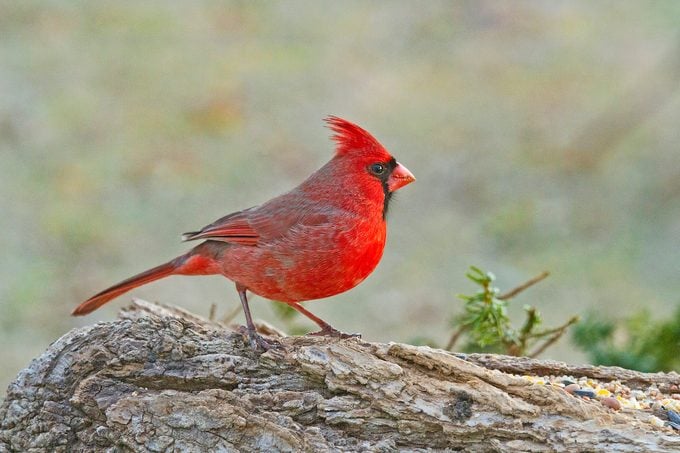
cardinal bird
Male cardinals are very vocal songbirds.

Northern cardinals are territorial during breeding season.

The roles among cardinals are clear. As resident birds, males establish and defend their territory through song—though they cross borders when food is scarce in the fall and winter. “This is when you see a lot of cardinals at your feeder together,” David says. Otherwise, “each pair owns a territory and generally keeps the others out.”

Birds & Blooms reader Mark Bolinger counted as many as three dozen cardinals at one time in his yard last winter, a mix of males and females. “Is this normal?” he asks.

Birding experts Kenn and Kimberly Kaufman explain, “Northern cardinals are flexible in their social behavior. During the breeding season, each pair is very defensive of their own territory, driving away other cardinals. But in fall, after breeding season ends, they become more tolerant of others. A flock may begin with a pair and their offspring from that year, and then other neighboring families may join them, concentrating where the most food is available. Cardinal flocks with as many as 100 birds have been reported, but these are rare, and gatherings of six to 20 are more typical. Your flock of three dozen was bigger than average.”

Do cardinals eat suet from bird feeders?

Both Male and Female Cardinals Sing

cardinal meaning and symbolism
Female cardinals sing to communicate with males.

One fascinating northern cardinal bird fact—according to the Cornell Lab of Ornithology, cardinals are among the female North American songbirds that sing. They often do so while incubating their eggs to communicate to their mate to return with food for their family.

Female cardinals will also sing back and forth to reinforce pair bonding early in the breeding season.

Males sing at least nine months a year. Only during the deepest of winter months do they take a break from singing.

Cardinals sing more than 24 different songs. The most common is “What cheer! What cheer! What cheer!” Also listen for a repetitive pew, pew, pew, pew song. A cardinal’s call sounds like a high-pitched “chip!”

Bird songs provided by the Cornell Lab of Ornithology.

Cardinals Eat Seeds From Bird Feeders

what do cardinals eat
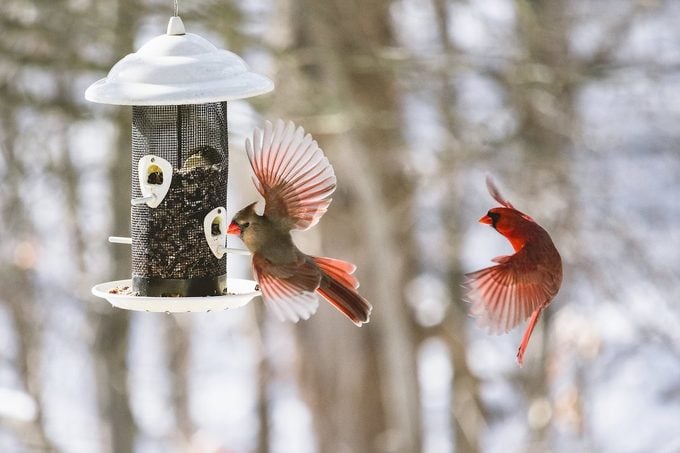
Female and male cardinal at a tube bird feeder

Attracting cardinals to your backyard feeding station is simple. Try a tube feeder or a tray feeder with large seeds such as sunflower or safflower, or sprinkle these seeds directly on the ground for cardinals to forage. They also devour dark-colored berries such as mulberries and blueberries.

Psst—here’s how to choose the best cardinal bird feeders and birdseed. Oh, and check out this DIY platform bird feeder you can make yourself to attract more cardinals to your backyard.

Northern Cardinal Nesting Habits

cardinal nest and babies
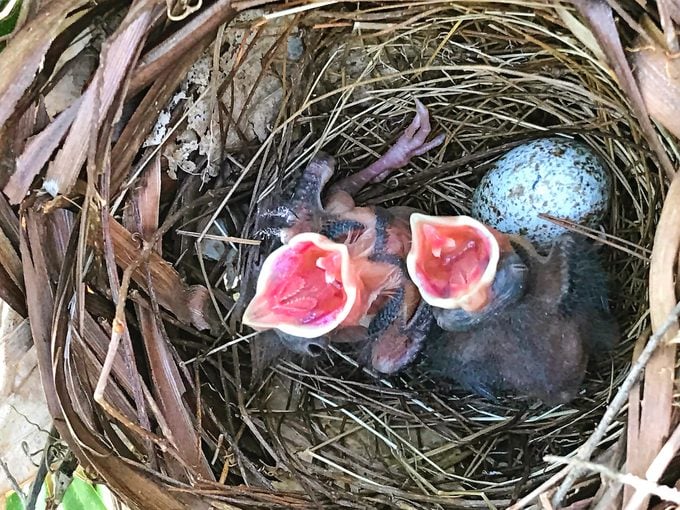
Baby cardinals and egg in a nest

Cardinals generally stay in the same area, which helps get a jump-start on nesting, with some laying eggs by February. For their first nests in early spring, cardinals often choose the protection of evergreens. This long breeding season allows for multiple broods each year and ensures the survival of at least a few offspring. Cardinals aren’t too particular when it comes to nest location, and this generalist approach makes them susceptible to predation.

It takes three to nine days for a cardinal pair to build a nest, with the female cardinal doing most of the work. She lays three to four whitish-gray cardinal eggs with brown speckles in a nest of twigs and grasses hidden in a dense tree or shrub. Compared to other birds, their nests are low, only 4 to 8 feet off the ground.

The male cardinal bird dad stays near the nest. “Males become active parents when chicks hatch,” David says.

Young baby cardinals are pretty demanding—in the first days after they hatch, their parents feed them up to eight times an hour!

About 20% of mated pairs separate each year; however, most cardinal couples stick together for several breeding seasons. During the winter they are not as attentive to each other, and often feed separately.

Weather Madness

I live in a biome of extreme Northwest Louisiana. Ten months of the year, the weather is reasonably moderate. Winter assails us with a few frosty days, tantalizes the kiddies with an occasional impotent attempt at snow, and a rare, unwelcome ice event that deprives us of power, schools, and the robs the public of its ability to drive.

One memorable winter, we got six inches of ice. Bud drove the two of us to work in his Jeep, so we weren’t too much disfurnished. Mother is terrified of ice, so she moved in for the duration. The power and internet were off as expected. School was canceled so my kids were iced in with Mother. None of them were happy. Mother occupied herself by supervising them in the constant fetching of firewood and futilely trying to make the unmotivated kids do chores., reasoning it would be a nice surprise for us to come home to a spotless house. Indeed, it would have but not surprisingly, the lazy lumps didn’t share her vision. Her disappointment and their resistance grew each passing day.

Mother is cold-natured, so her firewood needs were extreme. She kept the temperature above eighty as much as possible. Frustrated at her demands, the unhappy, overheated kids escaped to their rooms where they threw the windows open. When not obsessing with keeping the home fires burning, Mother busied herself with cooking, though the kids were perfectly willing and capable of fending for themselves. Mother was confused by the variety and scope of my well-stocked pantry and gravitated toward combining multiple unrelated, easy choices. Her bizarre menu one lunch consisted of chili, fish sticks, and a tomato and okra combo she dubbed “gumbo,” despite the fact it contained no spices, chicken, sausage, or shrimp. The kids were repulsed and Mother judged them.

Time dragged for the prisoners. One the evening of day four, the street was slushy but well-trafficked. The kids suggested Mother could make it home. Irately, she refused. “I’d slide in the ditch. Besides, l’m out of firewood!” On day five, though the street was totally dry, Mother’s car tires were still encased in six inches of pristine ice. It wasn’t going anywhere.

Day six was balmy. As I pulled in the driveway, I was amused to see the kids industriously breaking up the ice behind Mother’s tires. I pitched in to help free it. I backed it out for her so she could head home. Coincidentally, Bud met her driving toward her house about twenty mph at the head of a long line of frustrated drivers.

Hello!

I have been MIA for a couple of weeks. I’ve been having my house updated and had no space or heart to work. Thank goodness, it’s done, so I’m back with a lighter heart and wallet. The next time this house gets work, it will be the kind d’s problem.

The Delightful Mischief of a Toddler Next Door

We lived nextdoor to a charming toddler for a while. I believe she got the personality quotient intended for the entire family. Abby and her parents came over for coffee with us one morning. I opened my pot and pan cabinet and gave the tiny girl full access, much to her delight. Armed with a sippy cup of milk, a bowl of vanilla wafers, and a couple of wooden spoons, she set to, making a mess of the cookies and milk stirred into the pots. Her tidy mom was appalled at the mess but we hadn’t had a baby playing on our kitchen flooring a long time, so we enjoyed it.

Abby banged the pots and made a destroyed the snacks. When satisfied with her work, she took a long, hard look at the wooden spoons in her possession. With renewed purpose, she examined the larger spoon, toddled over to her mother and shook the spoon in Mom’s face.

Giving her mom a hard look, Abby gritted her teeth, shook the spoon at Mom, and pronounced sternly,” I’m SICK!” Immediately, she stepped up her aggression, “I meat it!” (I mean it!)

Her mother was mortified at Abby’s mimicry. We didn’t even try to explain away our laughing at the toddler’s behavior. We let her take the spoon home with her, figuring it might even the odds.