Twenty-Seven Biscuits

image imageMother made twenty-seven biscuits for breakfast most mornings. The number wasn’t intentional; that was just how it worked out.   Her recipe wasn’t measured, just experience.  She started out by hollowing out a hole in the flour in her big biscuit-making bowl into which she plopped out shortening scooped by hand straight from the eight pound can and poured in an indeterminate pool of fresh cow milk.  Bravely plunging her right hand in, she squished the glob of shortening through her fingers, working it round till it gathered just enough flour.  She worked the dough carefully, never using all the flour,  thereby letting the gooey mixture adhere to the bottom of the bowl. I thought that looked horrible and never mastered the age-old biscuit making technique that had probably come to her through many generations.

Once she was satisfied with her mix, she tossed it a time or two to coat with flour, and started pinching off biscuits, which she gave a quick roll or two in her hands before placing smooth side up on her biscuit pan. Finally, she buttered the top of each so they’d brown nicely and popped them in the hot oven.  About twenty minutes later, biscuits!  She always ended up with twenty-seven, though she never measured.  They were wonderful.  The flour-filled biscuit-bowl was covered and went back into the cabinet till the next baking, which would be supper if she didn’t make cornbread.
I am a biscuit-making coward.  I measure and mix my ingredients in a bowl, dust them with a handful of flour, then pinch them off and roll them out in my hands.  I spray them with cooking spray rather than dipping a spoon in melted butter to butter the tops, but they are still pretty good. 

Age-Old Biscuit Recipe 

(Can be easily doubled or tripled)

Preheat oven to 420 degrees

2 ½ cups self-rising flour (For plain, add 1 ½ teaspoon baking powder and ¼ teaspoon salt PER cup)

½ cup vegetable shortening or softened butter

¾ cup milk (I prefer undiluted fat-free evaporated canned milk.  Note:  this is not the sweetened condensed kind that goes in desserts)

Cooking spray

Mix 2 ¼ cups self-rising flour with shortening or butter.  Stir in up to ¾ cups milk to make gooey, not drippy dough.  Should be about the consistency of mashed potatoes.  Use remaining ¼ cup to dust top of dough, turn dust again.  Pinch out small handful, about ½ cup and roll a time or two in your floured palms.  Turn best side up on greased baking pan.  Spray tops with vegetable or butter spray to enhance browning.  Bake at 450 for 12-15 minutes on center rack. Done when tops are starting to brown nicely and browning can be seen around edges.  Should yield 8-10 biscuits.

These can be rolled out on lightly floured surface and cut with a biscuit cutter if you prefer.  Don’t waste leftover dough.  Roll into strips, butter and sprinkle with cinnamon sugar and bake for five minutes.  Wonderful treat.  I have made entire batch into cinnamon sugar strips for a treat.  Watch carefully to keep from burning.

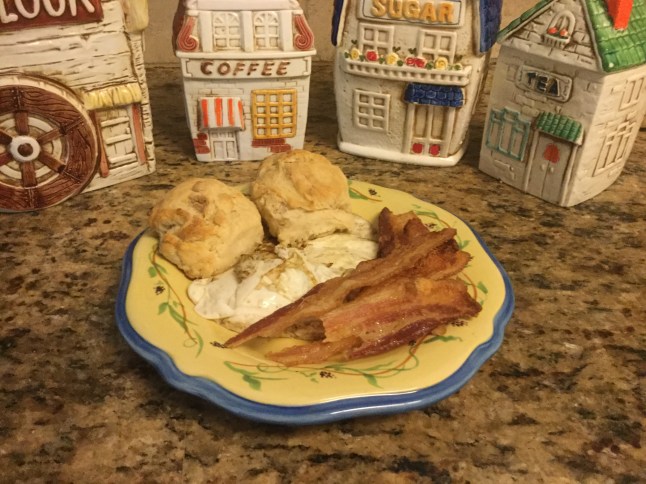
If you can stand the health risk, put your bacon in on a rack on a cookie sheet to bake on at the same time as your biscuits.  It will all come out perfect at the same time.

If you have leftovers reheat in microwave or slice in half, butter, and toast under broiler.

The previous part of the story was the easy part.  We lived on a farm.  There were five of us children ranging from thirteen to newborn.  From my earliest memories, Mother had to be up by five-thirty to get the biscuits in.  The cow would be bawling to be milked by six.  Daddy never milked.  He said the Bible said a man couldn’t take what he couldn’t give.  He never quoted the chapter and verse, but he knew it was in there.  The Bible said a lot of stuff that worked to suit him, but that’s a story for another day.

Anyway, Mother had to milk at six and get back in the house to have breakfast on the table and get things moving before the babies got up and the big kids got on the schoolbus.

That must have been so hard for Mother having to be up and out so early.  I was grown, caring for my family before I understood how hard.


Love at First Sight

Describe an item you were incredibly attached to as a youth. What became of it?

It was true love when I found this little guy under the Christmas tree. He was my constant companion. He was part of every game, sat on the chair with me while I ate, and slept with me. I even sneaked him into the bath with me, a hard lesson since it took him a couple of days to dry on the clothes line.

He tragically went missing one day. My search was futile. I moved on. Long afterwards, I found his tattered remains in the yard where the dogs had destroyed him. My heart broke all over.

The Mystery of the Monogram on a Toilet Seat

My mother often said, “If you have kids, you can’t have anything else.”  Well, she was wrong.  We had a new toilet seat.  After installing it, Daddy looked around, stared us down, and threatened.  “I’d better not see anybody’s initials on this seat!”  Where did that come from?  I’d never heard of anybody putting initials on a toilet seat.

I went about my business, that toilet seat and  initials, foremost on my mind.  I wrote LDS in my “Night Before Christmas” book, LDS in the sand under the big shade tree, scooped up some mud and wrote LDS on the dog house. Still unsatisfied, I heated the ice pick on a stove burner and burned LDS on a green Tupperware tumbler.

Feeling strangely unfulfilled and restless, I couldn’t think of a thing to do.  Billy was off somewhere playing with Froggy.  Mother and the baby were taking a nap, so if I stayed in the house, I had to be quiet.  I slipped in the kitchen to see if there was any Kool Aid miraculously left in the pitcher.  No luck. Dejected, I went to the bathroom.

There it was calling to me, pristine in its unblemished beauty.  The new toilet seat!!!  I sat down, my bare bottom luxuriating in its cool smoothness. I got up, locked the door, and turned the seat up. Making sure no one was looking through the window, I got Mother’s eyebrow pencil out of the medicine cabinet and wrote LDS in tiny letters where no one would ever see it.  Terrified, I erased my crime.  The finish was dull from pencil smears. My heart pounded!  I was caught!  I got tissue and buffed it off.  Thank goodness the shine was back.  Relieved, I sat on the side of the bathtub to catch my breath.  A nail fell out of my pocket and clattered to the bottom of the tub.  Never has the devil so possessed a soul.  Grasping the nail, I scratched BRS, Billy’s initials, on the toilet seat.  Horrified, at the enormity of my crime, I tiptoed past the room where Mother and the baby still slept.  By this time, Billy and Froggy had gotten back.  We were throwing mud balls at each other when I heard a shriek from the house.  “BILLY RAY SWAIN!!  You come here this minute!”  I didn’t need to go in to know what was wrong.  I heard “Spat! Spat! Spat!” and in a few minutes he was out, still snuffling.

“What happened?”

“Mother whooped me for putting my initials on the toilet seat. I told her I didn’t know how to write but she said, ‘Who else would put your initials on the toilet seat?’ “

How long could it be before she found the Tupperware?

The Good in the Boogerman

I was tantalized by the occult when a child, Naturally, since I was raised by a good Southern Baptist mother, I was deprived of as much supernatural exposure as Mother could manage. Fortunately, Daddy’s mother was extremely superstitious.

It goes without saying, Mother would never contradicted her to her face. Sometimes when Mamaw had a gaggle of grandchildren running wild around her, she’d launch into a ghost story, usually purported to be true. The wild grandchildren would immediately settle down at their mother’s knee to listen, enchanted and big-eyed with belief

Mamaw petrified us with tales of ghosts, spirits, deranged ax-murderers, boogermen, and bodies found in wells, totally unconcerned about the nightmares she was inspiring.

As soon as she could, Mother initiated damage control. “There are no ghosts or Boogermen!”

To this day, I don’t know why Mother took that stand, considering the good effect fear of ghosts and the boogerman had on those wild kids. Mamaw knew exactly what she was doing.

Sing at the table

Sing in the bed

Boogerman’ll git you

By the hair of the head!

Wheels

By the time I was in second grade, it seemed like all the town kids had bikes. I was wildly envious of them parking their bikes as I stomped off the bus like the clodhopper I was. Fortunately, bikes were off limits on the playground so I didn’t have to feel deprived about that.

Of course, as Christmas approached, I started in on Mother. I knew just what kind of bike I wanted, a blue Schwinn Spitfire. A realist, Mother let me know I definitely wouldn’t be getting a bike.

“Can’t Santa bring me one?” I asked.

“No, parents have to help pay for the things Santa brings. We don’t have the money.”

That cleared up all my questions about Santa Claus. I wanted to stamp my foot and say “Darn!” but I knew better.

Angola: Fact and Fiction

Plentiful stories about the prison have cemented misunderstandings

Published: June 1, 2020
Last Updated: June 1, 2023 

Angola: Fact and Fiction
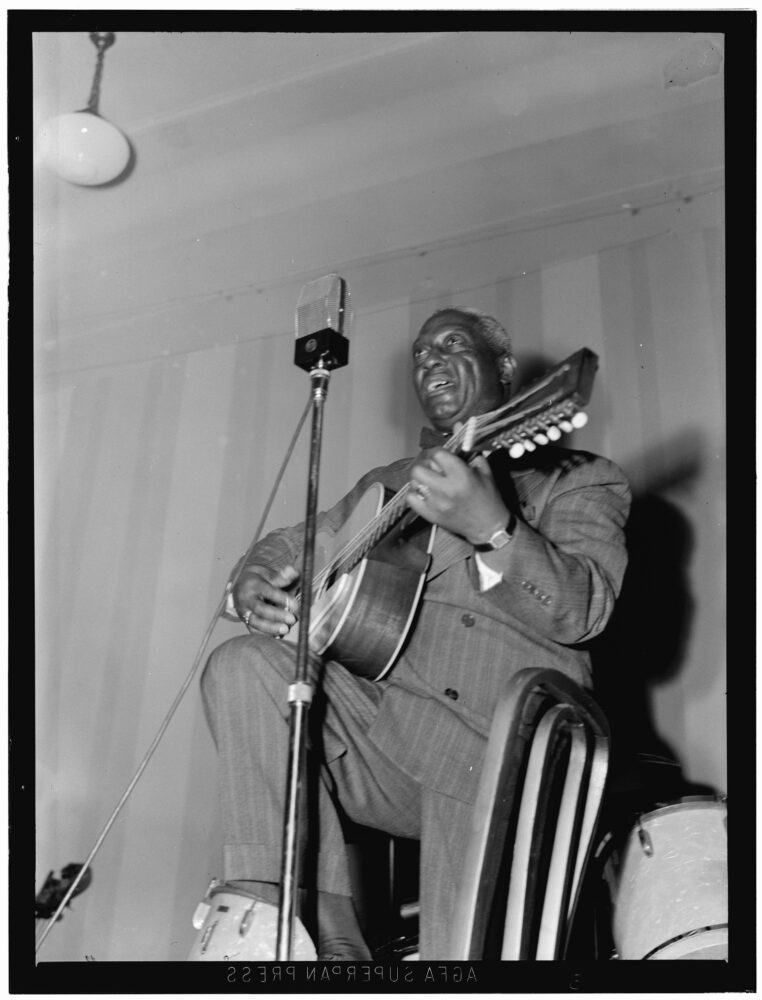
PHOTO BY WILLIAM P. GOTTLIEB, LIBRARY OF CONGRESSHuddie “Lead Belly” Ledbetter, pictured here performing at the National Press Club ca. 1938, didn’t need to sing his way out of prison—just to wait for time off for good behavior.

The Louisiana State Penitentiary is so infamous it doesn’t even need to use its real name: the prison is almost universally known as Angola, after one of the four plantations on which it was built. Over its century-plus of operation, Angola has come to occupy a complex place in the state’s history and culture, with myths and misunderstandings weaving themselves into the true stories of the prison’s history. Here, we present thumbnail clarifications of three of the most commonly repeated inaccuracies about Angola’s history. (The well-known, horrific stories of Willie Francis, who survived the electric chair only to be taken back and executed a few months later, and the prisoners who cut their own Achilles tendons in protest of conditions at the prison do not appear below, because these stories are true.)

The name Angola was given because of the origin country of many of the enslaved people who worked the original plantation.

This is inaccurate for a number of reasons. Angola, on Africa’s southern Atlantic coast, was a major source for slave traders, but as part of the Portuguese Empire, it tended to supply enslaved laborers to Brazil, also a Portuguese possession, with North American shipments restricted primarily to Charleston and Savannah in the years after the American Revolution. Even given the possible importation of enslaved Angolans to Louisiana though, the legal transatlantic slave trade was quashed in the early 1800s, with the US Congress legislating a total ban on international slave trading in 1808. Plantation owner Isaac Franklin did not purchase the properties later consolidated as “Angola” until the 1830s, by which point the American slave trade, in which Franklin made his initial fortune, was essentially all domestic. Franklin referred to one of his plantations as Angola, though Angora, an old rendering of Ankara in Turkey, also shows up in contemporary records; both names reflect a trend of naming plantations after faraway lands, real or imagined. (Franklin also owned Killarney, a neighboring property named for a town in Ireland, and Loango, a plantation presumably named for the major slave trading port located in what is now the Republic of Congo.) By 1880, surviving documentation all reflected the name “Angola” familiar today.

Lead Belly sang his way out of prison.

The story speaks to Louisiana’s conception of itself: whatever sins we may commit, our love of music unites us—and redeems us, to an extent. The legend goes that Huddie Ledbetter, universally known as Lead Belly, was incarcerated at Angola but sang so movingly to the governor, or sang in the governor’s presence, or wrote such a beautiful song, that O. K. Allen pardoned him. Repeated in contexts as august as Dr. John’s patter introducing the cover of Ledbetter’s “Goodnight Irene,” often cited as the song that melted the governor’s heart, this story is so widely believed that it’s the one thing people know who know nothing else about Lead Belly.

Alas, the truth is significantly less poetic: Ledbetter got time off for good behavior. Louisiana law provided for prisoners who had behaved in accordance with prison policies to be released early, with the important caveat that if they reoffended within the state, they would have to finish their commuted sentence for the first crime before beginning any sentence for the next. Ledbetter’s was one of six commutations signed on July 20, 1934, and one of 179 in the whole year, for crimes including murder, manslaughter, shooting at a dwelling, and carnal knowledge—such commutations were common enough to be essentially routine. Lead Belly’s music, cherished as it is, didn’t soften a governor—but it didn’t need to.

Outlaw and jailbreaker Charlie Frazier was welded into his cell.

Charlie Frazier was the most common of the various names under which one of the most prolific outlaws of Depression-era Louisiana was arrested—and the one associated with another Angola myth. Frazier, a stick-up artist in the Bonnie and Clyde vein, was a key figure in a 1933 jailbreak that shocked the Angola and Louisiana powers-that-were. This jailbreak did lead to the first cellblock being built at Angola, with the new Red Hat building (named for the red-painted straw hats worn by inmates) serving as a stricter adjunct to the barnlike dormitories that had housed all inmates before the escape. While Frazier was ultimately captured in Texas and slung into one of the new cells in 1936, it wasn’t welded shut for the simple reason that Frazier had to be taken to trial in St. Francisville for charges related to the deaths of Camp E Capt. John Singleton and foreman James W. Fletcher, Angola employees, and trusty guard Arnold Davis, all of whom were killed in the jailbreak. Newspaper reports and Frazier’s prison record reveals that he was almost immediately put back in the “red cap line,” at Camp E, from which he had escaped in 1933. Capt. C. C. Dixon, a long-time employee whose descendants also worked at the facility, was remembered as the only person Frazier would speak to after his rearrest; Dixon never corroborated the lurid but unlikely detail of the welded cell. For men used to the dormitories, the cells may have felt welded shut, but the jailers never literally threw away the key.

Marianne Fisher-Giorlando is a professor emerita at Grambling State University and the outside researcher for the Angolite, the inmate-edited and -published magazine of the Louisiana State Penitentiary. Chris Turner-Neal is the managing editor of 64 Parishes.

Nostalgic Christmas Gifts: A Tricycle Story

I got a bright shiny, red tricycle like this one might have looked the Christmas of 1953. My older sister got the big kid version. It had a gigantic front wheel and step for an additional rider. That was fortunate, since in the manner of three-year-olds everywhere, I carelessly abandoned it where I finished riding, right behind the back tire of Daddy’s truck.

Of course, he backed over it, destroying it. Naturally, it scared the pudding out of him. In the manner of 1950’s parents, he wore my behind out for scaring him and making him ruin my tricycle. That was a wasted lesson. He’d already demonstrated what a truck did to a tricycle. To make it worse, the smashed tricycle lay near the front gate for a while before hitting the trash.

Fortunately, my sister let me ride behind her all over the yard. When she was otherwise occupied, I appropriated it and propelled it like a scooter. I remembered my previous lesson and didn’t park it behind Daddy’s truck.

In the prosperous days before my parents indulged begetting, we got bigger Christmas gifts. One memorable Christmas, I got a Radio Flyer Red Wagon, my second set of wheels. I convinced my parents to let me bring it to my uncle’s house on Christmas Day. My cousin and I got one unforgettable ride down a steep gravel road narrowly missing plunging into a deep creek before it occurred to my parents to set limitations on its use.

Fortunately, my precious red wagon wasn’t damaged.

Payin’ for My Raisin’

I used to hear that phrase a lot when I messed up as a kid. “You’re gonna have to pay for your raisin’.” Truer words were never spoken. At ninety-six, my mother lives quite happily in an independent living apartment. Well, she should be happy. She has friends, eats three meals a day in the dining room, has her apartment cleaned, and her laundry done. The only thing she does is make her bed.

This morning, I picked Mother up at nine am for her doctor’s appointment. I drooped her off right at the entry, parked the car, and escorted her to the office, got her seated and checked in.

“How long till they take us back?” she asked.

“Probably not long.” I told her. “We’re a few minutes early.”

“I hope not.” she grumbled. “It’s cold in here.”

They called her in at nine-thirty on the dot, her appointment time. “Right on time.” I said. “That’s good.”

They weighed her, took her to a room, and checked her vitals. A very nice medical assistant took her medication list and history. “I’ll be back to take you for a scan. she told Mother.

“I hope she gets right back. There’s no point in keeping me waiting. What else does she have to do?” Mother complained.

The woman was back in seven minutes. “I’m sorry you had to wait. I had two ahead of you.” she explained. She took Mother’s arm, carefully walking her to the scan. I relaxed, looking forward to checking my email while Mother was occupied. It seemed like they were back in less than five minutes.

“I’ll tell the nurse you’re ready.” the assistant said.

“How long will that nurse be?”Mother queried before the door closed.

“I don’t know. You saw the office was full. Maybe it won’t be too long. “ I said.

“They ought not to book so many.” She was kind of crabby. I reminded her she only has this big check up yearly and has to have a lot done. Last year we were here three hours.

“It will take as long as it takes. We’ll go to lunch when we’re done.” I reminded her.

“I’m already hungry. Oh yeah. I have to take my medicine!” She dug through her jacket and pants pockets fruitlessly. “Dern, I don’t have it. What’s gonna happen if I don’t get it on time? I’ve never been late before.”

That was news to me. I could have sworn we’ve been through this dozens of times.

“Mother, look again. I’m sure you have it. There it is! You can get a cup of water when the nurse comes in.” No such luck. I had to ask for a cup of water.

We waited. Mother fussed. “Where is that nurse? Did she go off to lunch and leave me waiting?” Mother is not usually fussy but she was wound up today.

“Mother, they have a lot of staff here. I’m sure they don’t go off and leave you waiting. They’ll be here when they get here. We just have to wait.” I tried to sound patient.

At eleven, the nurse saw Mother,and broke the news it would be a short wait till she could see the doctor as well as have an xray and go to lab. Mother smiled sweetly. When the door closed, I braced myself.

“We’ve been here forever. I’m ready to go!” She spouted.

“Well, we can’t till we’re done.” I told her. By noon we were out the door. Can you imagine how many times Mother lived through this scenario with five children?

The Sad Saga of the Beakless, Tailless, Gizzard-bobbing, One-leg Hopping chicken

Being a farm kid is not for sissies and cowards. The dark side of the chicken experience is slaughtering, plucking, cleaning, and preparing chickens for the pot.  I watched as Mother transformed into a slobbering beast as she towered over the caged chickens, snagging her victim by the leg with a twisted coat-hanger, ringing its neck and releasing it for its last run.  We crowded by, horribly thrilled by what we knew was coming.  It was scarier than ”The Night of the Living Dead”,  as the chicken, flapping its wings, running with its head hanging crazily to one side, chased us in ever larger circles until it finally greeted Saint Peter at the Pearly Gates.  It looked horribly cruel, but done properly, a quick snap of the wrist breaks the chicken’s neck instantly, giving a quick death. Of course, this is my assessment, not the unfortunate chicken. The chickens always looked extremely disturbed.

Afterward, my mother grabbed the dead chicken, plunged it into a pot of boiling water, plucked the feathers, slit its pimply white belly, removed its entrails, cut off its feet and head, and prepared it for dinner.  I was repulsed  when Mother found  unlaid eggs in the egg cavity and used them in cooking.  That just didn’t seem right.  I was happy to eat the chicken, but future eggs….disgusting.  It kind of seemed like genocide, or chickenocide, to coin a new term.

Mother looked out one day and saw one of her chickens eating corn, oblivious to the fact that her gizzard was hanging out, bobbing up and down merrily as she pecked corn with all her lady friends.  Apparently she had suffered injury from a varmint of some kind.  Clearly, she wouldn’t survive with this injury, so Mother and I set about catching her.  At least she could be salvaged for the table.  Well, she could still run just fine.  We chased her all over the yard with no luck.

Finally, Mother decided to put her out of her misery by shooting her.  She missed.  She fired again and shot the hen’s foot off.  I knew I could do better.  I shot her beak off, then hit her in the tail.  By this time, we both felt horrible and had to get her out of her misery.  Her injuries had slowed the poor beakless, tailless, gizzard-bobbing, one-leg hopping chicken down enough so we could catch her and wring her neck.

All chickens didn’t end life as happily.  The LaFay girls, Cheryl, Terry, and Cammie raised chickens to show at the fair for 4-H, with a plan to fill their freezer with the rest.  Late one Thursday evening while their widowed mother was at work, they realized tomorrow was the day for the big barbecue chicken competition.  Mama wouldn’t be in until way too late to be helping with slaughtering and dressing the chickens.  After all the time and effort they had put in on their project, they had no choice but to press forward without Mama’s help.  They’d helped Mama with the dirty business of putting up chickens lots of times.  They’d just have to do manage on their own.

Cheryl, the eldest, drew the short straw, winning the honor of wringing the chicken’s neck.  She’d seen Mama do it lots of times, but didn’t quite understand the theory of breaking the neck with a quick snap.  She held the chicken by the neck,  swung it around a few times in a wide arc,  giving it a fine ride, and released it to flee drunkenly with a sore neck.   The girls chased and recaptured the chicken a couple of times, giving it another ride or two before the tortured chicken managed to fly up in a tree, saving its life.

Acknowledging her sister’s failure, Terry stepped up to do her duty.  She pulled her chicken from the pen, taking it straight to the chopping block, just like she’d seen Mama do so many times.  Maybe she should have watched a little closer.  Instead of holding the chicken by the head  and chopping just below with the hatchet, Terry held it by the feet.  The panicked chicken raised its head, flopped around on the block, and lost a few feathers.  On the next attempt, Cammie tried to help by holding the chicken’s head, but wisely jumped when Terry chopped, leaving the poor chicken a close shave on its neck.

indian-dress-and-henBy now, all three girls were squalling.  Cheryl tied a string on the poor chicken’s neck, Cammie held its feet and they stretched the chicken across the block.  By now, Terry was crying so hard so really she couldn’t see.  She took aim, and chopped Henny Penny in half, ending her suffering.   Guilt-stricken, they buried the chicken.  Defeated, they finally called their Aunt Millie, who came over and helped them kill and dress their chickens for the competition, which they won.  All’s well that ends well.