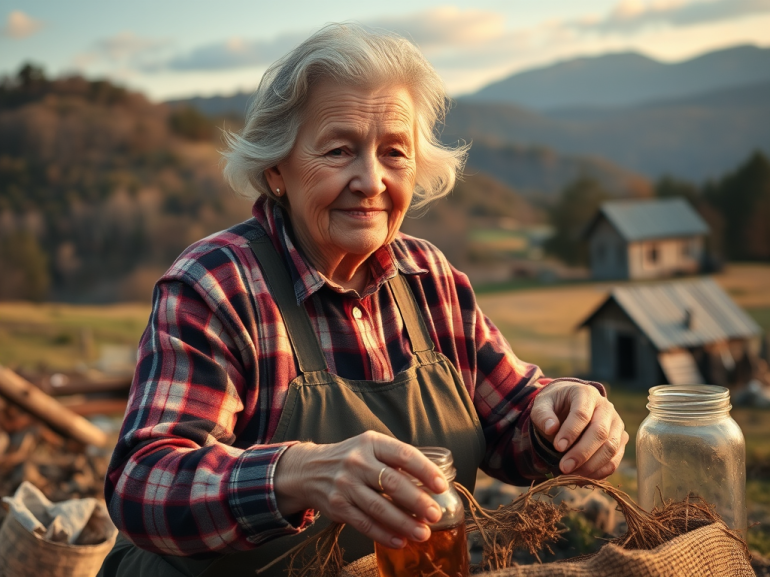
Surviving Hardship: Cousin Kat’s Life Lessons from Virginia

Cousin Kat was born the eldest of seven in 1916 in the mountains of Western, Virginia. Her father died of a cerebral aneurysm when she was only twelve. Her father and my grandmother were siblings. Sadly, Cousin Kat and her brother, only one year younger, had to leave school. They went to work immediately upon their father’s death. Neither of them ever got to live at home again after that. They took whatever jobs they could get. She did housework and canning. She helped with the sick or the elderly. She assisted with children and helped with gardening. She took on whatever tasks she could find. Her brother did whatever work he managed to find, usually on a farm.

Her widowed mother was left with five small children, the youngest on three. A kind-hearted neighbor allowed her and the children to harvest his bean field. Other neighbors helped harvest their fields, saving them from starvation. Another neighbor gave them a pig to fatten. These kindnesses saved them from starvation. Her father-in-law allowed them to move in a laborer’s house on his farm so they wouldn’t have to pay rent.

As the other children were old enough, they went to work for a dollar or two a week and their board, just as the older children had. Their happiest times were when they got to come home and be together on weekends.

Things got better for the family during Roosevelt’s New Deal. The oldest boy went into the CCC and was able to more money home. Kat got work with NYC and was able to get a earn some cash and get a little schooling. Eventually, there were benefits for women and orphans, easing the pressure. One after the other, the children joined the military or moved away to get better jobs. Cousin Kat married at eighteen. She and her husband moved to Maryland for five years to work and save every penny. They came back home and bought a small farm next to her mother. Her husband farmed and Kat took a job in a garment factory.

Cousin Kat was frugal her whole life, never spenting a penny she if she could avoid it, influenced by her hard early years.

Hard Time Marrying Part 15

!fireplace-3She had supper ready when Joe and the boy came in.  She’d laboriously managed to cook beans in a cast-iron pot hanging over the fire and baked cornbread and some sweet potatoes in the coals, pleasant work she was accustomed to.  Joe’s brows lifted when he saw supper and bowls and cups out on the table.  She crumbled cornbread in a cup and Joe poured buttermilk over it for the baby before lifting her to Anya’s lap.  They all fell to with an appetite. 

“My name is Anya, not Anna.  I’ll stay and earn my keep till I can manage, but I ain’t no whore.  Don’t come sniffing around me.  I don’t want to owe you nothing.  I’m gittin’ better so I can do for the baby and tend the house, but you need to keep the boy with you.”  She looked him fiercely in the eye.

Joe looked her and raised his voice.  “I’ll thank you to call me Joe.  Don’t you think I could’a already done hurt you if I’d wanted? I don’t want nothin’ more from you than you take care of yourself and the baby.”  He dropped his voice, speaking more to himself.  “I been getting along without a woman for a long time, but I ain’t fell so low I got to take up with a stringy, beat-up neck bone like you.”

Poor Joe was unaware her hearing had improved and was surprised to have a hot sweet potato hit him in the jaw.  “I’ll thank you to keep a civil tongue in your head,” she warned him through clinched jaws. 

“Yes, ma’am.”  He muttered.  “Beggin’ pardon, ma’am.  No call for me to be spiteful.  We are both in a pickle and battling ain’t gonna help.”

“You keep to your place and I’ll keep to mine till I can do better.”  The tension eased a bit now they understood each other.

They passed the evening watching the children at their play.  Joe had brought them a kitten from the barn.  The boy teased it with a bit of string, delighting the baby girl.  Joe and Anya caught themselves laughing at it a time or two.

“What’s the boy’s name?”  This was the first time it had occurred to her to ask.

“I don’t know.  I just been calling him boy.  His mama was sick when she got here and never told me nothing.  She died the next day.”  He stared into the fire.

“You mean these ain’t your young’uns?”  She was incredulous.

“No, I don’t know nuthin’ exceptin’ their mama up and died soon’s she got here.  I’d send ‘em back to her folk if I knew who they was.  She come with nuthin’ but my letter, a bundle of clothes, and these young’uns after I wrote off for a wife. I buried her out in the mesquite and tried to take the kids back to Talphus fer the town or the church to do for ‘em and them miserable bastards run me off like a scalded dog.  When I got back after doing chores that night, you was up in the house lookin’ at the baby.  I thought I’d done buried their mama alive.  It warn’t till just now the coyotes dug her body out of the grave till I knew you warn’t the woman I married.  Oh, Lordy.  I don’t know why I ain’t left well enough alone.”


Hard Time Marrying Part 2

“These young’uns is got scarlet fever. You ain’t leaving ‘em for this town to deal with. Jist take ‘em on back where you come from.”  The sheriff steadfastly refused responsibility for the children.

“But they ain’t mine.  I don’t even know their names.”

“Ya married their ma ago ain’t cha?  Then they’s yourn!  I hate it for ‘ya, but I ain’t gonna letcha leave ‘em here to sicken the whole town.  We’ll getcha some provisions to help out, but that’s it.  Ya got to git out’a town with them sick young’uns.  Pull this wagon out to that mesquite tree ‘n  I’ll git ‘cha some supplies.

Morosely, Joe waited on the edge of the sorry town as a wagon pulled up.  Shouting at him to stay back, a gimpy old geezer rolled off a barrel of flour, putting a burlap bag of beans beside it, and piling a few cans of milk, a bolt of material, and a few paper wrapped parcels on top of it.  He went on his way, leaving Joe to wrestle them into the wagon the best he could, stowing them so they wouldn’t crush the burning children.

Joe felt as low as he’d ever had, pulling up to his rough cabin. He knew nothing about children or the sick.   Maybe these poor wretches wouldn’t suffer too long.

Bumps in the Road

Though I most frequently talk about the amusing things our family experienced, of course there was another side.  Mother is a lovely lady, cheerful, fun-loving, and totally centered on her family, still at ninety-six.  She is and always was, scatterbrained, a trait she generously shared with her children.  It provided comic relief in otherwise hard times and sometimes precipitated hard times. I know now Daddy was bipolar, though he never went off the deep end.  As a young man, he was a binge drinker and gambler, though he gave it up to save his marriage.  Before setting out to establish a farm in his early forties he was always hunting or hanging with his cronies.  When I was a small child, Billy and I frequently got to tag along.  It was heaven! Upon his return from work we rushed joyously rushing to meet him shrieking, “Daddy’s home! Daddy’s home.” Then we’d likely be off for an adventure. Unfortunately, for his older two girls, Daddy made a point of  establishing an emotional and physical distance as we approached puberty.  He wanted no hint of inappropriate behavior in his family.  God only knows how he was influenced by his early life. 

About the time Daddy was nine, his sick father had moved into the home of his own mother. Suffering with a brain tumor, he lay abed for four years, unable to do anything for his poor family.  That grandma wanted nothing to do with her daughter-in-law and the starving children.  The fourth of seven, Daddy, along with his two older brother’s, took any work they could get, often for nothing more than the chance to put their feet under someone else’s table.  Daddy said one day he chopped bushes all day for a bag of meal. 

None of his father’s family wanted to be saddled with their ravenous appetites either.  They were all struggling. Daddy told of helping his uncle with the harvest one late fall day.  The three barefoot boys got there before daylight, hoping for breakfast.  Their shoeless condition was not slovenliness.  They’d have gladly worn shoes had they had them. Sadly, his aunt was plunging the breakfast dishes in hot water as they shuffled up to the back door.  She’d had no intention of feeding them, shooing them out to the field with Uncle Robert and their cousins. At noon, Annie Mae sent one of her girls to the field with a bag of biscuits slathered with cold gravy and a jug of water.  The biscuits were bland but filling, but the boys had been hoping for milk, and maybe a cookie or a pear

The weather turned about four that afternoon, a cold sleety rain.  The hungry boys followed their uncle to the house, looking forward to a hot supper and a cozy bed for the night.  Their mother wouldn’t be worried, knowing they were at Uncle Robert’s.  Surely, Uncle Robert would hitch up the wagon and bring them home in the morning.  They didn’t have shoes or coats!  In the days before their Daddy got sick, they’d often stayed at Uncle Robert’s with their cousins.

Again, the heartless Annie Mae met them at the door.  “You boys git on home before it gits any worse.  Your Mama’s gonna be worried about you.” Aunt Annie made it clear they and their appetites had no welcome at her table. Uncle Robert gave them each a quarter and a tow sack full of the corn they’d just helped harvest. He sadly watched his nephews head to their poor home, clearly having had his orders. The shoeless boys cried with misery as they gingerly stumbled the long three miles home on frozen feet.  Daddy vowed then never to turn a hungry visitor away.  He never did.  Mother was often angered when Daddy insisted she come up with a meal for drop-in company, even hours after mealtime.  It’s surprising how often Daddy’s offer was accepted, especially  by ne’er do wells. Meanwhile, Mother fumed at the stove. “Nobody with any raising would expect someone to drop in and be offered a meal!” Mother never had sandwich makings or quick food so a meal meant cooking.

On a further further note, the penurious Annie Mae made each of her own children raise heir own garden contributing to the family larder.  She benefitting further, selling off the excess.

Hard Time Marrying

omega


Their union had a bleak start. Shivering miserably on the depot platform in the freezing rain, the woman folded and refolded his tattered letter.  Angered, he thought of driving on when he saw her cradling a small child and holding the hand of a grimy toddler, a few tattered bundles at her feet. In her letter, she’d not mentioned the  little ones, though with all fairness, the marriage was only one of need on both parts. He hadn’t promised her anything either, so after hesitating, he was mollified by the thought that the little fellows served as proof she wasn’t barren.  Hurriedly, married minutes later at the preacher’s house, he apologized for the weather as they shivered the two hours home in his open wagon and was surprised to learn the woman didn’t speak or understand English.  Maybe that wasn’t so bad for a man accustomed to his own company.

Burning with fever by the time they got to his homestead, his unknown wife was dead by the next sundown, leaving him with  little ones he had no taste for. Barely reaching his knee, they toddled mutely in perpetual soggy diapers, uttering gibberish only they understood. As soon as he could, he buried his quilt-wrapped wife and headed back to dusty Talphus, Texas to rid himself of burden of her orphaned little ones. The church or the town would have to do for them. Loading them in a snug in a bed of hay, wrapped in a ragged quilt, hay heaped over them. he pitied and grieved for them on the long trip back to town, knowing the hard life they faced. Stopping several times to make sure they were warmly covered, he was relieved to find them pink and warm.

He hardened his heart against them, knowing only too well the life they faced. He’d never known family, just been passed from hand to hand.  He grieved knowing that was their lot, but deception had landed them with him and a lone-farmer could hardly be expected to shoulder the brats of a deadwoman he’d never even shared a bed with.

Aunt Ader’s Place Part 6

Mettie was abandoned by her mother, Cynthia, as an infant, leaving her with her own mother.  Though divorce was almost unheard of at that time, Cynthia was twice-divorced. Her father went on to remarry and took no responsibility for her.  He only visited her once, when she was the widowed mother of seven. Late one night, Mawmaw told this tale of her early years, the only time I ever heard this.

“I jist turned nine years old, ‘bout the age you are now. Me and Ma had picked some beans in the cool a’the mornin’ an’ I was a’helpin’ ‘er git ‘em ready fer canning. Ma set down in her rocker to rest jist a minute an’ I was a’playin’ with my kitten. I was glad she was a’sleepin’ a while since I didn’ want’a mess with them beans no how. After a spell, I saw Ma’s head was kinda hung to one side an’ spit was a’runnin’ out’a her mouth kinda foamy. She wouldn’ wake up. I got up to run over to git Miz Jone’s an’ seen there was a fire between our place an’ hearn. There warn’t nothin’ to do but run through it the best I could. Them flames was a’lickin’ at my feet an’ I was jist a’cryin’. I got Miz Jones, but it ain’t made no difference. When they got over to see ‘bout Ma, she was dead. They sent for Uncle Jeb to git’er buried.

I had to go to Uncle Jeb’s, then. He was awful good to me, but Aunt Lottie was jist hard down. She whooped on me ever chancet she got, an’ they was plenty. She made shore I ain’t done no sittin’ aroun’. I married soon’s I could, jist to git outta her way.

I never really had no home after Ma died.  I knowed Aunt Lottie didn’t want me around ‘lessen they was work to be done.  She’d put me out to help a woman that was having a baby, help with the canning, or help with the sick.  I never seen no pay, just worked for my keep.  Sometimes my mama would get settled and send for me, but I had to stay out of the way of her man,  so back I’d go to Uncle Jep and Aunt Lottie, till she could put me off on somebody else.  It was hard times for sure.

Five Photos, Five Stories Day One Hard Time Marrying

Man and kids (2)Thanks Author S B Mazing for challenging me to join her Five Photos, Five Stories.  This is just the type challenge I love.  It stimulates me to do what I want to do.  I will be writing a series based on vintage photos.  This will eventually become a book.  I have four others in front of it.  Who knows if it might push itself further up the line? I don’t know the story behind this photograph since it came from an estate sale.  I just love it.  It hangs in my writing room.  I know I am not telling the true story, but at least I am giving my friends a voice.  Now, the best part, I’d like to challenge Mom, at Maybe someone should write that down to join me.  I just love her stories and pictures!

Hard Time Marrying

Their union had a bleak start.  Meeting at the train in the freezing rain, she clutched his letter.  They married minutes later at the preacher’s house, barely speaking as they shivered the two hours home in his open wagon.  In her letter, she’d not mentioned the two little ones, though with all fairness, the marriage was only one of need on both parts. They were proof she could bear the children he hoped for.  Burning with fever by the time they got to his homestead; dead by the next sundown, she left him with two little ones he had no taste for.  Barely reaching his knee, they toddled mutely in perpetual ,soggy diapers dragging to their knees, uttering gibberish only they understood.  As soon as he could get her wrapped in a quilt, he buried this stranger wife and headed back to dusty Talphus, Texas with the sad burden of her orphaned little ones.  The church or the town would have to do for them.  Loading them in a snug in a bed of hay, wrapped in a ragged quilt, hay heaped over them.  he pitied and grieved for them on the long trip back to town, knowing the hard life they faced.  Stopping several times to make sure they were warmly covered, he was relieved to find them pink and warm.

He hardened his heart against them, knowing only too well the life they were facing.  He’d never known family, just been passed from hand to hand.

to be continued


Five Photos, Five Stories – Day Two: Snowcovered Gum Trees

Challenge from  Author S B Mazing
I am taking you up on this. Thanks.

authorsbmazing's avatarAuthor S B Mazing

FPFSChal5I took this picture when we first went skiing here in Australia. Up until today it amazes me when I see a gum trees in the snow. For me growing up in the Swiss Mountains The trees lose their leaves or then it is the trees with the needles. But skiing amongst snow covered gum trees was something special…

Skiing in Australia is pretty good, you know. Many Australians and non-Australians asked us how we can deal with the poor skiing down here, coming from Switzerland. And I usually tell them that it is not poor at all. The slopes are great and the way they look after them and groom them is outstanding. Cut yourself some slack, Aussies, your ski resorts are actually pretty good.

………………………………………..

A couple of days ago I received the following invitation:

Hi SB

I’m about to invite you to join in a challenge I…

View original post 173 more words