Angola: Fact and Fiction

Plentiful stories about the prison have cemented misunderstandings

Published: June 1, 2020
Last Updated: June 1, 2023 
Angola: Fact and Fiction
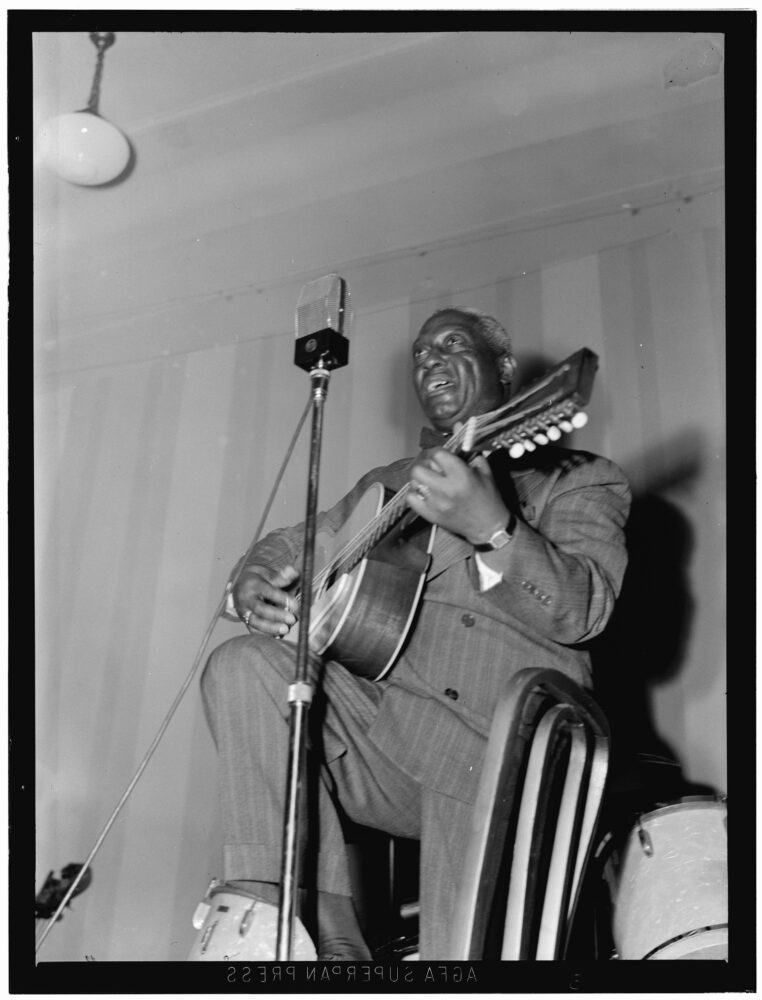
PHOTO BY WILLIAM P. GOTTLIEB, LIBRARY OF CONGRESSHuddie “Lead Belly” Ledbetter, pictured here performing at the National Press Club ca. 1938, didn’t need to sing his way out of prison—just to wait for time off for good behavior.

The Louisiana State Penitentiary is so infamous it doesn’t even need to use its real name: the prison is almost universally known as Angola, after one of the four plantations on which it was built. Over its century-plus of operation, Angola has come to occupy a complex place in the state’s history and culture, with myths and misunderstandings weaving themselves into the true stories of the prison’s history. Here, we present thumbnail clarifications of three of the most commonly repeated inaccuracies about Angola’s history. (The well-known, horrific stories of Willie Francis, who survived the electric chair only to be taken back and executed a few months later, and the prisoners who cut their own Achilles tendons in protest of conditions at the prison do not appear below, because these stories are true.)

The name Angola was given because of the origin country of many of the enslaved people who worked the original plantation.

This is inaccurate for a number of reasons. Angola, on Africa’s southern Atlantic coast, was a major source for slave traders, but as part of the Portuguese Empire, it tended to supply enslaved laborers to Brazil, also a Portuguese possession, with North American shipments restricted primarily to Charleston and Savannah in the years after the American Revolution. Even given the possible importation of enslaved Angolans to Louisiana though, the legal transatlantic slave trade was quashed in the early 1800s, with the US Congress legislating a total ban on international slave trading in 1808. Plantation owner Isaac Franklin did not purchase the properties later consolidated as “Angola” until the 1830s, by which point the American slave trade, in which Franklin made his initial fortune, was essentially all domestic. Franklin referred to one of his plantations as Angola, though Angora, an old rendering of Ankara in Turkey, also shows up in contemporary records; both names reflect a trend of naming plantations after faraway lands, real or imagined. (Franklin also owned Killarney, a neighboring property named for a town in Ireland, and Loango, a plantation presumably named for the major slave trading port located in what is now the Republic of Congo.) By 1880, surviving documentation all reflected the name “Angola” familiar today.

Lead Belly sang his way out of prison.

The story speaks to Louisiana’s conception of itself: whatever sins we may commit, our love of music unites us—and redeems us, to an extent. The legend goes that Huddie Ledbetter, universally known as Lead Belly, was incarcerated at Angola but sang so movingly to the governor, or sang in the governor’s presence, or wrote such a beautiful song, that O. K. Allen pardoned him. Repeated in contexts as august as Dr. John’s patter introducing the cover of Ledbetter’s “Goodnight Irene,” often cited as the song that melted the governor’s heart, this story is so widely believed that it’s the one thing people know who know nothing else about Lead Belly.

Alas, the truth is significantly less poetic: Ledbetter got time off for good behavior. Louisiana law provided for prisoners who had behaved in accordance with prison policies to be released early, with the important caveat that if they reoffended within the state, they would have to finish their commuted sentence for the first crime before beginning any sentence for the next. Ledbetter’s was one of six commutations signed on July 20, 1934, and one of 179 in the whole year, for crimes including murder, manslaughter, shooting at a dwelling, and carnal knowledge—such commutations were common enough to be essentially routine. Lead Belly’s music, cherished as it is, didn’t soften a governor—but it didn’t need to.

Outlaw and jailbreaker Charlie Frazier was welded into his cell.

Charlie Frazier was the most common of the various names under which one of the most prolific outlaws of Depression-era Louisiana was arrested—and the one associated with another Angola myth. Frazier, a stick-up artist in the Bonnie and Clyde vein, was a key figure in a 1933 jailbreak that shocked the Angola and Louisiana powers-that-were. This jailbreak did lead to the first cellblock being built at Angola, with the new Red Hat building (named for the red-painted straw hats worn by inmates) serving as a stricter adjunct to the barnlike dormitories that had housed all inmates before the escape. While Frazier was ultimately captured in Texas and slung into one of the new cells in 1936, it wasn’t welded shut for the simple reason that Frazier had to be taken to trial in St. Francisville for charges related to the deaths of Camp E Capt. John Singleton and foreman James W. Fletcher, Angola employees, and trusty guard Arnold Davis, all of whom were killed in the jailbreak. Newspaper reports and Frazier’s prison record reveals that he was almost immediately put back in the “red cap line,” at Camp E, from which he had escaped in 1933. Capt. C. C. Dixon, a long-time employee whose descendants also worked at the facility, was remembered as the only person Frazier would speak to after his rearrest; Dixon never corroborated the lurid but unlikely detail of the welded cell. For men used to the dormitories, the cells may have felt welded shut, but the jailers never literally threw away the key.

Marianne Fisher-Giorlando is a professor emerita at Grambling State University and the outside researcher for the Angolite, the inmate-edited and -published magazine of the Louisiana State Penitentiary. Chris Turner-Neal is the managing editor of 64 Parishes.

Consequences

A straightforward, impressive woman, Eva was a CPA working for a prestigious business firm in Washington DC. Her husband Charles was a CPA for the federal government. Together, they had built an enviable life including a beautiful home in the suburbs with five children. A nanny/housekeeper cared for their home and children.

Things went well for about fifteen years until an audit revealed that Eva had been doing a bit creative bookkeeping. When it all unraveled, Eva was given the choice of prosecution or repayment. As you would expect from someone who was embezzling, Eva and Charles had no cash reserves.

They sold their house. Charles borrowed from his retirement and both cashed in their whole life insurance. By hook or crook, Eva was able to repay what she’d stolen and avoid prison. Of course, she lost her CPA credentials. Charles’s job was unaffected.

They took the last of their meager funds and bought a tent which they pitched in a national park. Along with their children, they crowded into the tent with their business clothes. Eva got another job in business, though not as a CPA.

Every morning, the family dressed in the bath house at the park and headed off to work and school. The kids caught the bus at the park entrance. They lived this way for six months until they managed to save up for an apartment. They had to move their tent every two weeks to meet park requirements. The kids rather liked the perpetual camping though Eva and Charles were heartily glad to get a roof over their heads again.

Despite their setbacks, the couple managed to stay together till most of their children were grown, eventually divorcing for some other reason. When I knew Eva, she was in her sixties and my children’s summer caregiver. I was thoroughly surprised when she told me this story and often wondered how her story played out afterwards.

Your Money’s No Good Here!


It’s good to compare notes with your family.  My brother just told me my dad helped his brother-in-law counterfeit quarters back in the 1930s.  Daddy’s oldest sister, Aunt Jenny, married Uncle Chester, a bona fide reprobate, a rabble-rousing drunk who enlisted Daddy to help with his quarter counterfeiting business.  I don’t know if Daddy would have even qualified for reform school if he’d gotten caught, since he was just a hungry little kid trying to win a place at Aunt Jenny’s table for a few days. Mama and his younger sisters were about to starve since his own father was sick in bed at his mother’s house.  Grandma wanted nothing to do with her daughter-in-law and the grandkids, though she was willing to care for her son.  The boys were pretty much working for room and board anywhere they could.

At any rate, Uncle Chester made pretty good quarters, a time-consuming job requiring a steadier hand than his, since he was rarely sober.  According the Daddy, Uncle Chester made impressions of both side of quarters using Plaster of Paris casts lined with onion-skin paper.  The steady hands were needed to line the molds up and glue them together, leaving a tiny pour-hole at the top, where they could pour in Uncle Chester’s special melted alloy.  Once the ragged quarters set, a little artistry work was required to finish them off.  Voila!  Quarters!

Babbittquarter

Uncle Chester had no trouble passing his bogus quarters at the grocery store, the mercantile, and the hardware store. The problem came at the bar.  Though he was normally stingy and careful, one night he got a snootful and wanted to buy a round for everybody in the house.  Indiscreetly, he brought out a bag of quarters to pay his tab.  They didn’t ring true when he poured them on the counter.  The proprietor objected, Uncle Chester tore into him, and Uncle Chester ended up in Leavenworth.

That really wasn’t so bad.  His cell-mate taught him to make twenty-dollar bills.  Before long, Uncle Chester was out, but wasn’t able to pass his twenties because he couldn’t get the color just right.  After a number of frustrating attempts, he poured up some quarters and headed back to the bar.  When he poured his clinky quarters out on the bar, just as Uncle Chester anticipated, the bar-tender objected.  “Are you telling me my money’s no good?”  A fight and arrest ensued.  Uncle Chester went back to Leavenworth for a refresher, polished his craft, and never had any more counterfeiting troubles.

All’s well that ends well.

Miss Laura Mae’s House Part 10

vintage-mother-daughter-dresse-6196-7163-1435636454
One of my favorite eavesdropping episodes was about a friend of Miss Laura Mae’s whose husband was in prison and daughter in the orphanage.

“I got a letter from my friend Alice Marshall today. Her husband has been out of jail a long time now and her daughter Helen just had her fifth. Just look at this picture she sent me of Helen’s family. She is so proud.” she said, passing a picture to Mother.

I wanted to see that picture so badly I forgot I wasn’t supposed to be listening in. “Let me see! Let me see!” A daddy, a mother holding a baby, three little girls, and a small boy stood in front of a car. The woman and little girls had on matching dresses. The man and boy looked neat in dark pants and plaid shirts. “Their dresses are all alike! How did they get dresses alike?” I had to know.

“Helen can sew real good. She makes everything her and the girls wear. Ain’t that something?”

I had to agree. “Mother, can you make dresses alike for me and you and Phyllis?” It seemed like a small thing to me.

“I don’t know,” Mother said. “That would cost a lot of money. I don’t have patterns for matching dresses, and I sure don’t have that much material.”

“Please, Mother. Please……….” The whining did it.

“Stop that whining! Go play in the yard. You’re not supposed to be in here listening to grown people talking, anyway.”

I gave up and sat on the back step, feeling sorry for myself as Miss Laura Mae went on with her story. “I know Alice couldn’t see nothing but hard times when Martin got sent to prison. It was back in The Depression. He stole a hog ‘cause they was hungry an’ got five years in Angola. Alice moved back in with her mama in Baton Rouge, but it wasn’t long before her mama died leavin’ her nowhere to go. She got a job in a hotel restaurant washing dishes and got a meal with her shift. She rented a room in a boardin’ house, but didn’t make enough to feed Helen. She had to put the poor little thing in a church home. Poor child had to stay there four years. Alice went to see her ever’ Sunday, and kept tellin’ her they was all gonna be together agin. I didn’t see how they ever would, but Martin finally got out of jail. He was able to git a job at a sawmill and after a month or so, they got enough together to git a place an’ get Helen home. You never saw anybody so proud as Alice an’ Martin. I was real proud for ‘em. They had a couple of boys after than an’ done real good, but Alice always felt bad for puttin’ Helen in that home, but pore thing, she couldn’t even feed herself. Don’t you know Martin felt awful fer puttin’ ‘em both in that spot. He was a good man and never did git in no more trouble. I don’t believe he ever would’a stole that hog if he had’na been tryin’ to feed his family, anyhow. Them was some hard times, real hard times.”

https://atomic-temporary-73629786.wpcomstaging.com/2016/04/28/miss-laura-maes-house-part-11/
https://atomic-temporary-73629786.wpcomstaging.com/2016/04/28/update-to-miss-laura-maes-house-part-11/