Kathleen Carries On Part 1

surprise
Kathleen, Surprised

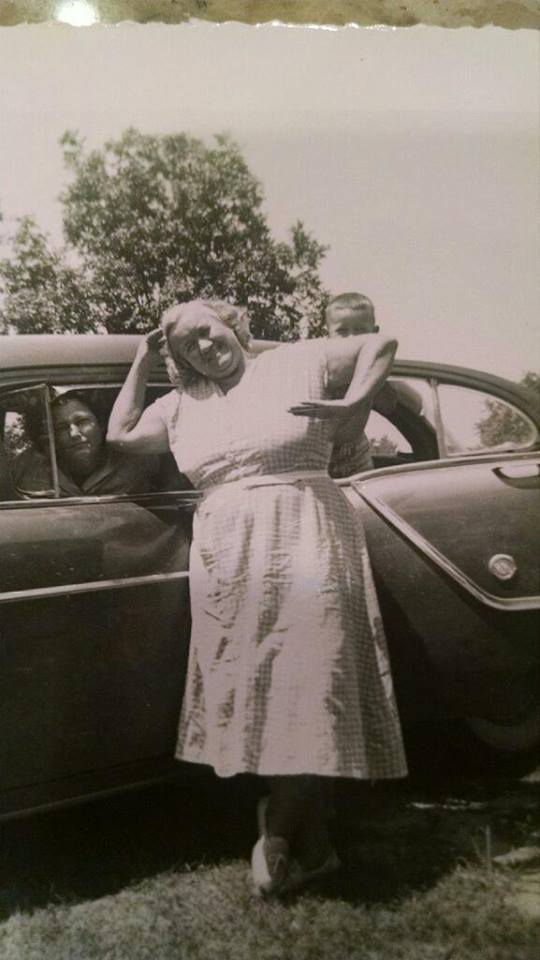
Mother is sensitive about her age and height, so I can’t mention the fact that she is past ninety-six and “not tall.” In fact, she got busted by the nurse at her last exam. “How tall are you?” asked the nurse.

Mother looked her in the eye and said, “5’2,” bold as brass.

The nurse stared her down. “Let’s measure you.” They came back in a minute and the nurse said. “I’ll give you 4’ 9 3/4 .”

1.  She asked a nice young police officer to “jack her off.” 

2. She once crashed a formal wedding in cut off blue jeans.

3. She was once locked in a museum garden and had to be rescued by the fire department.

4. She was locked in Windsor Castle. More on that later.

5. She rolled up a car window up on a camel’s lip.  These things happen.

6. She made change in the offering plate at church and came out twenty dollars ahead

7. She lost her bra at church one Sunday.  She never could explain that!

8. When two intruders broke in her house, she made one of them help her into her robe and refused to give them more than eleven dollars. Go figure.

9. She threatened a rapist.

10. She won’t say “Bull.”  That sounds crude.  She substitutes “male cow.” God knows she tried to raise me right!  

Carrying on #1:

Mother parked her car at the mall, got her sweater and purse and went in to shop and enjoy a leisurely lunch with friends. More than two hours later, she came out and discovered her car wouldn’t start. She’d left her lights on! She didn’t want to call her kids for help, so she flagged down a young police officer, planning to buffalo him with her sweet old grandmother act. “ Officer, my battery’s down. Can you please jack me off?” Luckily, she was neither arrested nor jacked off.

To be continued

Bumps in the Road Part 3

At one desperate point, while Eddie was about the slow business of dying at Grandma Swain’s, Mettie gratefully moved her family to her brother Albert’s recently acquired farm, miles and miles from town. Red dust fogged up with the rare passing conveyance. In foul weather, the red dirt road was impassable. There was no possibility of the kids attending school since the nearest bus stop was ten miles away where the dirt road joined a hard surface road. School attendance was not mandatory at this time.

Mettie’s focus was on survival. Fortunately, in addition to the farmhouse he and his wife moved into, a battered, unpainted house was available for the poor band. Had Mettie not been in such need, he would have used it as a barn  Again, it was free. They could get milk and butter from Albert’s cows if Mettie helped with the milking. Albert’s wife, Mary, kindly passed along a hen with twelve chicks and young rooster. They could eat from Mary’s garden if she and the girls helped with gardening and canning. Of course they would! They settled in the hovel where wind sailed through the rickety walls and rain poured through the leaky roof. The uncles put the boys to cutting  and splitting wood for shingles, then set them to roofing.  A toilet leaned crazily out back, but the deep well provided cool,clean water.  Of course the rural farm had no utilities, no matter, since Mettie hadn’t funds to pay. Her brothers, Willie and Albert, did what they could to help, from plowing her garden, providing her a pig to fatten and slaughter in the fall. Willie traded a fine sow with a litter of pigs and gifted her bony milk cow.  Fortunately, when the old cow freshened, it was a heifer, ensuring Mettie would have a young cow to replace the old one at her inevitable  This was a Godsend.  A family without a milk cow was in trouble.

When Eddie eventually died in 1937, the four younger children qualified for seventy-four dollars a month Aid to Dependant Children. Mettie was able to move to a better house near town so the little girls could go to school. Mettie had a penchant for moving till the day she died. Daddy said she’d start crying and nothing would satisfy her till she got to move. No doubt, she had mood issues.

The same year the family got on “relief,” her eldest son joined Civilian Conservation Corp for which he was provided clothes, wages, food, and lodging for working on government conservation projects.  He was paid the princely sum of thirty dollars a month, twenty-five of which went directly to his mother.  Three years later, the second son joined.  The boys had never lived dressed or lived so well.  At thirteen, Daddy was six feet tall.  He was able to pass for fifteen, snagging a job on an nearby oil rig as a night watchman. He slipped home most nights to eat  a late supper.  All three boys had given up school long ago to look for work.  At any rate, Daddy said they couldn’t face the taunting of hateful kids over their bedraggled clothes.

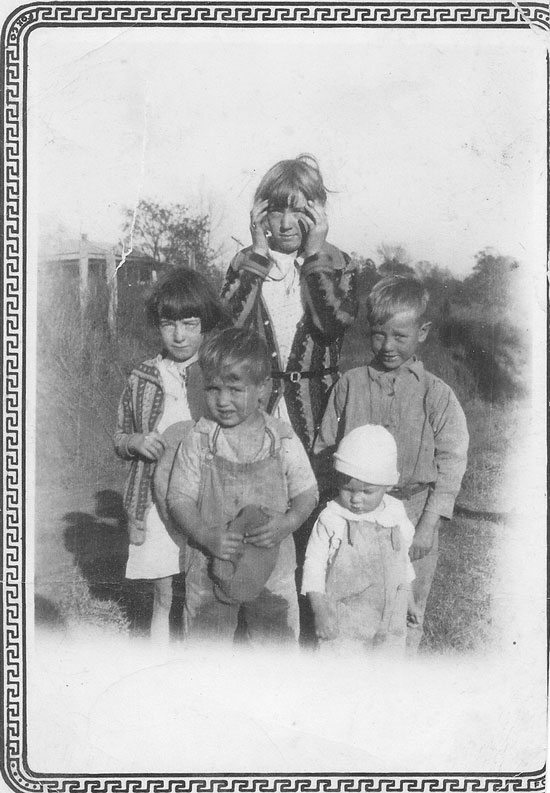
My father is boy in front row holding hat
Eddie Swain

Bumps in the Road

Though I most frequently talk about the amusing things our family experienced, of course there was another side.  Mother is a lovely lady, cheerful, fun-loving, and totally centered on her family, still at ninety-six.  She is and always was, scatterbrained, a trait she generously shared with her children.  It provided comic relief in otherwise hard times and sometimes precipitated hard times. I know now Daddy was bipolar, though he never went off the deep end.  As a young man, he was a binge drinker and gambler, though he gave it up to save his marriage.  Before setting out to establish a farm in his early forties he was always hunting or hanging with his cronies.  When I was a small child, Billy and I frequently got to tag along.  It was heaven! Upon his return from work we rushed joyously rushing to meet him shrieking, “Daddy’s home! Daddy’s home.” Then we’d likely be off for an adventure. Unfortunately, for his older two girls, Daddy made a point of  establishing an emotional and physical distance as we approached puberty.  He wanted no hint of inappropriate behavior in his family.  God only knows how he was influenced by his early life. 

About the time Daddy was nine, his sick father had moved into the home of his own mother. Suffering with a brain tumor, he lay abed for four years, unable to do anything for his poor family.  That grandma wanted nothing to do with her daughter-in-law and the starving children.  The fourth of seven, Daddy, along with his two older brother’s, took any work they could get, often for nothing more than the chance to put their feet under someone else’s table.  Daddy said one day he chopped bushes all day for a bag of meal. 

None of his father’s family wanted to be saddled with their ravenous appetites either.  They were all struggling. Daddy told of helping his uncle with the harvest one late fall day.  The three barefoot boys got there before daylight, hoping for breakfast.  Their shoeless condition was not slovenliness.  They’d have gladly worn shoes had they had them. Sadly, his aunt was plunging the breakfast dishes in hot water as they shuffled up to the back door.  She’d had no intention of feeding them, shooing them out to the field with Uncle Robert and their cousins. At noon, Annie Mae sent one of her girls to the field with a bag of biscuits slathered with cold gravy and a jug of water.  The biscuits were bland but filling, but the boys had been hoping for milk, and maybe a cookie or a pear

The weather turned about four that afternoon, a cold sleety rain.  The hungry boys followed their uncle to the house, looking forward to a hot supper and a cozy bed for the night.  Their mother wouldn’t be worried, knowing they were at Uncle Robert’s.  Surely, Uncle Robert would hitch up the wagon and bring them home in the morning.  They didn’t have shoes or coats!  In the days before their Daddy got sick, they’d often stayed at Uncle Robert’s with their cousins.

Again, the heartless Annie Mae met them at the door.  “You boys git on home before it gits any worse.  Your Mama’s gonna be worried about you.” Aunt Annie made it clear they and their appetites had no welcome at her table. Uncle Robert gave them each a quarter and a tow sack full of the corn they’d just helped harvest. He sadly watched his nephews head to their poor home, clearly having had his orders. The shoeless boys cried with misery as they gingerly stumbled the long three miles home on frozen feet.  Daddy vowed then never to turn a hungry visitor away.  He never did.  Mother was often angered when Daddy insisted she come up with a meal for drop-in company, even hours after mealtime.  It’s surprising how often Daddy’s offer was accepted, especially  by ne’er do wells. Meanwhile, Mother fumed at the stove. “Nobody with any raising would expect someone to drop in and be offered a meal!” Mother never had sandwich makings or quick food so a meal meant cooking.

On a further further note, the penurious Annie Mae made each of her own children raise heir own garden contributing to the family larder.  She benefitting further, selling off the excess.

Just Folks Getting By Part 5

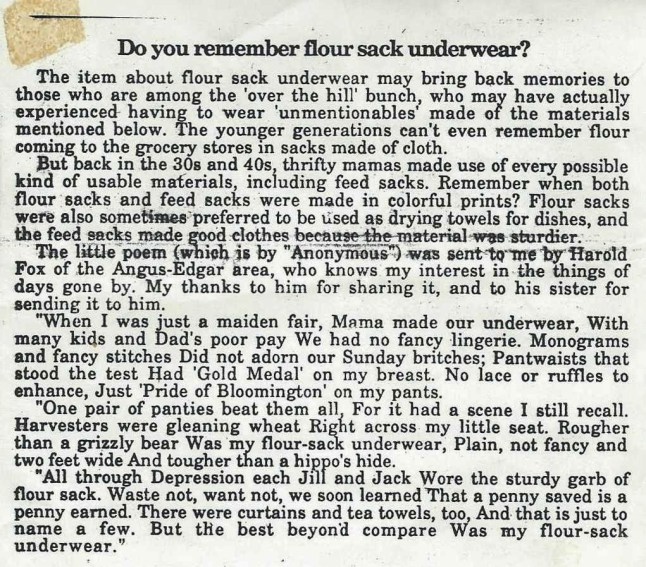
flour-sack-underwear-poemhttp://suttonhistoricalsociety.blogspot.com/2014/07/the-flour-sack-underwear-poem.html#links

“I was never so proud of anything as that bus ticket.  I wrote back that afternoon I’d be on the four o’clock bus the next day.  I rushed around and got our clothes washed and ironed.  It didn’t take long to pack your four little dresses, nightgown, flour sack panties, slips and socks in a cardboard box tied up with string.  By that time I was down to two dresses, a slip, and three pair of flour sack panties.  I made room for Mama’s Bible recording our marriage, you two kids’ birthdate and Jimmy’s death. I’d got so skinny, I didn’t get another brassiere when mine wore out.  Aunt Lucy wasn’t able to go to the bus station.  She was down in her back.  I cried when I kissed her, not knowin’ if I’d ever see her again.  We set out walkin’ three miles to the bus station before it was good light, wearing cotton dresses and our only sweaters.  You was draggin’ a little rag doll Aunt Lucy had made you out of a flour sack and a wore-out apron.  Nobody wasted nothin’, then.  Our little bit of stuff got mighty heavy before we made it half a mile down that dusty road.  I had to stop and let you sit on the box and rest a time or two.  I couldn’t carry you, the box, and the sack lunch Aunt Lucy had packed. Lucky for us, Amos Jones came by in his old pick up and gave us ride.  He stopped off at the café and we had coffee, since we’d got there early.  He bought you a glass of milk and gave you the fried egg sandwich he’d brung for his lunch.  I sure was proud.  You’d been too sleepy to eat good when we left Aunt Lucy’s and I wanted to make our lunch last.  When he left, he made me take a dollar.  He growed up with your daddy and wanted to do something for his old friend.  I figured it was his last dollar.  It was for sure my only dollar and I was proud to git it.  I sure hope it didn’t hurt him too bad to give it, but he wouldn’t let me refuse.  It’s funny how folks with the least to give is the most likely to help. 

Amos and his wife had four kids.  Aunt Lucy wrote me ‘bout a year later his wife died in childbirth leavin’ him with all the kids and a sick baby.  About two months later he married a widow-woman who had a baby ‘bout the same age.  A tractor had rolled over on her husband just before her baby was born.  She married him moved right in to take care of his kids and nurse the baby.  She knew folks would talk bad about them marryin’ so soon, but they both had to have some help.  I sure wouldn’t have thought bad about them.  They was just doin’ what they had to to take care of their young’uns.”

Jenny didn’t know anything about that kind of desperation.  “Didn’t she have any family or friends she could have stayed with till she could have gotten a job?  I can’t imagine marrying that quick if something happened to Ben.  You’d need some time to mourn.  They couldn’t have loved each other.”

“Honey, I’m glad you don’t remember nothin’ about a life that hard.  If that woman had folks, they might’a been starvin’ too.  Most men didn’t have jobs, ‘cept farmin’.  A woman had to be powerful lucky to come up with a job.  If a feller had a job to give, it went to a man with a family.  Until your Uncle Marsh found me that dishwashin’ job where he worked, I did any work I could git.  I sat with the sick, nursed new mama’s, helped with crops and canning.  I almost never got a nickel.  I was workin’ for food and a place for me and you to sleep, and lots of time, havin’ to dodge the menfolks.  If I went to milk, I took you with me so you got some milk right off. If I worked in the kitchen, I tried to slip you a little somethin’.  I never threw a biscuit out, even if it was left on somebody’s plate.  That might be all the supper you was gittin’.   I was always scared you was gonna starve.  They was whole families walkin’ down the road with nothin’ but the clothes on their backs.  I was always skeert that was gonna be you and me.  Lots of folks starved.  It was rough!  To this day, I won’t leave a penny laying in the road.  That could end up the last penny I’d git.”

Jenny hugged her little one.  “It must have been awful worryin’ about your baby being hungry.  I’d move heaven and earth to take care of Lucy.  I worry if I don’t eat right so she can get plenty.  I know if something happened to me, Ben would do the best he could, but he’d have to learn everything.  If something ever happened to me, would you come take care of Lucy?”

“Why sure I would, honey, but don’t borrow trouble.  You’ll spoil your milk.  Let’s talk about something happy.  I never saw anybody so proud as you after your daddy got home and Shirley was born.  You thought you was her mama.  One morning she squalled out while I was at the clothesline.   Before I could git in there, you’d got up in the crib with her and took your dress off.  You had her cuddled up to your little flat chest tryin’ to nurse her.  She couldn’t find nothin’ and she was mad as hops.  You was such a little mama.”

“Ooh, don’t tell Ben that one.  He’d carry me high.  I’d never hear the last of it.  How is Shirley?  Have you heard from her since you got here?”

“No, she’s got her hands full with them three little ones, an’ Martin workin’ nights, trying to sleep days.  I never could’a kept y’all quiet.  That’s why I started keepin’ ‘em at my place instead of goin’ over there when she’s teachin’.  Joey starts school next fall, though, so that’ll just leave Betsy and Marty with me durin’ the day.  Them two is a handful.  She’s kind a’talkin’ ‘bout havin’ another one, but I hope she’ll take a little time with it, till them girls is a little bigger. I’m glad you had this one in May so I can stay the whole summer with you.  What are you gonna do when you go back to work?  I wish I lived close enough so I could keep her.”

“Well, I haven’t told Ben, but I’m thinking about staying home with her.  As long as it took her to come along, I don’t know if I’ll be able to have another one. He’s doing really well down at the hardware store. By the time I got somebody in to keep her, I wouldn’t come out much ahead workin’.  You know how that is, don’t you.”  She reached over and squeezed her mother’s wrinkled hand.

https://nutsrok.wordpress.com/2017/02/12/just-folks-getting-by-part-1/

https://nutsrok.wordpress.com/2017/02/13/just-folks-getting-by-part-2/

https://nutsrok.wordpress.com/2017/02/14/just-folks-getting-by-part-3/

https://nutsrok.wordpress.com/2017/02/15/just-folks-getting-by-part-4/

https://atomic-temporary-73629786.wpcomstaging.com/2017/02/16/just-folks-getting-by-part-5/

Just Folks Getting By Part 1

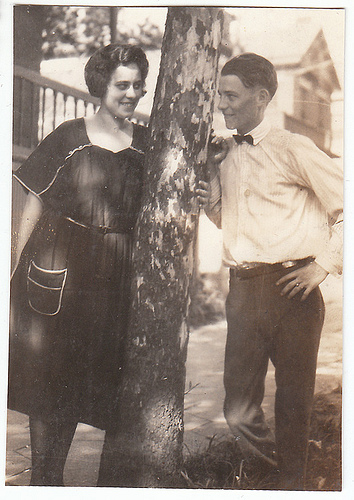
This story is not about my family, but from a time and place when my grandparents struggled to raise their family.  This is a picture of my grandparents Roscoe Gordon Holdaway and Mary Elizabeth Perkins Holdaway when they first married.  Mary Elizabeth Perkins and Roscoe Gordon Holdaway Wedding Pictu“Mama, how come I had to live in that orphanage for a while when I was little?  If you ever told me, I don’t remember.” Jenny sat in a porch rocker nursing her new baby.  Her mother Lucille sat across from her in another, crocheting a blanket for Little Lucy.
Oh, Jenny, I been wondering when you was gonna ask about that.  That like to broke my heart.  I don’t want you to think bad of your daddy.  He was a real good man, but got caught up in some trouble when you was just a baby.  We was a’farming the Henderson Place up in the Panhandle where The Dustbowl was the worst and he got caught moonshining.  You have to understand, back in The Great Depression, things was different.  They’d been a long drought an’ he hadn’t made a good crop in years.  Dust just kept a blowin’ ever’thing away.  It was just awful seein’ them dust clouds roll in, knowin’ we was gonna be a’smotherin’ and lose our crops..  That dust would git down in your lungs and turned to mud.   That’s what happened to your brother Jimmy when you was just a baby.  He died of the dust pneumonia.  Anyway, that’s what got your daddy moonshining.  We was a’starvin’ and then Jimmy got bad sick.  It was real flat out there and he put a still in the storm cellar.  The sheriff seen the smoke and come and broke it up and hauled him off to jail.  I didn’t know what I was gonna do.  Since I’m a’gonna be here a few days, it’d be a good time to tell you.  Now, you got a baby of your own, you ought’a be able to know what a hard thing it is to leave a young’un.  I always worried you’d hold it against me, but if I hadn’t a’put you in that orphanage, you’d a’died like Jimmy.  You almost did anyway.”  Lucille had difficulty speaking through her tears.

“Oh Mama.  I never held anything against you.” Jenny interjected.  “I remember you coming to get me on your days off.  I went there when I was so little, I didn’t know any other life.  I couldn’t wait to see you when Mama Margie and Mama Bertha told me you were coming.  Not many kids ever had anybody to come see them.  I thought I was real lucky, especially when you’d take me out on my birthday and Christmas every year.  Those were really special times.  Most kids never went out except when we all went.  I remember getting to sleep over with you a few times.  Those were the best times, snuggled close to you in your bed in your cute little-bitty room in that kitchen.”

“I’m glad you remember it that way, but that wasn’t a ‘cute little-bitty room.’  It was a cot in the pantry, but it’s a mercy that’s what you thought.  Mr. Jones let me clear out a space big enough for a cot.  Do you remember I had all them canned goods stowed up under the bed?  Till Mr. Jones let me git a cat, I had to set mousetraps all around and they’d be a’snappin’ all night.  I shore was proud of Ol’ Smoky.  She wouldn’t let a mouse stay on the place.  I sure slept a lot better after she come.  She was a good old cat.”  They both got a good chuckle out of that.

Two Roads Part 5

img_1668

Image pulled from internet

Though Neeley’s marriage to Eddie did not start with love, they were good people who needed each other.  Both considered themselves damaged goods.  Neeley got a home and a father for her child, Eddie, a wife and mother for his young daughter.  They both had healthy appetites for life and love which made for a solid marriage.  Neeley loved little Clara Bea from the start, knowing how abandonment felt.  Both got a better deal than they expected.  During those days, divorce was almost unheard of.  Eddie had despaired of finding a decent woman to marry after his wife abandoned him.  He’d never even thought of approaching a young woman since she’d left.  It was remarkable that Neeley was the child of a divorcee who married a divorced man at a time when most people had never even met a divorced person, much less have a close link to two.

Since there was no whisper of Neeley’s liason with Joey, it was assumed Neeley was a foolish young girl who’d fallen for an older fellow.  Though it made for interesting gossip, it was not a real scandal since he’d made an honest woman of her.  Then, as so often through life, society felt the woman fell short, not the man.

In the Deep South of that time, a great majority of people still made their living as farmers.  Large landowners with sharecroppers or tenants were on the top of the heap. Small farm owners came next. About the least a man could support his family on was forty acres.  He had to have a mule and equipment. The rental farm included a house.  He most likely had to borrow money for planting and had debt at the grocery store most of the time and just scraped by.  Should they fall on hard times and not be able to maintain their credit, their only option might be to become a sharecropper.  Sharecroppers were set up by landowners and split the crop with owner.  It was often unfair and kept farmers in debt.  Many had to sneak off in the night when debt got too high.  Sharecropping kept farmers bound to place.

Eddie owned a small farm and had very little money long before The Great Depression.  They raised most of what they needed.  Along with their garden, they had a cow, hogs, and a flock of chickens and cultivated a few acres of cotton for cash.  The occasional sale of a hog and Neeley’s butter and egg money helped out.  All they really had to buy was coal oil for their lamps, coffee, sugar, flour, baking soda, a few clothes for Eddie, and shoes.  Women’s and girl’s clothes came from feed sacks.  Flour sacks were reincarnated as underwear.  Their’s was a subsistence life, not by choice.  It was the life Neeley was raised to expect.


Something for Nothing!!!!

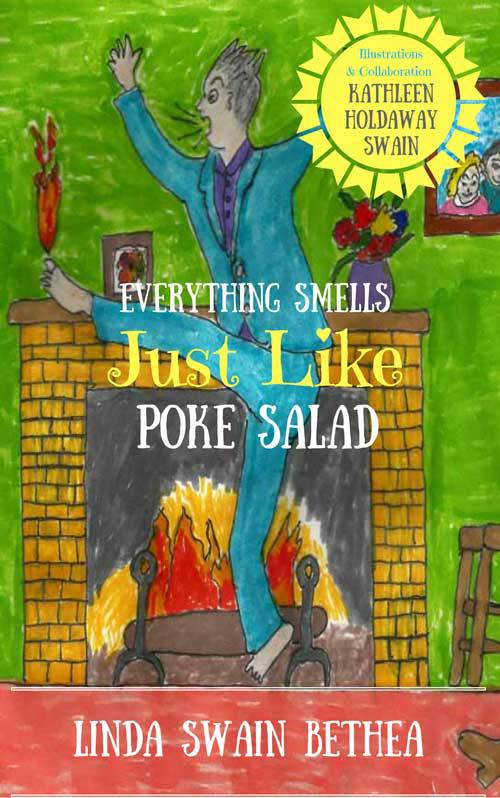
Click on this image on the right for a link to get this ebook free from Kindle Saturday or Sunday only.  Please share!Book for orderI grew up in a family of competitive storytellers.  A little thing like a stubbed toe gets us started.  “Do you remember the time Grandpa cut his ingrown toenails out then fooled around and set his toe on fire?”  That is not a hypothetical example.  It’s beloved and oft-repeated tale. 
At family dinners, wild tales start as soon as we’ve said Grace and the food is being passed around.  “Remember that fifty-two pound turkey Daddy brought home to fatten for Thanksgiving on year!”

Someone else breaks in, “That old turkey was the meanest thing that ever walked!  We couldn’t even walk out in the yard without him flying over the fence and flogging us.  Mother was looking forward to him teaching those terrible Downs kids a lesson the next time they came out trying to tear the place up!”

The story is snatched away, “Yeah, and then………….”

It goes on and on.  I’ve always looked forward to getting these stories down before they were lost, and after I retired, I got serious about it, knowing there was a possibility I might not live forever.  Mother is hale and hearty far into her eighties, so with her help, I got down to business.  The icing on the cake is that Mother illustrated the stories.  Everything Smells Just Like Poke Salad is the result of our collaboration.  It is available as an ebook on Kindle, in a full-color illustrated edition for family and friends and in a black and white print edition on Amazon.  For the next five days, as a special promotion, it is available free on Kindle.  Please take a look at it.


Your Money’s No Good Here!


It’s good to compare notes with your family.  My brother just told me my dad helped his brother-in-law counterfeit quarters back in the 1930s.  Daddy’s oldest sister, Aunt Jenny, married Uncle Chester, a bona fide reprobate, a rabble-rousing drunk who enlisted Daddy to help with his quarter counterfeiting business.  I don’t know if Daddy would have even qualified for reform school if he’d gotten caught, since he was just a hungry little kid trying to win a place at Aunt Jenny’s table for a few days. Mama and his younger sisters were about to starve since his own father was sick in bed at his mother’s house.  Grandma wanted nothing to do with her daughter-in-law and the grandkids, though she was willing to care for her son.  The boys were pretty much working for room and board anywhere they could.

At any rate, Uncle Chester made pretty good quarters, a time-consuming job requiring a steadier hand than his, since he was rarely sober.  According the Daddy, Uncle Chester made impressions of both side of quarters using Plaster of Paris casts lined with onion-skin paper.  The steady hands were needed to line the molds up and glue them together, leaving a tiny pour-hole at the top, where they could pour in Uncle Chester’s special melted alloy.  Once the ragged quarters set, a little artistry work was required to finish them off.  Voila!  Quarters!

Babbittquarter

Uncle Chester had no trouble passing his bogus quarters at the grocery store, the mercantile, and the hardware store. The problem came at the bar.  Though he was normally stingy and careful, one night he got a snootful and wanted to buy a round for everybody in the house.  Indiscreetly, he brought out a bag of quarters to pay his tab.  They didn’t ring true when he poured them on the counter.  The proprietor objected, Uncle Chester tore into him, and Uncle Chester ended up in Leavenworth.

That really wasn’t so bad.  His cell-mate taught him to make twenty-dollar bills.  Before long, Uncle Chester was out, but wasn’t able to pass his twenties because he couldn’t get the color just right.  After a number of frustrating attempts, he poured up some quarters and headed back to the bar.  When he poured his clinky quarters out on the bar, just as Uncle Chester anticipated, the bar-tender objected.  “Are you telling me my money’s no good?”  A fight and arrest ensued.  Uncle Chester went back to Leavenworth for a refresher, polished his craft, and never had any more counterfeiting troubles.

All’s well that ends well.

Lessons of a Hard Life

Daddy was a pragmatist with a dim view of positive reinforcement. Throughout his life, he’d seen many of acquaintances make the expedient rather than the better choice. I don’t know whether he considered his choice of associates might have an effect on their decision-making but he did need a fix of low company from time to time, probably feeling they held a lofty view of him. He held himself apart from drinking and trashy behavior, but did appreciate hearing just enough to reinforce his self-view, also providing an opportunity for edification should these “friends in low places” need his help and guidance. They enjoyed his generosity far more than his immediate family. Taking care of one’s family is a thankless task, whereas news of “bread cast upon the waters” may be touted far and wide. Though not a minister, he frequently preached that a person trying to lift himself out of a “life of sin” is to be praised far above those never wallowed. I am sure, this was personal, since he took every opportunity to use his own early behavior and redemption as an example of all he’d overcome. For some reason, he never encouraged us to sample the delights of sin so we could ascend to sainthood as he had, just made sure we never enjoyed the opportunity to mess up.
It was heart-warming to hear of the improved behavior of Josey Johnson, who only two weeks earlier had abandoned a loving husband or wife and little children for the company of a hard-drinking friend. If Daddy could corner Josey and get in a little preaching and Josey came home, Daddy was ecstatic. Josey could count on all kinds of favors, till he or she took off again. Daddy wasn’t bad about letting us know when Josey backslid, but hastened to update us if Josie returned home for some rest and rehabilitation. It didn’t matter that Josey might have been kicked out of a den of iniquity and was roosting at home till something better came along.
Unfortunately, Daddy never understood that not all people seek the low life. Life is full of people who do the right thing, just because it is right. I still wish he’d learned that not everyone falls, given the opportunity. I know his difficult background shaped his attitude.

family3

This photo pictures my father and several of his siblings. He is the boy in the middle holding the cap. I feel sure my grandmother seized the opportunity to have their pictures made by someone who happened by with a camera. They were sharecroppers. It is unlikely she was able to make any preparations for this photo. Times got even harder for the family when her husband died at forty-two, leaving her with five children between three and eighteen. The eldest had already married and left home. The oldest boy, at eighteen was working at whatever he could find. The fifteen-year-old boy went into the Civilian Conservation Corps as soon as he could. My father was thirteen and did farm work and odd jobs to help out till he got on as a night watchman at an oil rig at fifteen. The rig wasn’t too far from the house so he often slipped home to get something to eat and warm up, since he was too poorly clothed to keep warm.