

I’ve had milkweed for years but never been fortunate enough to attract a monarch butterfly. The only thing monarchs can eat is milkweed, Many times, I’ve made the rounds of garden centers hoping to find a plant laden with a caterpillar. Last week, I finally snagged two plants with the coveted caterpillars. As soon as I got them home, I tucked the plants with my little friends in the protective net enclosure I had tucked back for a lucky day.

I was so happy to have them safely home I went back a couple of times to check that they were still munching along.
Yesterday morning I found they had pupated and were attached to their little house. They should morph into butterflies in about fourteen days.
For more information check out the link and article below:
http://www.monarchs-and-milkweed.com/_themes/blue-red-purple-blank/blrule.gif
Article from Fish and Wildlife Services
Side Menu: Main Navigation

Our beloved butterfly
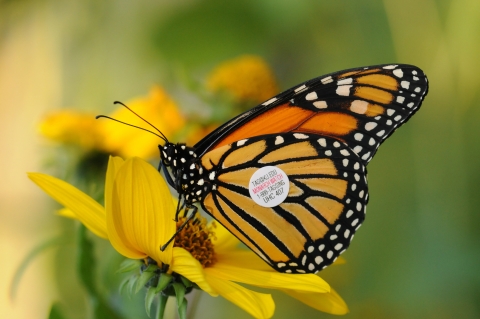
With its iconic orange and black markings, the monarch butterfly is one of the most recognizable species in North America. Monarchs are particularly remarkable because they migrate each year, flying from as far as Canada and across the United States to congregate at a few forested overwintering sites in the mountains of central Mexico and coastal California. These sites are an amazing phenomenon: thousands of monarchs cluster in the trees in California, and millions of monarchs drape large swathes of forest in Mexico.
But over the past two decades, monarch numbers in North America have declined, prompting the U.S. Fish and Wildlife Service to join Tribes, state agencies, other federal agencies and non-government groups to identify threats to the monarch and take steps to conserve monarchs throughout their range.
Working together to save the monarch
As the premiere conservation agency in the United States, the U.S. Fish and Wildlife Service has the responsibility to ensure that the monarch migration phenomenon continues. It’s going to take everyone – from government agencies to individuals to ensure a future filled with monarchs. You can do your part for monarchs in your backyard, in your back forty and along every back road.
We’re “all in” on monarch conservation. And we can’t do it alone. We’re focused on increasing monarch habitat on the lands we manage and engaging with all partners on monarch conservation, including Tribes, state and federal agencies and conservation groups.
Monarch butterflies are known for their impressive long-distance migration and large clusters they form while overwintering in Mexico and coastal California. Once abundant, monarch butterfly populations have been steadily declining since the mid-1990s due to several threats. Here, you can find information about how you can help monarchs, contribute to their habitat and find resources and assistance to help guide your actions.
Learn more about the monarch species.
You can help save the monarch
Everyone can play a role in monarch conservation.
Learn more about ways you can get involved:
- Federal, tribal, state & local governments
- Agriculture and ranching
- Rights-of-way
- Home gardeners
- Education & science
- International collaboration
Status under the Endangered Species Act
Is the monarch federally protected now?
No. We have proposed to list the monarch butterfly as threatened under the Endangered Species Act. Protections would not apply until the effective date of a final rule. Learn more about the process to list a species as threatened or endangered.
Proposal to list as threatened
We’re seeking public comment on a proposed rule to list the monarch butterfly as a threatened species (4.1MB PDF) under the Endangered Species Act. The listing proposal is accompanied by a proposed critical habitat designation for the species at its overwintering grounds in coastal California and a proposed 4(d) rule that offers species-specific protections and flexibilities to encourage conservation.
According to the most recent monarch Species Status Assessment, by 2080 the probability of extinction for eastern monarchs ranges from 56 to 74% and the probability of extinction for western monarchs is greater than 95%. Threats to the species include the loss and degradation of breeding, migratory and overwintering habitat, exposure to insecticides and the effects of climate change .
Press release: Monarch butterfly warrants Endangered Species Act protections
 Nutsrok

Fantastic!!
LikeLike
Ooh, don’t let any soybean farmers see that milkweed!… 😱
LikeLike
It it bad for soybeans?
LikeLiked by 1 person
The only thing they hate worse is sunflowers.
LikeLike